Magicicada periodical cicadas are categorized into broods (see brood chart). Each brood has a unique 17 or 13-year interval of time where cicadas hatch, burrow into soil, tunnel underground feeding off roots for 99% of their life, emerge as nymphs, molt, fly, gather, scream, and reproduce.
Brood II has been emerging every 17 years possibly for millennia. The last times it emerged was in 2013, 1996, 1979, 1962… minus 17 years … back as far as we know. The next time Brood II cicadas will emerge is in 2030.
Sometimes broods “straggle” though. A number of Magicicada will emerge four years earlier than expected, deviating and potentially breaking away from the rest of the brood. In theory, if stragglers are abundant enough, they can form what is called a “shadow brood”, as long as their offspring survive and perpetually reproduce. A shadow brood of Brood II, based on 4-year stragglers, would become Brood XV(15), and would emerge in 2026. There’s more information about stragglers and “spurious broods” on the UCONN Cicada site.
This year, 2026, while we’re looking for 4-year Brood II stragglers we will also look for evidence of an established Brood XV. There are credible reports by cicada researchers Chris Simon and Elias Bonaros that Brood XV may exist in New Jersey in Union County, specifically Fanwood, NJ. Conceivably, an instance of Brood XV could form anywhere Brood II exists — if you’re in Brood II territory, expect the unexpected.
We will definitely be looking for Brood XV this spring.
So, how can we tell that there is a legitimate Brood XV in place rather than ordinary Brood II stragglers? The key will be the abundance of cicadas. A Brood XV population should resemble a typical on-schedule Brood II population: hundreds to thousands of shed skins (exuvia), hundreds to thousands of adults, chorusing and not just individuals singing alone, noticeable mating and egg laying; a Brood XV should last 2-4 weeks. Ordinary Brood II stragglers should arrive in far fewer numbers: dozens per acre not thousands, individual songs but no choruses, little to no mating or egg laying; birds should pick off most of the stragglers so they will not last long. While it is possible to have a pure straggling event that seems full brood emergence event (see Princeton in 2017 for Brood X stragglers), most of the time you’ll find one or two adults per suburban yard.
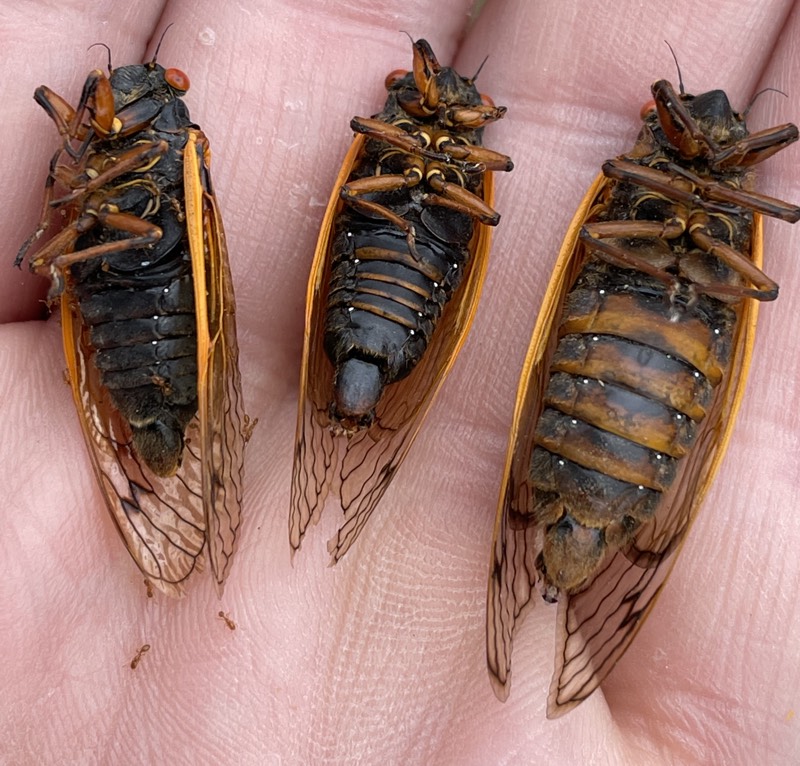
Our NJ town (30 miles west of Manhattan) is covered in Magicicadas. Can they be straggers when the entire town is covered in them? Here are some photos I took today:Photo Album
Comment by Charlene — May 22, 2009 [AT] 6:49 pm
Charlene, yes, they’re stragglers even though there are so many. They’re stragglers by virtue of the fact that they’re arriving 4 years early.
Comment by Dan — May 22, 2009 [AT] 7:02 pm
Thanks to Charlene’s post I went to Fanwood. found 7 tenerals and captured one nymph which will eclose here in the comfort of my home. Heard some light M. septendecim choruses. did not see any M. cassini or M. septendecula. Some trees where covered with at least 100 exuvia. Some had none. The question is have we seen the maximum yet or is it just starting? Please keep an eye out for further emergence sites here in the North East.
Comment by Elias — May 25, 2009 [AT] 1:10 pm
Update on my mini colony that is being kept alive in a Butterfly pavilion. One young male started to sing today. The amplitude is very low. Also a female in the cage responded with wing flick signalling. Brought home 8 from New jersey, 6 still alive. Today is Day #4. Next couple of days may need to look in Staten island or back to Fanwood. Anyone have any other reports? I know the weather is terrible. We need some sunshine!!
Comment by Elias — May 28, 2009 [AT] 8:17 pm
Notes:
It is theorized that all broods are shadow broods of another brood. Brood II <-- Brood VI <-- Brood X <-- Brood XIV. When Magicicada straggle in enormous numbers they can form new broods offset by 4 or 1 years, which is why we have 13-year broods (mostly in the warmer south) and 17-year broods (mostly in the colder, glacier-prone north) with the difference being 4 years. Read: K S Williams, C Simon. 1995. The Ecology, Behavior, and Evolution of Periodical Cicadas. Annual Review Entomology. 40:269-295. https://doi.org/10.1146/annurev.en.40.010195.001413
Broods are named and numbered using Roman Numerals. C.L. Marlatt devised this naming convention. The letter I = 1, II = 2, III = 3, IV = 4, V = 5, VI = 6, VII = 7, VIII = 8, IX = 9, X = 10, XIII = 13, XIV = 14, XIX = 19, XXII = 22, XXIII = 23. 17-year broods are named I-XVII (1-17) and 13-year broods are named XVIII-XXX (18-30), though many do not exist.
17-year broods, twelve exist (I, II, III, IV, V, VI, VII, VIII, IX, X, XIII, XIV), one is extinct (XI) and four missing broods (XII, XV, XVI, XVII) either never existed or went extinct before recorded history.
Of the thirteen possible 13-year broods, three exist (XIX, XXII, XXIII), one is extinct (XXI) and nine either never existed or went extinct (XVIII, XX, XXIV, XXV, XXVI, XXVII, XXVIII, XXIX, XXX)
Only a pair of 13-year and 17-year broods can emerge in the same year. XIII and XIX co-emerged in 2024.Two or more 17-year broods cannot emerge in the same year. Two or more 13-year broods cannot emerge in the same year.
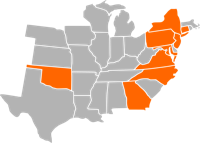
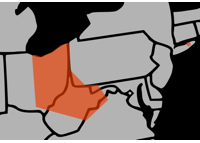
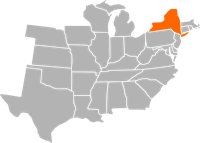
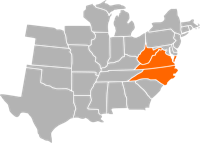
Brood II, a brood of Magicicada found in Connecticut, Georgia, Maryland, North Carolina, New Jersey, New York, Oklahoma, Pennsylvania and Virginia, is set to emerge in the year 2030, but some Brood II stragglers will emerge in 2026.
GET READY! If you had an abundance of cicadas back in 2013, you are likely to find a handful in your yard in 2026.
What is a straggler? A straggler is a periodical cicada that emerges later or earlier than expected. Magicicada often emerge 4 years earlier than expected. You can also call them “precursors” when they emerge earlier.
When to look for stragglers?
Stragglers will emerge in the spring sometime between late April and May.
Their emergence will be triggered by the warming of the soil where they live. When the soil gets to be approximately 64°F eight inches deep, they will emerge. Air temperatures in the 70s and 80s warm the soil. Warm rain helps as well. Read more about that.
Tip: We usually don’t see them emerge until the trees have leaves and purple iris bloom.
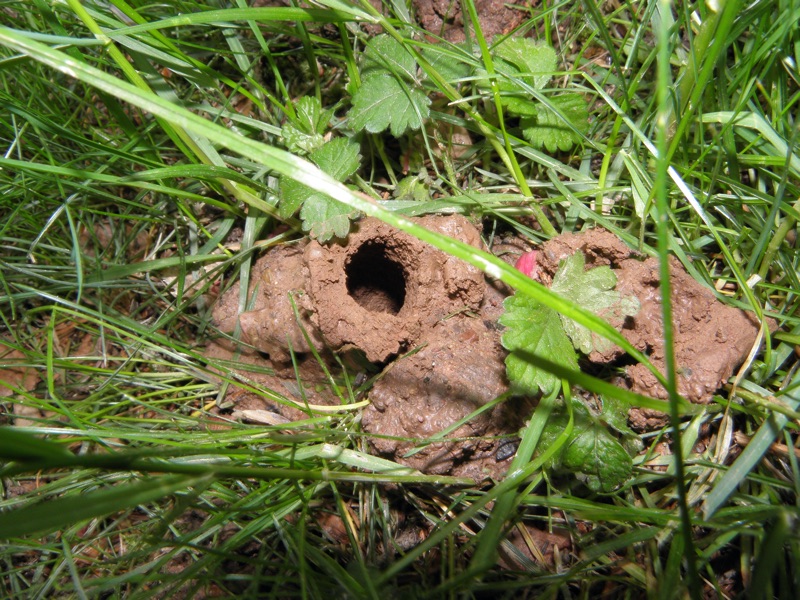
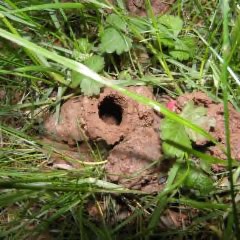
You can also look for cicada chimneys or tunneling cicadas under logs, slates or rocks in April and early May. Look, observe, but do not disturb them.
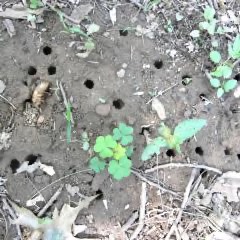
A cicada chimney is an elevated exit cicadas build above their tunnels:
There might be a “shadow brood”, Brood XV, around the Fanwood, NJ area. This would be a brood established from Brood II stragglers, with a large enough of a population to breed and sustain a new brood offset 4 years from Brood II. We will see.
New York (NY)
Cornwall-On Hudson, NY
Fishkill, NY
Germantown, NY
Red Hook, NY
Rhinebeck, NY
Staten Island, NY
Stony Point, NY
North Carolina (NC)
Madison, NC
Yadkin County, NC
Oklahoma (OK)
Oklahoma City, OK
Virginia (VA)
Brentsville, VA
Calvert County, VA
Charlottesville, VA
Doylesville, VA
Fredricksburg, VA
Front Royal, VA
Glen Allen, VA
Kinderhook, VA
Lake Ridge, VA
Louisa County, VA
Manassas Battlefield Park, VA
Martinsville, VA
North Garden, VA
Rhoadesville, VA
Springfield, VA
Stafford County, VA
Stanardsville, VA
Woodbridge, VA
What do they look like?
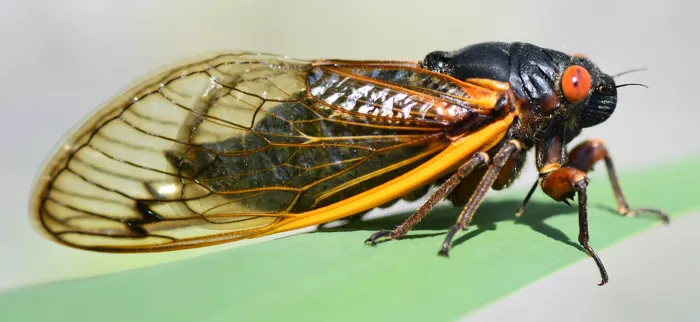
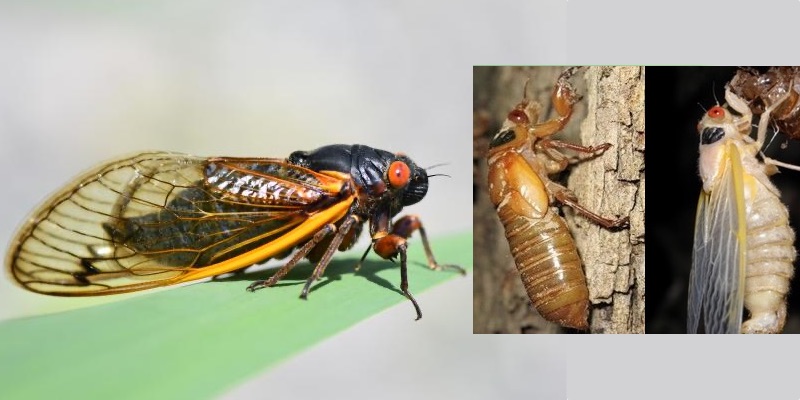
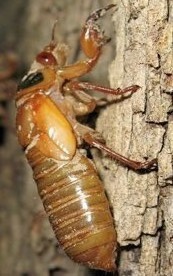
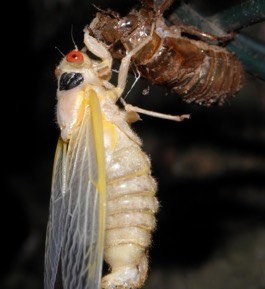
They look like this once they’ve molted:
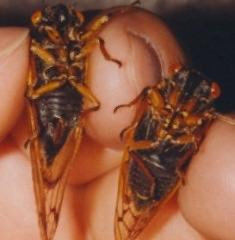
Red eyes (typically), black bodies, orange-black legs and orange-yellow wings.
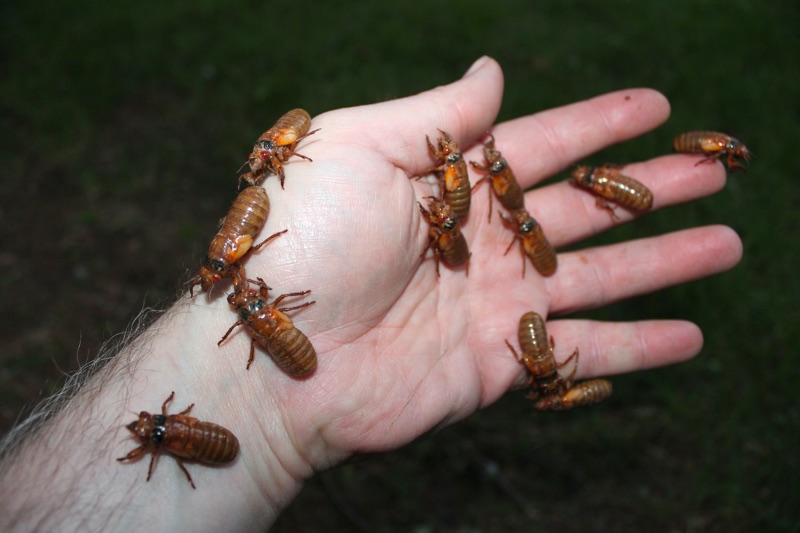
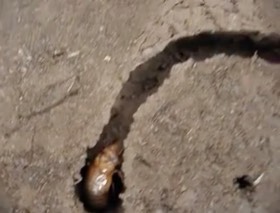
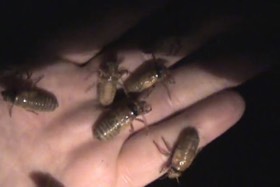
Nymphs that have recently emerged from the ground:
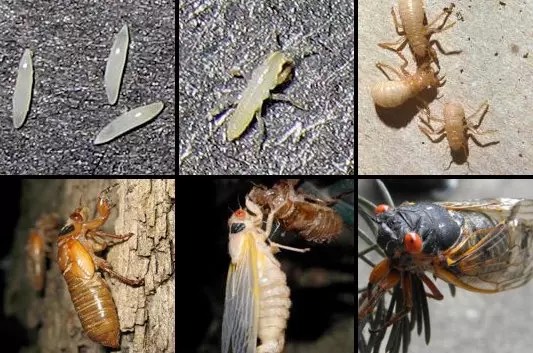
This is each major stage in their life cycle:
Top, Left to Right: cicada egg, freshly hatched nymph, second and third instar nymphs. Bottom, Left to Right: fourth instar nymph, teneral adult, adult. (Photos by Roy Troutman and Elias Bonaros).
Magicicada periodical cicadas often emerge earlier or later than expected. This phenomenon is called straggling, and the individual cicadas that emerged earlier or later are called stragglers. Magicicada are presumed to straggle for a number of reasons including subterranean overcrowding and the effects of urban heat islands on subterranean environments (a recent phenomenon). Evolutionarily speaking, it is a mechanism that allows them to break away from their original brood and form a new one. Right now on the homepage of the UCONN Cicada site they have a good story about how Brood XIV connects to Brood X, which connects to VI, which connects to II.
Stragglers, in the past, were observed and documented (MORRIS,J. G. 1870. Seventeen-year locust two years too late. Amer. Ent., 2: 304.) but it is much easier to do so today thanks to apps like iNaturalist, Cicada Safari, and mobile phones and social media in general.
So, where are we observing stragglers in 2025?
Down in the Baton Rouge area of Louisiana, Brood XXII is emerging 2 years early (iNaturalist Map). Brood XXII typically has a 13-year lifecycle.
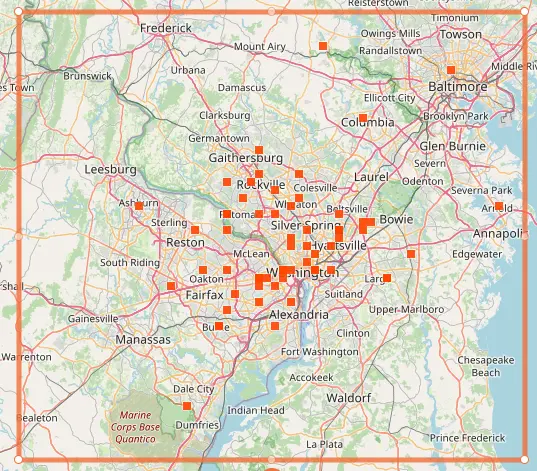
There are many Brood X stragglers emerging in the Washington D.C. area (iNaturalist Map).
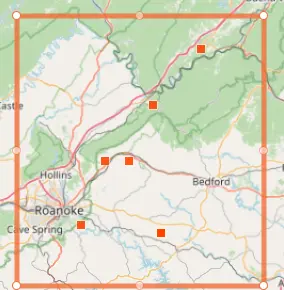
Brood I stragglers are appearing in the Roanoke, Virginia area emerging four years early. (iNaturalist map).
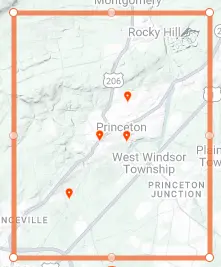
There are a handful of Brood X stragglers in the Princeton, NJ area. (iNaturalist Map).
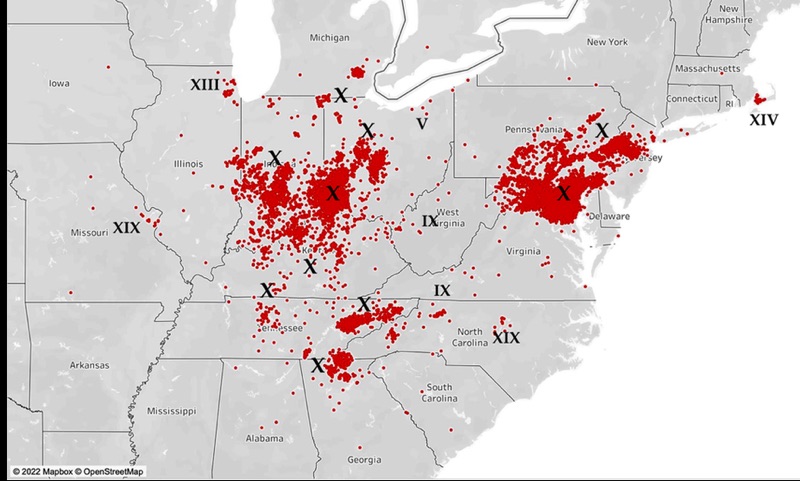
And here’s a map that plots all the Broods, courtesy of Cicadas @ UCONN:
Two notes:
1) The general public does not like the term stragglers when applied to cicadas that emerge early, because straggling generally means to be late, not early. Marlatt referred to them as precursors (Marlatt, 1989). You can use that term if you like.
2) People called cicadas locusts in the recent past. Scientifically speaking and in modern times, a locust is a grasshopper. Cicadas and grasshoppers are very different insects, but they can emerge in large numbers and do some damage to plants (cicadas cause flagging on trees, while locusts eat everything), hence the confusion.
One phenomenal behavior of Magicicada periodical cicadas is they “straggle”, meaning they emerge earlier or later than the year they are expected. Typically they emerge 1 or 4 years before they’re supposed to emerge.
Brood XXIII is expected to emerge in four years in 2028, but enough are emerging in 2024 for cicada researchers like Chris Simon to take notice! She let us know about the stragglers on May 8th.
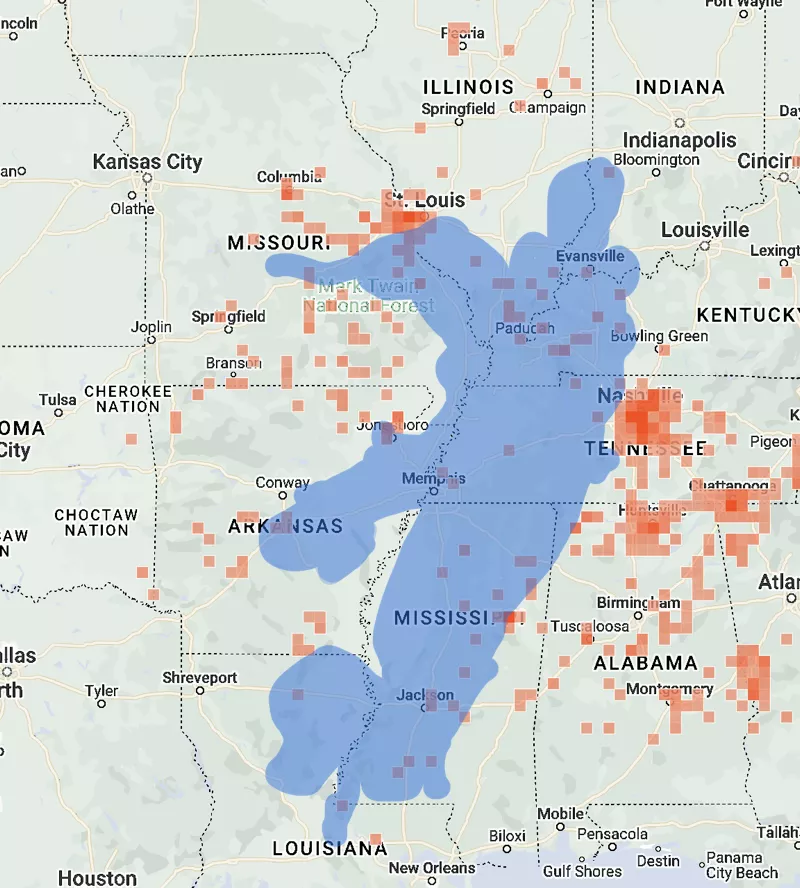
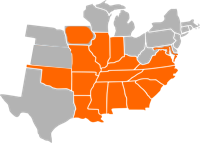
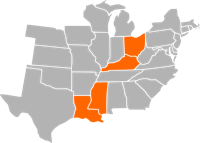
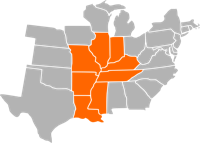
Brood XXIII is found in Arkansas, Illinois, Indiana, Kentucky, Louisiana, Mississippi, and Tennessee. This is not a perfect map (it overlaps with Brood XIX), but XXIII cicadas will show up in that area.
Arkansas: Bayou Deview Wildlife Management Area, Poinsett County, Devalls Bluff, Harrisburg, Holland Bottoms, Jacksonville, Jonesboro, Knox Co., Lake Hogue, Lake Poinsett State Park, Little Rock, and Wynne.
Illinois: Anna, Carbondale, Carterville, Chester, Clinton Lake, Marissa and Robinson.
Indiana: Harmonie State Park, Hymera, Leanne, Richland, Sullivan And Posey Counties.
Kentucky: Benton, Calvert City, Gilbertsville, Henry County, Murray, and Paducah.
Louisiana: Bastrop, Choudrant, Grayson and West Monroe.
Mississippi: Alva, Arlington, Booneville, Brandon, Clinton, Corinth, Desoto County, Florence, French Camp, Hernando, Holcomb, Houlka, Jackson, New Albany, Oxford, Potts Camp, Silver Creek, Tishomingo, and Water Valley.
Tennessee: Atoka, Benton, Cordova, Henry County, Huntingdon, Jackson, Lavinia, Leach, Lexington, McNeary County, Memphis, Paris, Savannah, and Speedwell.
Here’s a blue overlay of there Brood XXIII emerges from the UCONN map on the iNaturalist data (as of May 5th):
Surrounding the blue area on the west and east is Brood XIX and north will be Brood XIII.
Mary Rotter Fullerton found, or rather heard and recorded, a Brood XIII Magicicada cassini straggler on October 2nd, 2023, in Park Ridge, Illinois! This cicada emerged 7 months early!
Listen to the edited file (volume increased, background noise removed):
There are squirrel sounds in the mix as well.
Mary says:
Very cool, I have never heard one in fall. It was in a 50-year old maple tree that hosted many stragglers (early Brood XIII?) this past spring of 2023. Park Ridge, IL.
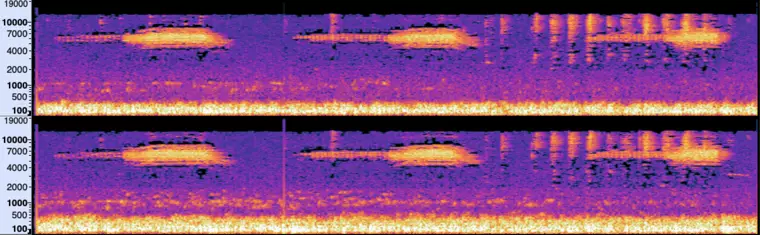
Spectrogram:
David Marshall of InsectSingers.com confirmed that this is indeed a Magicicada cassini.
David says:
Yes to me that’s unquestionably a set of cassini calls. There are some literature records of autumn Magicicada, sometimes with speculation that it’s related to sudden late-season warmups.
Be on the lookout in 2022 (or any year)! Any place you see a red dot is a possibility. Even central Massachusettes (former home of Brood XI) and Ontario — maybe so.
Straggler-related facts:
What is a Magicicada:
A Magicicada is a genus of cicada that lives in the United States that typically emerges in 17 or 13-year cycles depending on the species.
They look like this:
What is a Brood:
A Brood is a numbered group of Magicicada cicadas that emerge in a specific series of years.
Example: Brood X (X is the Roman numeral for 10) emerges every 17 years, i.e. 2021, 2038, 2055, etc.
What is a Straggler:
A Straggler is a Magicicada that emerges earlier or later than anticipated.
Example: If a Brood XIX (13-year, next due in 2024) cicada emerges in 2022, we can say it is a straggler that emerged 2 years early.
Stragglers that emerge earlier than expected have also been called “precursors” (Marlatt 1898). I also call them “pioneers”.
Aside from Brood X, what else is happening in terms of Periodical cicadas?
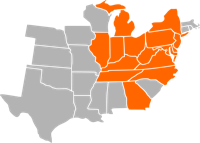
Expect some early-emerging cicadas from Brood XIV, showing up 4 years early. Brood XIV exists in Georgia, Kentucky, Indiana, Massachusettes, Maryland, North Carolina, New Jersey, New York, Ohio, Pennsylvania, Tennessee, Virginia, West Virginia.
There might be some 1-year stragglers form Brood IX. Brood IX is in North Carolina, Virginia and West Virginia.
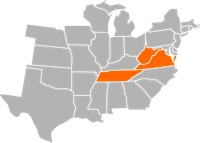
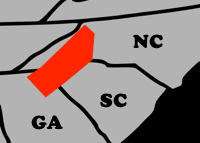
There might be some 4-year stragglers from Brood VI. Brood VI is found in Georgia, North Carolina, South Carolina, and Oklaholma. And Ohio?Brood VI is a weird one.
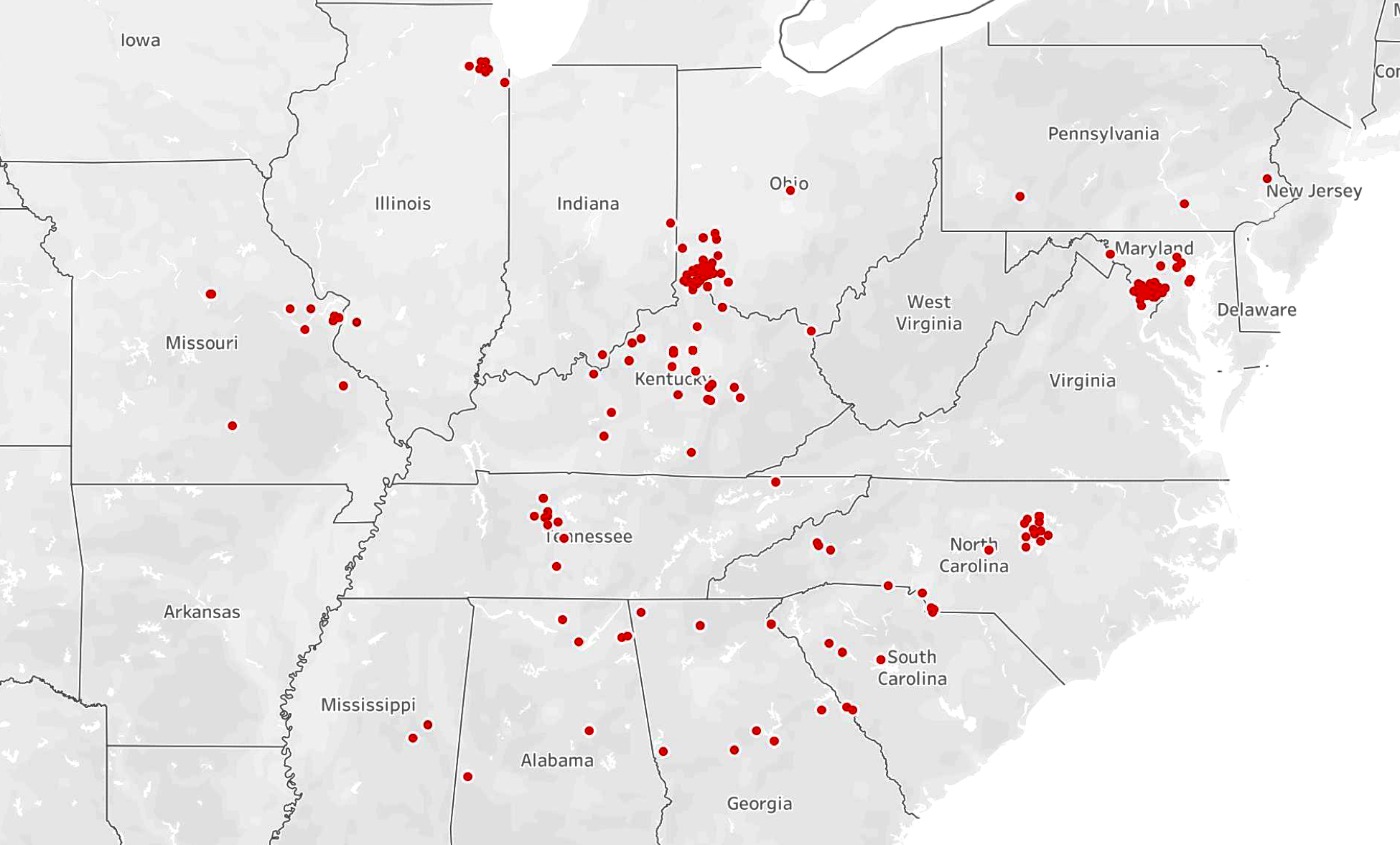
Many periodical cicadas emerged four years early in the Chicago area in 2020. These cicadas belong to the Brood XIII (13) which is set to emerge in 2024, and last emerged in 2007. Periodical cicadas often emerge in years proceeding or following the year their brood is expected to emerge. This phenomenon is called straggling. Most of the time these “stragglers” emerge in small numbers and are quickly eaten by predators, and do not go on to sing, chorus (synchronized singing for the purpose of attracting females), mate, and lay eggs. Sometimes they emerge in numbers large enough to survive, chorus, and reproduce — this seems to have happened in the Chicago area in 2020. It is thought this is how new broods formed over the millennia — cicadas emerge 4 or 1 year early in significant numbers and form a new brood. When enough stragglers emerge to successfully reproduce it is called an acceleration.
So, is a new brood forming around Chicago? Is this due to climate change or localized “heat islands”? Will the progeny of these stragglers emerge in 13, 17 or 21 years? Lots of questions — but we’ll need to wait quite some time to answer them.
There is a precedence for Brood XIII cicadas straggling in the Chicago area:
In 1969 massive numbers of periodical cicadas emerged in the Chicago suburbs 1 (Williams, K.S. & Simon, C. 1995).
In 1986, another 4-year acceleration was observed in the Chicago area by Monte Lloyd 1.
In 2003, many people left observations on our forums. Observations were made in Glenview, Flossmoor, Riverside, Downers Grove, Homewood, Westmont, Oak Park, and Hinsdale. Here are some examples:
Magicicada emerging this evening
Date: Wednesday, Jun/4/2003
As I went for a walk this evening I noticed quite a few periodic cicadas emerging in the grass, crawling on the sidewalks and on the trunks of trees. This is not our year for the 17-year brood. We should not have them until 2007. Has anyone else in the Chicago area seen these cicadas? — Sue, Flossmoor, IL
Cicada singing
Date: Monday, Jun/9/2003
I heard the cicadas singing for the first time this morning after my walk. Now that I have my doors open I can hear them on and off. — Sue, Flossmoor, IL
In 2020 many people left comments on the Brood XIII page, emailed us (thanks Neil) and left sightings via the Cicada Safari app.
The next periodical cicada emergence is Brood XXII (22) in 2027. Some periodical cicada stragglers are expected to emerge from Brood II (2) in 2026.
Magicicada Brood Chart
The Brood Chart features the names of the broods (Roman numerals), emergence years, cycle-length, straggler-years, species and states where they may emerge.
Emergences: 2031, 2014, 1997, 1980, 1963.
Cycle: 17-Year.
Stragglers: 2027 (-4), 2030 (-1)
Species: M. septendecim, M. cassini, M. septendecula.
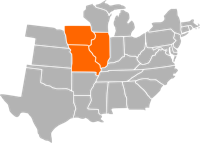
States: IA, IL, MO
Emergences: 2036, 2019, 2002, 1985, 1968.
Cycle: 17-Year.
Stragglers: 2032(-4), 2035(-1)
Species: M. septendecim, M. cassini, M. septendecula.
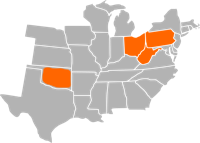
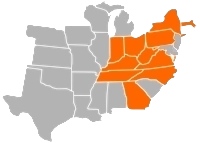
States: OH, PA, WV and OK
Emergences: 2038, 2021, 2004, 1987, 1970.
Cycle: 17-Year.
Stragglers: 2034(-4), 2037(-1)
Species: M. septendecim, M. cassini, M. septendecula.
States: DE, GA, IL, IN, KY, MD, MI, NC, NJ, NY, OH, PA, TN, VA, WV, DC
Emergences: 2041, 2024, 2007, 1990, 1973.
Cycle: 17-Year.
Stragglers: 2037(-4)
Species: M. septendecim, M. cassini, M. septendecula.
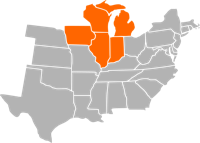
States: IA, IL, IN, MI, WI
Emergences: 2028, 2015, 2002, 1989, 1976.
Cycle: 13-Year.
Stragglers: 2027(-1), 2032(+4)
Species: M. tredecim, M. neotredecim, M. tredecassini, M. tredecula.
States: AR, IL, IN, KY, LA, MO, MS, TN
Here is a map of all Broods from the Cicadas @ UCONN site. Zoom in and click the pins to see which Brood it represents. (May not work on older devices.)
What specific day will they emerge?
Generally speaking, these cicadas will begin to emerge when the soil 8″ beneath the ground reaches 64 degrees Fahrenheit (Heath, 1968). A nice, warm rain will often trigger an emergence. They can emerge anytime from early April to early June. It all depends on the weather.
What should you look for before they emerge?
Chimneys / Turrets
Look for cicada chimneys a.k.a. turrets. These are structures cicadas build out of the soil, positioned above the hole where they will emerge.
Holes
Look for holes in the diameter of an adult’s finger near the root system of a tree. These are sure signs that cicadas will emerge in the area.
Cicadas Under Stones & Slates
You might discover some cicada nymphs while turning over stones or when performing landscaping chores.
This is a recently emerged nymph crawling up a tree. Note that its eyes are red.
Once cicadas nymphs have emerged from the ground, they will try to find a tree (or similar vertical surface), and then begin the process of shedding their old nymph skins (ecdysis), expanding their wings, and changing to their adult coloring. Watch this amazing transformation.
How to tell the difference between the seven Magicicada species:
Left to right: Magicicada cassini, Magicicada septendecula, Magicicada septendecim:
The first way is based on the Brood. Take a look at the Brood chart above, and see which species appear with the Brood.
There are 3 basic types of Magicicada: “‘Decims”, “‘Cassini” and “‘Deculas”.
Magicicada neotredecim Marshall and Cooley 2000. 13-year life cycle. Broods: XIX, XXIII.
Magicicada tredecim (Walsh and Riley, 1868). 13-year life cycle. Brood: XIX, XXII, XXIII.
Their songs are very similar, however, when M. neotredecim & M. tredecim emerge in the same location, M. neotredecim’s song takes a higher pitch. Sounds like “Pharaoh, Pharaoh!”.
Visual Appearance:
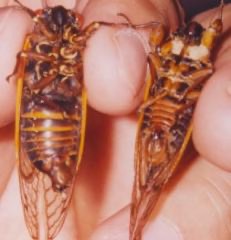
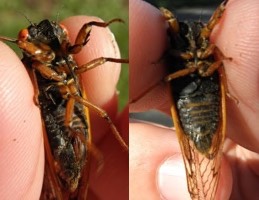
Male on left; Female on right.
M. neotredecim & M. septendecim have broad orange stripes with more orange than black on their abdomens.
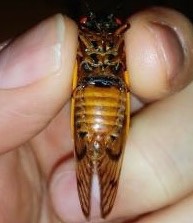
M. tredecim, by comparison, have almost entirely orange abdomens.
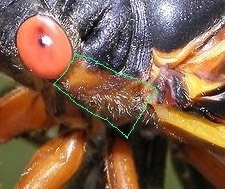
M. septendecim cicadas also have an area of orange coloring between the eye and the wing (pronotal extension).
“Cassini” aka Dwarf Cicadas
There are two species in this category:
Magicicada cassini (Fisher, 1851). 17-year life cycle. Broods: I-V, VIII-X, XIII, XIV.
Magicicada tredecassini Alexander and Moore, 1962. 13-year life cycle. Broods: XIX, XXII, XXII.
Their songs are essentially identical:
M. cassini Call and Court:
Note how it makes a quick burst of sound, followed by some rapid clicks.
Visual Appearance:
Female on left; Male on right.
M. tredecassin & M. cassini cicadas have black abdomens with virtually no orange at all. Orange stripes are possible in the mid-west (important to note for Brood IV).
“Decula”
There are two species in this category:
Magicicada septendecula Alexander and Moore, 1962. 17-year life cycle. Broods: I-VI, VIII-X, XIII, XIV.
Magicicada tredecula Alexander and Moore, 1962. 13-year life cycle. Broods: XIX, XXII, XXIII.
Their songs are essentially identical:
M. tredecula Call:
Note the “tick, tick, tick” rhythm of the call.
Visual Appearance:
Female on left; Male on right.
M. septendecula & M. tredecula have stripes that feature more black than orange. Otherwise, they’re very similar to M. cassini.
How to figure out if they’re coming to your town?
Verify that they’re coming to your state. Check the Magicicada Brood Chart on this page.
Check Cicada Brood Maps linked from this page to see if they’re coming to your general area.
Check to see if they’re coming to your neighborhood. Good sources include:
Ask someone who lived there 17 (or 13) years before.
Old timers (hint: old timers usually call them locusts).
Check your local Library for old newspaper articles.
Check with a local college: contact the entomology, forestry, or agriculture-related departments.
Your local national, state, county, and town parks department (parks and rec). Some county parks departments plan events around cicada emergences.
When will they emerge?
They will emerge sometime in the Spring, for sure.
They typically emerge once the soil 8 inches (20 cm) below the surface gets to 64 degrees Fahrenheit (18 degrees Celcius). At that temperature, they will start digging their tunnels to the surface. After a couple of days with above-ground temperatures near the 80’s F, and after a good rain, they will emerge. Read this paper for more info: Thermal Synchronization of Emergence in Periodical “17-year” Cicadas (Homoptera, Cicadidae, Magicicada) by James Edward Heath, American Midland Naturalist, Vol. 80, No. 2. (Oct. 1968), pp. 440-448.
Cicadas in sunny areas of your yard will emerge before cicadas in shady areas.
Cicadas in the southernmost states will emerge before cicadas in the northern states.
Question: Why do I have cicadas in my neighborhood, but your chart indicates that I shouldn’t?
Answer: Some possibilities: 1) they are stragglers, periodical cicadas that emerge too soon or late, 2) they are not periodical cicadas but are a different North American species, 3) you live on a continent other than North America, in which case, try one of these pages, or 4) SURPRISE! The U.S. is a big place and some cicada populations have yet to be documented.
Question: Why don’t I have periodical cicadas in my area, but the information on your website indicates that I should?
Answer: Two possibilities: 1) they went extinct or otherwise died off in your area, or 2) they aren’t everywhere in a state – normally there are large gaps in their range.
Question: What are stragglers?
Answer:Stragglers can emerge 1 or 4 years early or 1 or 4 years late. Don’t be surprised if you see some periodical cicadas emerge earlier than planned this year. 17-year brood members are most likely to straggle 4 years early, and 13-year brood members are most likely to straggle 4 years late. Straggler probability chart.
Question: Are there other types of Periodical cicadas?
Answer: There are two known species of periodical cicadas that are not Magicicada . One lives in India and the other in Fiji.
Question: Why are there no Brood XI, XII, XV, or XVI?
Answer: Perhaps you’ve noticed there are no Broods XI (11), XII (12), XV (15), XVI (16), XVII (17), XVIII (18), XX (20), XXI (21), XXIV (24), etc. Don’t worry about that. They never existed or are extinct (XI, XXI).
Question: In total, how often do periodical cicadas emerge?
Answer: Over the next 10 years (including 2025), there’s a 90% chance at least one Magicicada brood will emerge somewhere in the U.S.A. Across time, that percentage falls to 77%. Next year (2026) no Broods will emerge. The next 3 year gap (max gap) is 2043-2045.
Example Emergence Timeline
This is an example of a typical cicada emergence. The exact dates will depend on the weather and density of the emergence in your location. Hot weather means an early start and quicker finish to the season — cool weather means a later start and a protracted season.
In 2020, the main periodical cicada brood expected to emerge in the U.S. is Brood IX (9). Brood IX will emerge in southern West Virginia, western Virginia, and a small portion of north-western North Carolina. This we know for sure.
If you want to see where cicadas are being reported, try the Cicada Safari App is available for Android and Apple devices .
OK, here’s the point of this article:
Cicadas from other broods will also emerge this year in small numbers. When cicadas emerge early or late, they’re called stragglers. Don’t get hung up on the meaning of the word. If it makes you happy, call the ones that emerge early “precursors”, “pioneers”, or “heralds”.
Members of Brood XIX (19) are emerging in parts of North Carolina and Georgia, where Brood XIX is know to exist. There’s some discussion of this over on the Cicada Discussion, Science and Study Group on Facebook. You might see them in Alabama, Arkansas, Georgia, Illinois, Indiana, Kansas, Kentucky, Lousiana, Missouri, Mississippi, North Carolina, Oklahoma, South Carolina, Tennessee, and Virginia.
The rest of Brood XIX will emerge in 2024. Here’s a map.
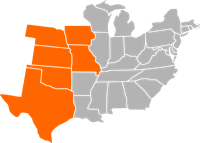
Members of Brood XIII (13) are likely to emerge 4 years early in Iowa, Wisconsin, Illinois, Indiana, and possibly Michigan.
The rest of Brood XIII emerge in 2024 (a big year for periodical cicadas). Here’s a map.
Some members of Brood X (10) should emerge 1 year early in Delaware, Georgia, Illinois, Indiana, Kentucky, Maryland, Michigan, North Carolina, New Jersey, New York, Ohio, Pennsylvania, Tennessee, Virginia, West Virginia, and Washington D.C.
The rest of Brood X will emerge next year in 2021. Here’s a map.
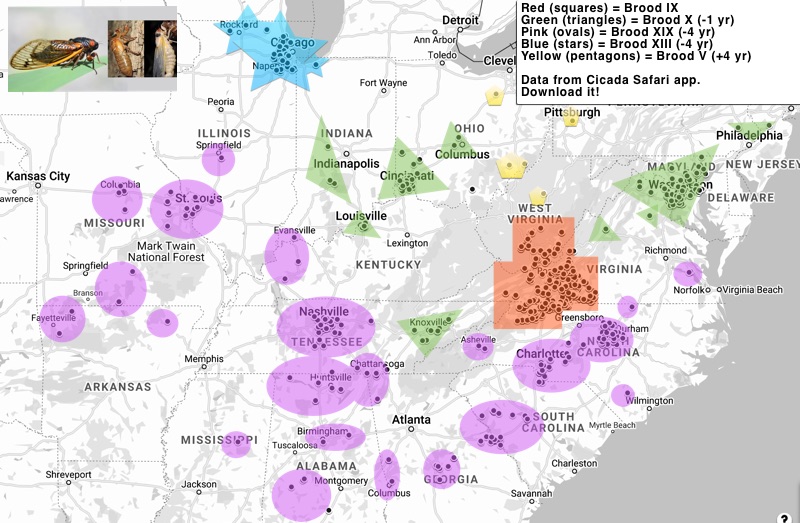
Here’s a screen shot from the Cicada Safari app:
Within the app, you can zoom in to see where the cicadas are appearing. Here’s a “Live Map” of the sightings from the app.Pinch and zoom to get details.