Brood II, a brood of Magicicada found in Connecticut, Georgia, Maryland, North Carolina, New Jersey, New York, Oklahoma, Pennsylvania and Virginia, is set to emerge in the year 2030, but some Brood II stragglers will emerge in 2026.
Update (6/12/2026): Oklahoma (link to iNaturalist post) and Virginia (link to iNaturalist post) had enough emerge to both survive and chorus — which is a sign that they’ll mate and reproduce. The 2026 Magicicada Stragglers project shows 753 observations to date. Virginia had the most stragglers observations by a wide margin at 414. New Jersey was next with 61, the North Carolina with 57, and New York with 52.
GET READY! If you had an abundance of cicadas back in 2013, you are likely to find a handful in your yard in 2026.
If you see or hear one, report it using the iNaturalist app or website or using the Cicada Safari app. Share your observations on Instagram, TikTok, Facebook, X, Bluesky and YouTube. You can use the hashtag #BroodII. Chat about them on the Facebook Cicada Discussion Group.
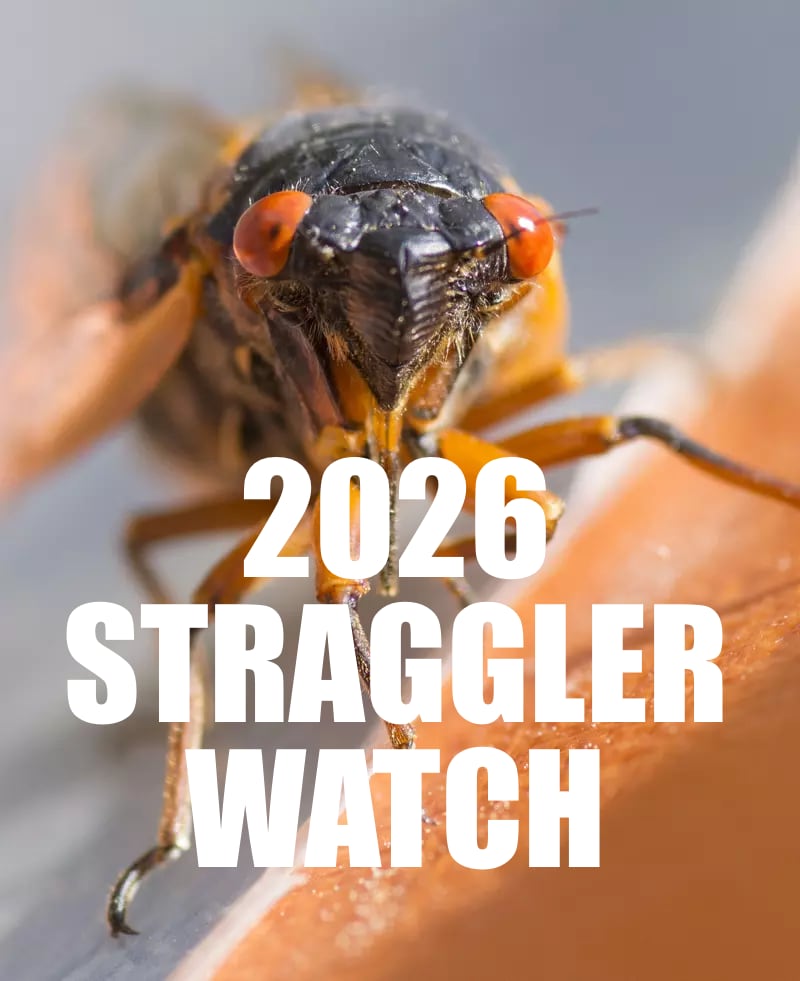
What is a straggler? A straggler is a periodical cicada that emerges later or earlier than expected. Magicicada often emerge 4 years earlier than expected. You can also call them “precursors” when they emerge earlier.
When to look for stragglers?
- Stragglers will emerge in the spring sometime between late April and May.
- Their emergence will be triggered by the warming of the soil where they live. When the soil gets to be approximately 64°F eight inches deep, they will emerge. Air temperatures in the 70s and 80s warm the soil. Warm rain helps as well. Read more about that.
- Tip: We usually don’t see them emerge until the trees have leaves and purple iris bloom.
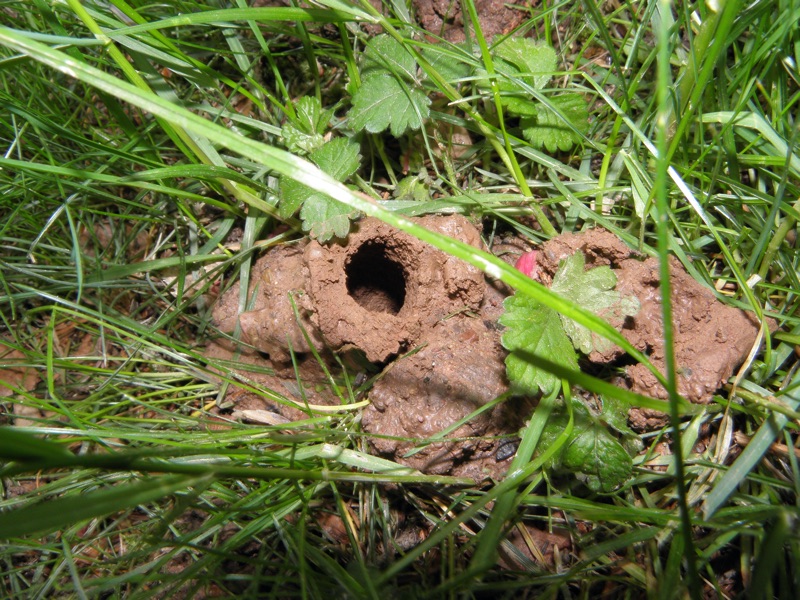
You can also look for cicada chimneys or tunneling cicadas under logs, slates or rocks in April and early May. Look, observe, but do not disturb them.
A cicada chimney is an elevated exit cicadas build above their tunnels:
Where to look for stragglers?
Check this map on the UCONN website. That is where Brood II last emerged.
Hot spots from 2013:
Stragglers found in 2026: 
Connecticut (CT)
- Meriden, CT
New Jersey (NJ)
- Berkeley Heights, NJ
- Colonia, NJ
- Edison, NJ (Roosevelt Park)
- Flat Rock Brood Nature Center, NJ
- Iselin, NJ
- Lewis Morris Park, NJ
- Maplewood in Essex County, NJ
- Metuchen, NJ
- Millburn, NJ
- Montclair, NJ
- Mountainside, NJ
- Plainfield, NJ
- Scotch Plans, NJ
- Upper Montclair, NJ
- West Milford, NJ
- Westfield, NJ
There might be a “shadow brood”, Brood XV, around the Fanwood, NJ area. This would be a brood established from Brood II stragglers, with a large enough of a population to breed and sustain a new brood offset 4 years from Brood II. We will see.
New York (NY)
- Cornwall-On Hudson, NY
- Fishkill, NY
- Germantown, NY
- Red Hook, NY
- Rhinebeck, NY
- Staten Island, NY
- Stony Point, NY
North Carolina (NC)
- Madison, NC
- Yadkin County, NC
Oklahoma (OK)
- Oklahoma City, OK
Virginia (VA)
- Brentsville, VA
- Charlottesville, VA
- Doylesville, VA
- Fredericksburg, VA
- Front Royal, VA
- Glen Allen, VA
- Kinderhook, VA
- Lake Ridge, VA
- Louisa County, VA
- Manassas Battlefield Park, VA
- Martinsville, VA
- North Garden, VA
- Rhoadesville, VA
- Springfield, VA
- Stafford County, VA
- Stanardsville, VA
- Woodbridge, VA
What do they look like?
They look like this once they’ve molted:
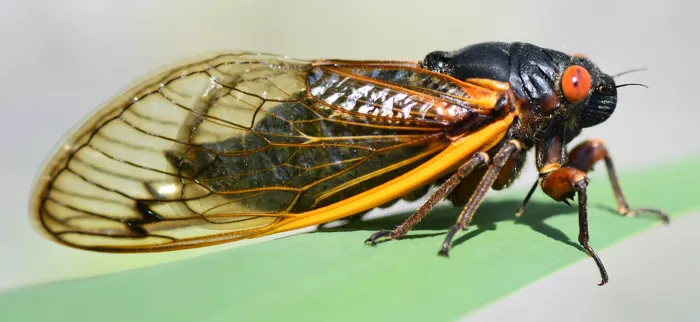
Red eyes (typically), black bodies, orange-black legs and orange-yellow wings.
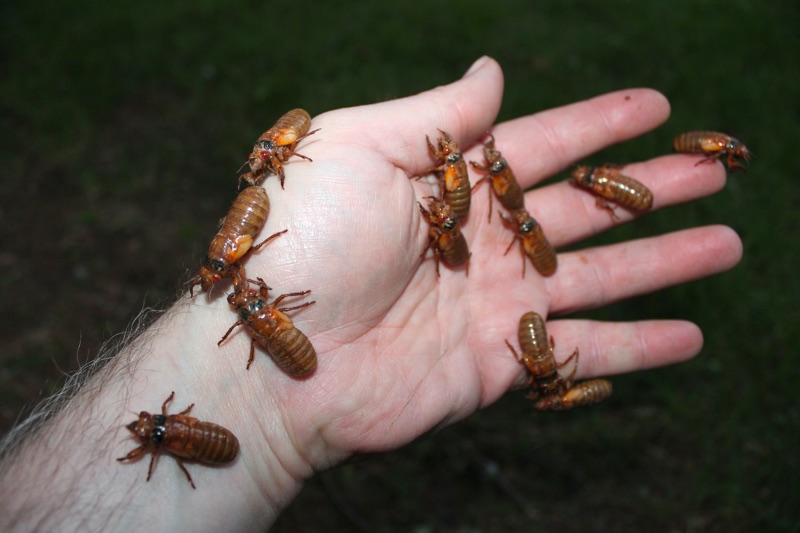
Nymphs that have recently emerged from the ground:
This is each major stage in their life cycle:
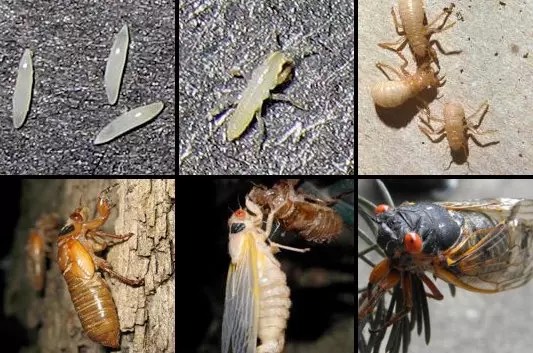
Top, Left to Right: cicada egg, freshly hatched nymph, second and third instar nymphs. Bottom, Left to Right: fourth instar nymph, teneral adult, adult. (Photos by Roy Troutman and Elias Bonaros).
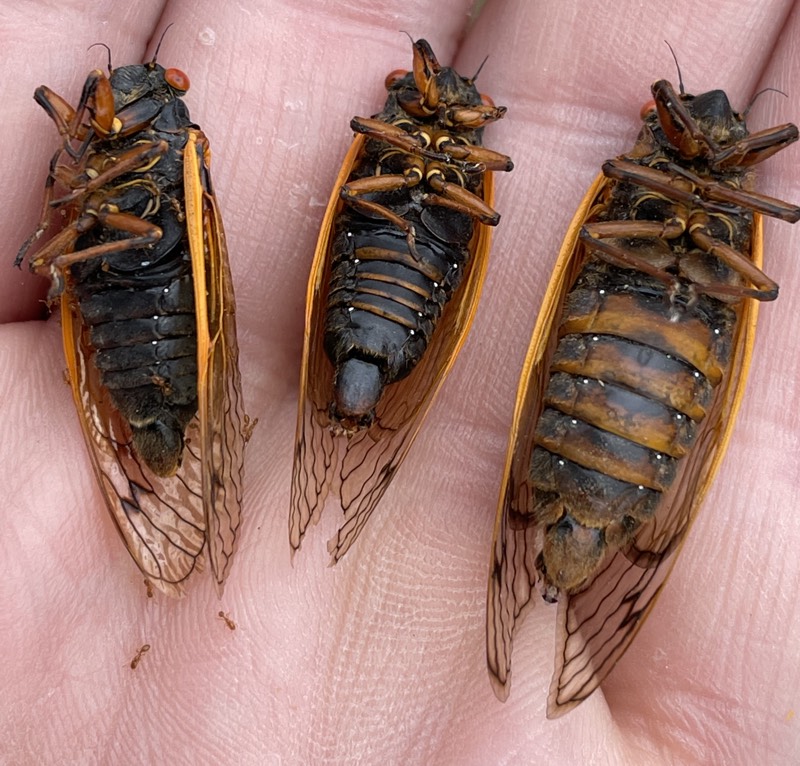
There are 3 types/species of Magicicada in Brood II: Magicicada cassini, Magicicada septendecim, and Magicicada septendecula.
Left to right: Magicicada cassini, Magicicada septendecula, Magicicada septendecim::
23 replies on “2026 Brood II Straggler game plan”
I have a newly emerged cicada this morning in Blossvale, NY!
Awesome! At this time of year it is probably a Neotibicen tibicen tibicen (Linnaeus, 1758) aka Morning Cicada or Neotibicen linnei (Smith and Grossbeck, 1907) aka Linne’s Cicada
Hi! It sounds like July is late in the year for periodical cicadas, but I’m in CT and I just spotted a cicada and it was red/orange and black, not green. Is it possible to be a periodical cicada? I snapped a pic but it’s of the underside through a mesh screen at night, so not the best.
@Angela — That would be a Okanagana rimosa rimosa (Say, 1830) aka Say’s Cicada
Heard and observed a single cicada in Cartersville, GA around 12:30pm today.
Surprisingly, I just saw one Highland, NY! I couldn’t believe it when I saw it fly. I checked, and there are broods in nearby towns. This is my first year in the area.
Yes, Brood II is in Highland NY! Check out this map!
Oh wow! Thank you so much, Dan!!
South East OKC must be thousands near my place. My pictures are on cicada Safari.
They’re out and vocalizing in Far Hills, NJ at Willowwood Arboretum 🙂
out on our street in very limited numbers (lawton road bridgewater, Nj)
we have NEVER had them here before even during the 17 cycle
Hatch ~ April 20, Buckingham county 23936 (north of Dillwyn, near Ranson Rd). I could hear them crawling up from the ground at night. Hundreds hanging out on my car, especially the tires. I’ve three old maple trees and an 1880s farmhouse. My neighbors with newer houses didn’t have as many. I’m not hearing any singers.
Excellent news!
Must’ve been 100 hanging out on my garage this morning. Oak trees trunks are covered. Calverton, Va
Just uncovered over 40 while replacing old landscaping paper. Lake Monticello Virginia. All mobile and most are full grown. Just piling what if find on the driveway and hoping the woodpeckers, jays or squirrels notice them.
Critters like squirrels and birds love to eat cicadas
I don’t like these Insects(Cicada Stragglers whatever you call them. They emerge in our yard Around 16th I think. There are so many and I wish they would just all die off and go away.
My kids found at least 100 yesterday (4/24/26). They were everywhere.
I found six straggler shells under my ornamental cherry tree this morning (4/24) in Bremo Bluff, Virginia 23023! Also noted lots of holes in the ground. Haven’t seen or heard any actual cicadas yet. I will go out at dusk tonight and try to collect some and watch them hatch inside on my curtains! What fun! Longtime cicada lover.
Was there a chorus? Must’ve been a decent straggler emergence, cuz you gotta account for a lot to be satiated before they sing I would think.
Only individuals. M. septendecim. They sang for about a week. I would sit on my porch and listen to them each day.
Ugh I’m so excited Dan! I wonder how many will surface with that Shadow brood XV in Fanwood, NJ. I remember Elias said there was enough to chorus lightly for a few days!
I found one straggler and heard many singers back in 2009 (Brood II stragglers), so I am enthusiastic about them. I am interested to learn about the Fanwood situation.