
Skip to a section: Broods | Your Town | Pre Emergence Signs | Compare Magicicada Species.
17 & 13 Year Periodical Cicadas
The next periodical cicada emergence is Brood XXII (22) in 2027.
Periodical cicada stragglers are emerging from various broods around the U.S., most recently in central New Jersey. See what people have posted on iNaturalist.
Magicicada Brood Chart
The Brood Chart features the names of the broods (Roman numerals), emergence years, cycle-length, straggler-years, species and states where they may emerge.
| Brood | Year | Cycle | States |
|---|---|---|---|
| I | 2029 | 17 | TN, VA, WV |
| II | 2030 | 17 | CT, GA, MD, NC, NJ, NY, OK, PA, VA |
| III | 2031 | 17 | IA, IL, MO |
| IV | 2032 | 17 | IA, KS, MO, NE, OK, TX |
| V | 2033 | 17 | LI NY, MD, OH, PA, VA, WV |
| VI | 2034 | 17 | GA, NC, SC, WI, OH |
| VII | 2035 | 17 | NY |
| VIII | 2036 | 17 | OH, PA, WV, OK |
| IX | 2037 | 17 | NC, VA, WV |
| X | 2038 | 17 | DE, GA, IL, IN, KY, MD, MI, NC, NJ, NY, OH, PA, TN, VA, WV, DC |
| XIII | 2041 | 17 | IA, IL, IN, MI, WI |
| XIV | 2042 | 17 | GA, IN, KY, MA, NC, |
| XIX | 2037 | 13 | AL, AR, GA, IA, IL, IN, KY, LA, MD, MO, MS, NC, OK, SC, TN, VA |
| XXII | 2027 | 13 | KY, LA, MS, OH |
| XXIII | 2028 | 13 | AR, IL, IN, KY, LA, MO, MS, TN |
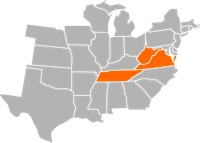
Brood I (1)
Emergences: 2029, 2012, 1995, 1978, 1961.
Cycle: 17-Year.
Stragglers: 2025 (-4), 2028 (-1).
Species: M. septendecim, M. cassini, M. septendecula.
States: TN, VA, WV
Brood II (2)
Emergences: 2030, 2013, 1996, 1979, 1962.
Cycle: 17-Year.
Stragglers: 2026 (-4), 2029 (-1)
Species: M. septendecim, M. cassini, M. septendecula.
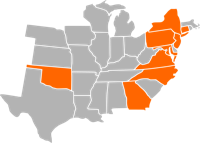
States: CT, GA, MD, NC, NJ, NY, OK, PA, VA
Brood III (3)
Emergences: 2031, 2014, 1997, 1980, 1963.
Cycle: 17-Year.
Stragglers: 2027 (-4), 2030 (-1)
Species: M. septendecim, M. cassini, M. septendecula.
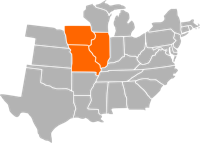
States: IA, IL, MO
Brood IV (4)
Emergences: 2032, 2015, 1998, 1981, 1964.
Cycle: 17-Year.
Stragglers: 2028 (-4), 2031 (-1)
Species: M. septendecim, M. cassini, M. septendecula.
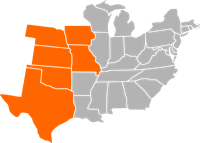
States: IA, KS, MO, NE, OK, TX
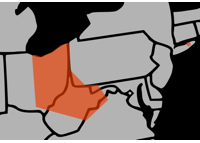
Brood V (5)
Emergences: 2033, 2016, 1999, 1982, 1965.
Cycle: 17-Year.
Stragglers: 2029 (-4), 2032 (-1)
Species: M. septendecim, M. cassini, M. septendecula.
States: LI NY, MD, OH, PA, VA, WV
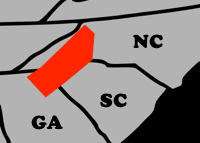
Brood VI (6)
Emergences: 2034, 2017, 2000, 1983, 1966.
Cycle: 17-Year.
Stragglers: 2030 (-4), 2933 (-1)
Species: M. septendecim, M. septendecula.
States: GA, NC, SC, WI, OH
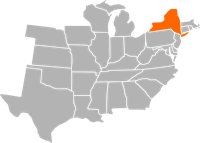
Brood VII (7)
Emergences: 2035, 2018, 2001, 1984, 1967.
Cycle: 17-Year.
Stragglers: 2031 (-4), 2034 (-1)
Species: M. septendecim.
States: NY
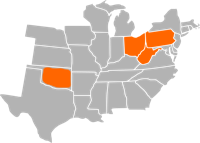
Brood VIII (8)
Emergences: 2036, 2019, 2002, 1985, 1968.
Cycle: 17-Year.
Stragglers: 2032(-4), 2035(-1)
Species: M. septendecim, M. cassini, M. septendecula.
States: OH, PA, WV and OK
Brood IX (9)
Emergences: 2037, 2020, 2003, 1986, 1969.
Cycle: 17-Year.
Stragglers: 2033(-4), 2036(-1)
Species: M. septendecim, M. cassini, M. septendecula.
States: NC, VA, WV
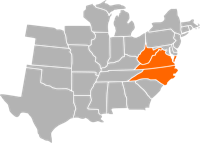
Brood X (10)
Emergences: 2038, 2021, 2004, 1987, 1970.
Cycle: 17-Year.
Stragglers: 2034(-4), 2037(-1)
Species: M. septendecim, M. cassini, M. septendecula.
States: DE, GA, IL, IN, KY, MD, MI, NC, NJ, NY, OH, PA, TN, VA, WV, DC
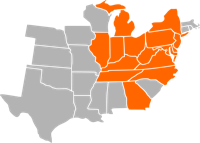
Brood XIII (13)
Emergences: 2041, 2024, 2007, 1990, 1973.
Cycle: 17-Year.
Stragglers: 2037(-4)
Species: M. septendecim, M. cassini, M. septendecula.
States: IA, IL, IN, MI, WI
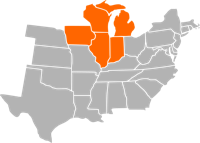
Brood XIV (14)
Emergences: 2042, 2025, 2008, 1991, 1974, 1957.
Cycle: 17-Year.
Stragglers: 2038(-4)
Species: M. septendecim, M. cassini, M. septendecula.
States: GA, IN, KY, MA, NC, NY, OH, PA, TN, VA, WV
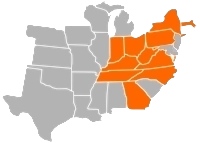
Brood XIX (19)
Emergences: 2037, 2024, 2011, 1998, 1985.
Cycle: 13-Year.
Stragglers: 2025(+1), 2028(+4)
Species: M. tredecim, M. neotredecim, M. tredecassini, M. tredecula.
States: AL, AR, GA, IA, IL, IN, KY, LA, MD, MO, MS, NC, OK, SC, TN, VA
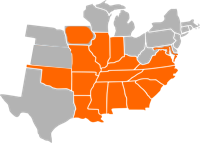
Brood XXII (22)
Emergences: 2027, 2014, 2001, 1988, 1975.
Cycle: 13-Year.
Stragglers: 2026(-1), 2032(+4)
Species: M. tredecim, M. tredecassini, M. tredecula.
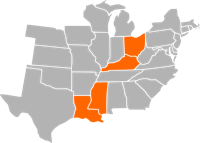
States: KY, LA, MS, OH
Brood XXIII (23)
Emergences: 2028, 2015, 2002, 1989, 1976.
Cycle: 13-Year.
Stragglers: 2027(-1), 2032(+4)
Species: M. tredecim, M. neotredecim, M. tredecassini, M. tredecula.
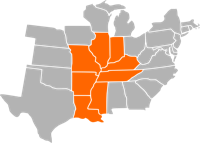
States: AR, IL, IN, KY, LA, MO, MS, TN
Here is a map of all Broods from the Cicadas @ UCONN site. Zoom in and click the pins to see which Brood it represents. (May not work on older devices.)
What specific day will they emerge?
Generally speaking, these cicadas will begin to emerge when the soil 8″ beneath the ground reaches 64 degrees Fahrenheit (Heath, 1968). A nice, warm rain will often trigger an emergence. They can emerge anytime from early April to early June. It all depends on the weather.
What should you look for before they emerge?
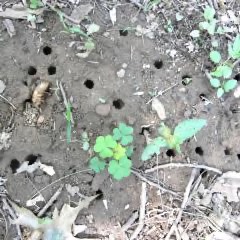
Chimneys / Turrets
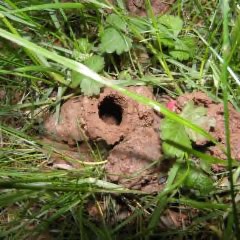
Look for cicada chimneys a.k.a. turrets. These are structures cicadas build out of the soil, positioned above the hole where they will emerge.
Holes
Look for holes in the diameter of an adult’s finger near the root system of a tree. These are sure signs that cicadas will emerge in the area.
Cicadas Under Stones & Slates
You might discover some cicada nymphs while turning over stones or when performing landscaping chores.
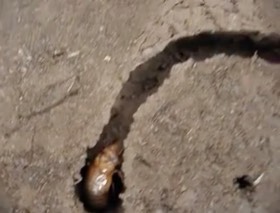
What do they look like when they emerge:
Here is a great video of Magicicada nymphs once they have emerged from the ground:
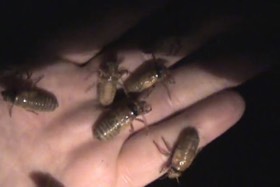
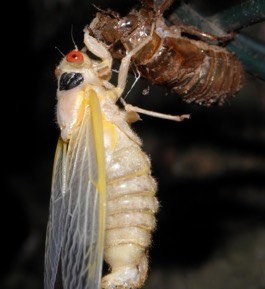
This is a recently emerged nymph crawling up a tree. Note that its eyes are red.
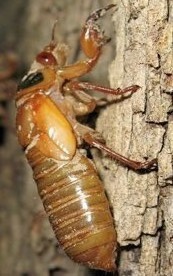
Once cicadas nymphs have emerged from the ground, they will try to find a tree (or similar vertical surface), and then begin the process of shedding their old nymph skins (ecdysis), expanding their wings, and changing to their adult coloring. Watch this amazing transformation.
How to tell the difference between the seven Magicicada species:
Left to right: Magicicada cassini, Magicicada septendecula, Magicicada septendecim:
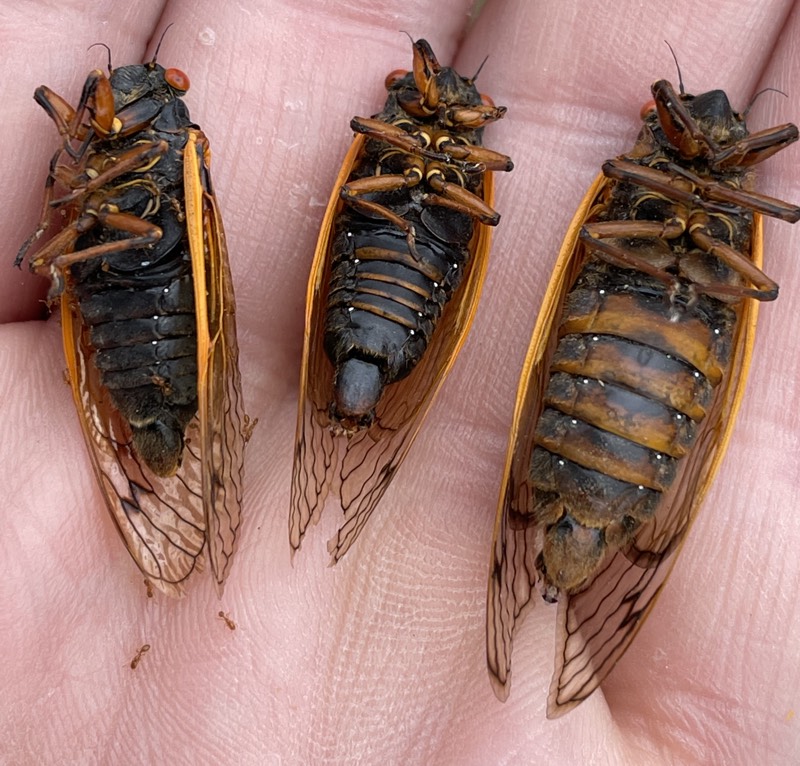
The first way is based on the Brood. Take a look at the Brood chart above, and see which species appear with the Brood.
There are 3 basic types of Magicicada: “‘Decims”, “‘Cassini” and “‘Deculas”.
“Decims” aka Pharaoh Cicadas
There are three species in this category:
- Magicicada septendecim (Linnaeus, 1758). 17-year life cycle. Broods: I-X, XIII, XIV.
- Magicicada neotredecim Marshall and Cooley 2000. 13-year life cycle. Broods: XIX, XXIII.
- Magicicada tredecim (Walsh and Riley, 1868). 13-year life cycle. Brood: XIX, XXII, XXIII.
Their songs are very similar, however, when M. neotredecim & M. tredecim emerge in the same location, M. neotredecim’s song takes a higher pitch. Sounds like “Pharaoh, Pharaoh!”.
Visual Appearance:
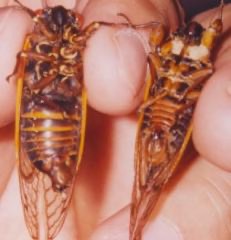
Male on left; Female on right.
M. neotredecim & M. septendecim have broad orange stripes with more orange than black on their abdomens.
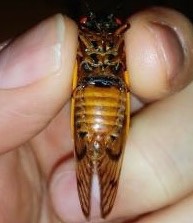
M. tredecim, by comparison, have almost entirely orange abdomens.
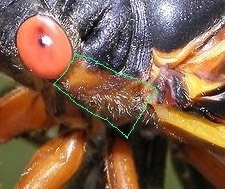
M. septendecim cicadas also have an area of orange coloring between the eye and the wing (pronotal extension).
“Cassini” aka Dwarf Cicadas
There are two species in this category:
- Magicicada cassini (Fisher, 1851). 17-year life cycle. Broods: I-V, VIII-X, XIII, XIV.
- Magicicada tredecassini Alexander and Moore, 1962. 13-year life cycle. Broods: XIX, XXII, XXII.
Their songs are essentially identical:
M. cassini Call and Court:
Note how it makes a quick burst of sound, followed by some rapid clicks.
Visual Appearance:
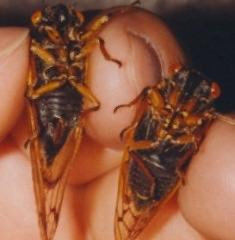
Female on left; Male on right.
M. tredecassin & M. cassini cicadas have black abdomens with virtually no orange at all. Orange stripes are possible in the mid-west (important to note for Brood IV).
“Decula”
There are two species in this category:
- Magicicada septendecula Alexander and Moore, 1962. 17-year life cycle. Broods: I-VI, VIII-X, XIII, XIV.
- Magicicada tredecula Alexander and Moore, 1962. 13-year life cycle. Broods: XIX, XXII, XXIII.
Their songs are essentially identical:
M. tredecula Call:
Note the “tick, tick, tick” rhythm of the call.
Visual Appearance:
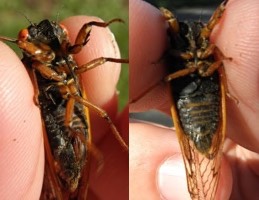
Female on left; Male on right.
M. septendecula & M. tredecula have stripes that feature more black than orange. Otherwise, they’re very similar to M. cassini.
How to figure out if they’re coming to your town?
- Verify that they’re coming to your state. Check the Magicicada Brood Chart on this page.
- Check Cicada Brood Maps linked from this page to see if they’re coming to your general area.
- Check to see if they’re coming to your neighborhood. Good sources include:
- Ask someone who lived there 17 (or 13) years before.
- Old timers (hint: old timers usually call them locusts).
- Check your local Library for old newspaper articles.
- Check with a local college: contact the entomology, forestry, or agriculture-related departments.
- Your local national, state, county, and town parks department (parks and rec). Some county parks departments plan events around cicada emergences.
- When will they emerge?
- They will emerge sometime in the Spring, for sure.
- They typically emerge once the soil 8 inches (20 cm) below the surface gets to 64 degrees Fahrenheit (18 degrees Celcius). At that temperature, they will start digging their tunnels to the surface. After a couple of days with above-ground temperatures near the 80’s F, and after a good rain, they will emerge. Read this paper for more info: Thermal Synchronization of Emergence in Periodical “17-year” Cicadas (Homoptera, Cicadidae, Magicicada) by James Edward Heath, American Midland Naturalist, Vol. 80, No. 2. (Oct. 1968), pp. 440-448.
- Cicadas in sunny areas of your yard will emerge before cicadas in shady areas.
- Cicadas in the southernmost states will emerge before cicadas in the northern states.
- You can try the Cicada Emergence Formula as well.
- If you don’t want them to damage your young or ornamental trees
- Spray them off with a garden hose.
- Foil around the trunk (to keep them from crawling up) (thanks Deborah).
- Insect barrier tape.
- Netting wrapped around & over the tree. “Insect barrier netting”. “Fruit tree covers”.
- Bagpipes (no joke, it worked at my friend’s wedding).
- Don’t use pesticides – we like all insects (especially pollinating bees).
- Are you scared of insects?
- Unlike some other insects & arthropods. cicadas are not poisonous or venomous.
- Try a hat, an umbrella, a bee-keeper outfit, a suit of armor…
- They’re coming, and they’re going to ruin my wedding!
Questions about the Brood Chart
Question: Why do I have cicadas in my neighborhood, but your chart indicates that I shouldn’t?
Answer: Some possibilities: 1) they are stragglers, periodical cicadas that emerge too soon or late, 2) they are not periodical cicadas but are a different North American species, 3) you live on a continent other than North America, in which case, try one of these pages, or 4) SURPRISE! The U.S. is a big place and some cicada populations have yet to be documented.
Question: Why don’t I have periodical cicadas in my area, but the information on your website indicates that I should?
Answer: Two possibilities: 1) they went extinct or otherwise died off in your area, or 2) they aren’t everywhere in a state – normally there are large gaps in their range.
Question: What are stragglers?
Answer: Stragglers can emerge 1 or 4 years early or 1 or 4 years late. Don’t be surprised if you see some periodical cicadas emerge earlier than planned this year. 17-year brood members are most likely to straggle 4 years early, and 13-year brood members are most likely to straggle 4 years late. Straggler probability chart.
Question: Are there other types of Periodical cicadas?
Answer: There are two known species of periodical cicadas that are not Magicicada . One lives in India and the other in Fiji.
Question: Why are there no Brood XI, XII, XV, or XVI?
Answer: Perhaps you’ve noticed there are no Broods XI (11), XII (12), XV (15), XVI (16), XVII (17), XVIII (18), XX (20), XXI (21), XXIV (24), etc. Don’t worry about that. They never existed or are extinct (XI, XXI).
Question: In total, how often do periodical cicadas emerge?
Answer: Over the next 10 years (including 2025), there’s a 90% chance at least one Magicicada brood will emerge somewhere in the U.S.A. Across time, that percentage falls to 77%. Next year (2026) no Broods will emerge. The next 3 year gap (max gap) is 2043-2045.
Example Emergence Timeline
This is an example of a typical cicada emergence. The exact dates will depend on the weather and density of the emergence in your location. Hot weather means an early start and quicker finish to the season — cool weather means a later start and a protracted season.
img src=”https://www.cicadamania.com/cicadas/wp-content/uploads/2024/04/Chart20250530800.webp” alt=”May 30th Update” width=”800″ height=”486″ class=”alignnone size-full wp-image-20191″ />
Here’s an Excel version of the chart. Feel free to use it and adjust it to match your experience.
Or watch the video version:
More Magicicada websites:
- For much more information about 17-year cicadas visit Cicadas @ UCONN. The maps on this page link to that site.
- The Cicada Safari App is available for Android and Apple devices. Use it to see where people are finding cicadas, and to report your sightings.
More Magicicada Information
- Cicada Images and Video for Sharing (by the Media, Educators, or anyone else)
- My best Photos (from Brood VII)
- A quick way to tell the difference between the 7 periodical cicada species
- All cicada questions that are frequently asked.
- Blog posts about Magicicadas (400+ Posts!)
- Learn to tell if a periodical cicada is ready to molt
- The 17 Most Interesting Periodical Cicada Facts
- Signs periodical cicadas are about to emerge.
- Use the Periodical Cicada Emergence Checklist for the Maximum Magicicada Experience
- A video to help you tell the difference between the species
88 replies on “Where will 17 & 13 Year Periodical Cicada Broods emerge next (2027)?”
cicadas are better than any other insect
Is there any place in Illinois where you can see both broods together in the same place? I’m thinking both broods are out by now. When would the best time be to see them both?
No, but they come closest in Springfield. So if you go there and go north, you’ll find Brood XIII, and if you go south, you’ll find Brood XIX.
It helps to use the Cicada Safari app. and iNaturalist.
Also, consider expanding the area you visit to the St. Louis and Chicago areas.
I’m just outside of Chicago, and there are lots in my back yard. I was hoping to get the “Thomas Jefferson” event and see both together. There are hardly any in the front yard, which also has old trees. Do you think more will be coming up in other areas of my property?
We drove up to Springfield IL on 20 May to see 13s and 17s at the same location. We had tracked sightings so we stopped at the Chesapeake Fish restaurant parking lot about 9:30 a.m. Only saw a 13.
We then went to the Audubon Center down the street and saw some more 13s in the vegetation around the house and some flyers along the trails. The Audubon staff called the Lincoln Memorial Gardens; they said they were covered-up in cicadas so we went there.
At just the entrance we saw 13s and 17s (based on their different sizes and markings). Some metamorphosing. i published some photos. Lots of symbolizing there, too. Inside the center, there was a demo for a group of young children. The docent had a terrapin which she offered a cicada and the turtle promptly gobbled it down.
I’m in Washington state…I guess we don’t get them here. But there must be SOME cicada species here, because one landed on me several years ago, and I’ve seen at least 2 shed skins from them this year.
Yes, Washington has many species Common cicadas of Washington state but they aren’t as numerous and gregarious as Magicicada. Here is a list of the cicadas people are finding in Washington now.
Oh my lord talk about cicadas my porch and yard is covered I’m 26 and have never seen it like this I’m in north alabama
There’s no shortage of cicadas in Alabama! I just checked the map.
I’m 19 years old. I’ve been waiting 17 years for this.
Thanks for sharing all the valuable information and insight. This is the first time I have really tried to pay attention to when they emerge and WOWWWW! The sheer amount of cicadas in my yard is insane!!! We’re in Lebanon, TN. I’ve been outside for the last couple of days taking pictures. It really is quite fascinating to see! Any particular reasoning to why some of them are albino? Or do they end up changing to a darker color later?
Right, they darken over time, usually within 12 hours.
Thank you for clarifying!
Omg they’re here and the sound is a constant 65/67dec. during sunshine. It quiets to 60 when cloudy and down to 35-40 at night. This singing is deafening. We hear it inside the house! Holes are everywhere. We live on an old farm and have noticed the sound comes from the wooded areas. We have one dog who eats them prolifically. He then proceeds to throw them up with the still red eyes. It’s soooo nasty. ???? it’s very rural here. 20 min to town, hour to a big city. I’m not hearing them in town like at home but it’s a mess with this dual emergence. When will the noise stop and will they defoliate my trees!?????
The sound lasts about 3 weeks. Ear plugs are recommended.
They don’t eat leaves, but the leaves of some branches of trees will turn brown if female cicadas kills branches during egg laying.
I’m planning a trip to Iowa for mushroom hunting in late April and was wondering if I could squeak my way into Illinois and see any of the broods emerge.
Or if not, I’d like to try and plan a trip to see them in Arkansas if possible (none really emerging here in Texas unfortunately.) What would be the ideal time to visit AK this year?
Early to mid May, should be OK. Stay tuned to this website.
Assume you mean AR for Arkansas (AK is Alaska) ????? Our temps have been cooler than usual, but according to the emergence calculator, may be as early as May 2. We are having good spring rains, and I’ve personally seen a few turret holes, so they are staging! Arkansas southern vs northern vs eastern regions may vary a lot in temperature due to we have so much difference in altitude, mountains vs flat farmlands. I can only speak for western central in the mountains.
AK prob = AR
Folks – I work in the Education Department for the Lake County Forest Preserve District in Lake County Illinois. We will have great emergences in our wooded preserves in many parts of the county. Ryerson Woods Forest Preserve in Deerfield is a great spot to view. On Sunday, June 9th, we plan to hold CicadaFest at Ryerson Woods. Insects, and of course, cicadas will be featured. We also have more programming centered around the cicada emergence and a great cicada exhibit opening at the Dunn Museum in Libertyville, IL on April 27th. Dr. Kritsky will be with us as well in early June. Keep checking out our website at lcfpd.org for programming and other cool cicada stuff.
@Mark, please comment more information as you get it.
This is great to hear!!! I have been collecting various specimens from various broods since 1985. But two years ago, I committed to embark on quest to begin collecting specimens from each and every brood until I cycle back to my local brood. I’m in York, PA and as soon as I see posts that the emergence is occurring, I’m immediately heading westward to photograph and collect!
I’m trying to find a good Cicada Emergence Viewing Spot in the midwest – willing to travel. I’ve heard of cicada fests/parties before (or at least I’ve seen T-shirts) Are there any suggestions on where would be the best spot to go to see the emergence?
Lake County Forest Preserve in Illinois was great last Brood XIII emergence.
Thank you so much! When would be the best time to go/increase our chances of seeing them? I’m very excited to experience it.
Lucky you. 17 year locusts were a no-show in my neighborhood of Naperville in 2007 and 1990 after being incredibly abundant in 1973. We probably lost most of the trees in the neighborhood to Dutch Elm disease in the ’70’s, which might explain their disappearance locally, but I didn’t see them carpeting the ground anywhere.
I know this is such a late comment. If you do come to northern Illinois/ Chicago land area… the neighborhood of Beverly (Beverly Hills/Morgan Park) should be absolutely thick with them. I grew up there on Longwood Drive…the 17 year showed up when I was 18 years old. You literally couldn’t even see our fence. It was absolutely black. The neighborhood has tons and tons of old trees so if you in the area, you should check it out.
Will they be in southwest Florida 2024? I hate them, they creep me out!
Are they expected to be in southwest Florida in 2024? I hate them, they creep me out!
@Laryan, Florida used to have them, but they died off in the 20th century. Florida has other less obnoxious types like these: Common cicadas of Florida.
thanks to share article , i used it ^_^
Your website solved a mystery for us. We’re hearing 2 different calls. (Are they male/female? different stages?…) One call is like the annual cicadas; one is lower, reminiscent of lots of frogs down by the river. We now know they are from 2 different species: M. cassini and the Pharaoh cicadas. Your recordings are very helpful! Thanks!
It is truly Wonderful!
Found an M. septendecim of each sex in our back yard on May 19th. Today, found a female M. cassini. Was talking to a friend about species emergence; she forwarded this article: https://insights.osu.edu/science/17-year-cicadas
Granted, 3 individuals total of two species is a rather meager sample size for Brood X, but I have not seen anything elsewhere in my references or on line about the emergence of each species peaking at different times during the whole emergence timespan. Do you have any other sources or websites you can direct me to about this? Thanks!
Anecdotally, the smaller species emerge after M. septendecim, but they reach their crescendo at the same time and are gone by the same time. All three cicadas prefer different slightly different habitats. The M. septendecim is more of a generalist and will occupy any level of the canopy. M. cassini, I’ve heard, prefer wet areas, but I’ve also seen them dominate suburban neighborhoods. They seem to prefer higher elevations. M. septendecula are particularly hard to find — when I do find them, they seem to occupy ravines, small and small shady areas of less than an acre.
Flying and landing in trees last 5 days. North Georgia mtns. Approximately 15 miles now of trail head for Appalachian trail.
At Fort Knox, KY and at least 50 red eyes shedding nymph forms on my back porch last night.
Can I come and get some? I want to move them to my farm.
Fort Knox, Kentucky. Red eyed cicadas everywhere. At least 30 on my back porch and some starting to shed
Dozens and dozens of nymphs crawling out of the ground in Princeton NJ tonight! They were all over the sidewalks. It has begun!!! Let’s get this party started!!!!
I’m wondering, do these 13 & 17 years periodical cicadas exist in Canada or only in the USA?
The 17/13 year species are only in the US. There are other species of periodical cicadas around the world — just not in Canada. There are cicadas in Canada, but they have different lifecycles.
I started seeing the 17-year cicadas emerging from the ground. Lots of wholes a few cicadas.
How many eggs does Magicicada casinii lay in one slit into the twig? They seem to be in pairs. I believe it lays one side then the parallet set.
Was there a cicada emergence in the coastal desert area of California during the summer of 2020?
A friend said they were unable to sleep due to the noise level.
Thank you.
California — there might have been. The species in California don’t emerge in a predictable cycle, like these 17-year cicadas, but many do have “proto periodical” peak years based on weather events — like a year with a lot of rain — or maybe other factors like overcrowding. Here is a list of cicadas in California.
I saw a cicada in Vienna, Virginia this morning, at least I think it is a cicada. I have a picture to share. Isn’t it quite early for Brood X?
Send it to cicadamania@gmail.com.
I live in Washington, NC. We are about 90 miles from the coast. Last night I heard the song of the Cicadas as I was walking my dog. It was loud. This morning I looked for any carcasses and found one and a dead one. I can send pictures if anyone is interested. Are they mapped to be this Far East ?
Email photos to cicadamania@gmail.com.
Aug 20, 2020 and I have over 15 cicadas that just emerged on a tree in my front yard in central Iowa. It sounds like they are in every tree. If the last periodic brood was 2014 what brood are these?
At this time of year, it’s just annual (not periodical) cicadas. Here’s the Iowa list. Probably a Megatibicen or Neotibicen.
Cicada sounds here in Bayonne, NJ (it is a city but they are everywhere) Not sure what kind though since we never see them.
I found a Cicadia shell on my deck today. I had no idea what it was but 3-4 of my science teacher friends all said it was a Cicadia… Thanking God they only emerge every 17 years. It reminds me of an enlarged dust mite….
Just found a large nymph climbing a tree in Greenville, SC. It is Dark brown and covered in clay, about 2 inches long.
Sounds like Megatibicen auletes.
I’m in Grayson County Va and the cicadas don’t seem near as prevalent this year as past years… the sounds at night are so much less… what’s going on?
I have one that is on my swing in the yard, I’m from Jersey, it has been there for two days and looks like it is going into a cocoon. I didn’t know what it was and had to look it up, it had a face like a small bat with large wings.
it is Augustand we have some cicadas emerging here in NJ….they re not the big green nnuals- which we have too. Stragglers? It has been very hot after a cold spring.
I recall a very Large Population in West side of Birmingham, Al. in 1955 or 1956. Green wing I think. I used to scare my Grand Mother by Hanging the shells on my t shirt by the dozen. My first fun with Cicadas.
I live in McLean va but no sign of any cicadas. Will they be coming soon? It’s July 18
I found one in my yard today here in Cincinnati, looks like one of the decim photos above. July 12/2020
I found 2 in my yard today. July 12, 2020 Kennesaw, GA
I was going to use the Cicada Safari app, but it wants too much personal info and location. I get enough junk, spam already. Yes, it bugs me.
Hopefully this is useful to someone tracking them.
You probably found one of the annual species of cicadas.
Spotted several cicada shells in my yard at Santee S.C. and looked them up and found this world of info. With all the problems we are having this year in our world is a comfort to know Mother Nature will keep on going even long after we have destroyed ourselves. I have kept one of my cicada shells, named him George and placed him in a place of honor in my artifacts collection.
HI There.
I live in northern NJ and it seems to me like we ALWAYS have cicadas–every year. I love that sound on a hot summer morning.
My son asked me why we haven’t heard any yet this year and I don’t have an answer.
I could have SWORN I heard them this past Saturday morning, and got all happy again. But then–nothing since.
What is going on? Is it actually possible we will have a summer without ANY cicadas??
THank you.
@maggie, the Jersey annual cicadas are starting to emerge now. Here’s a list of all Jersey cicadas. You should start to hear Lyricen and Morning cicadas in the coming week.
I live in the Western Suburbs of Chicago where it has turned sharply cooler this afternoon. It’s around 67 degrees and supposed to drop into the upper 50’s tonight. Will the cooler temperatures have a negative impact on the cicada activity? Not to mention yesterday’s high winds associated with Tropical Depression Cristobal, which took down a lot of smaller branches and twigs throughout the area. They seem to be calling less right now around 6pm CT on 6/10/2020.
I live in SW virginia and am experiencing Brood IX at this time…pretty amazing!
We attract many hummingbirds to our yard and are now seeing them at the feeders only early in the morning and at dusk. Can the huge numbers of cicadas that we have on our property interfere with the nesting cycle of the hummingbirds?
I live in Chicago’s southwest suburb of Orland Park. We must have the Brood XIII stragglers here too. I initially saw nymphs climbing walls of my house on Wednesday,June 3rd. By the weekend, my shrubs, trees, wood retaining walls and cedar siding were strewn with hundreds of not thousands of nymph shells. Today, it’s simply a massive chorus when you sit outside.
I live in the west suburbs of Chicago, and for the past week we have had a growing symphony of cicada calls. I did see a dead cicada on the sidewalk during of my walks. This started about the beginning of June, when I heard one lone cicada singing.
Reminds me of the “War of the World” movie, the original one. Their constant drone sounds just like the spaceships nbn before they began laser fire
So what brood is emerging here in at least the suburbs of Chicago-DownersGrove?
If they’re “stragglers” of brood 13 there sure is a lot of them.
Almost as big as full emergence.
Could a different brood have expanded or moved its territory?
@tim, its Brood XIII, but it may be “accelerating” to establish a new brood, or at least demonstrating the biological mechanisms that allow a brood to form another brood.
In the eastern states we have a series of broods — XIV (14), X (10), VI (6), and II (2) — that are believed to have have derived from on another.
I live in Wheaton, and have had the same experience. These are not stragglers, the symphony grows each day
@howard, did you experience these cicadas in this location 17 years ago?
We are at Rendezvous Mountain State Park north of Wilkesboro and not seeing them but hearing them! Sounds like The Twilight Zone!
I’m in Maywood, Il and I have a kid of them they greet me every morning in my backyard especially there shells. I’m afraid of them I have to sweep them away to go out the door. I don’t sit in my yard because of them. How long will they be here???
@S.Ruiz. Typically 3-4 weeks.
Birmingham, AL. Just saw two large very dark cicadas with red eyes and almost black coloring. They were hitting against my car widow as I got out this morning.
I also have seen many shells in my yard of Magicicada as well as live nymphs in the evenings. Last night I found 28 nymphs in 15 minutes. I am just north of Chicago.
I also have seen many shells in my yard of Magicicada as well as live nymphs in the evenings. Last night I found 28 nymphs I. 15 minutes. I am just north of chicago.
Our brood in northern Illinois is not expected to emerge until 2024
but this morning (June 1st 2020) we discovered a Magicicada on the
house drying off (having just emerged). Is there somewhere to report
this? I have photos.
@Michael, sounds like stragglers from Brood XIII. You can report it with the Cicada Safari app.
It is also possible that they are an early (one year) emergence from brood XIII. We have them in the western suburbs of Chicago. Elmhurst, LaGrange Park, Oak Park etc..
I can hear cicadas in our area of Georgetown, SC. Have yet to find the actual bug.
I discovered a red eyed cicada Here in Searcy County, Arkansas today. I got a photo of it. It seems to not be in any group set to emerge. May 28,2020