Welcome to the amazing world of cicada insects!
Last Updated: Saturday March 21, 2026.
2026 Periodical Cicada Forecast:
Magicicada in the U.S.A.
There are no major broods of Magicicada set to emerge in 2026, however smaller spurious broods or stragglers from the major broods may emerge, specifically stragglers from Brood II and XXII.
We will also be investigating Brood XV in New Jersey. This would be a "shadow brood" of Brood II.
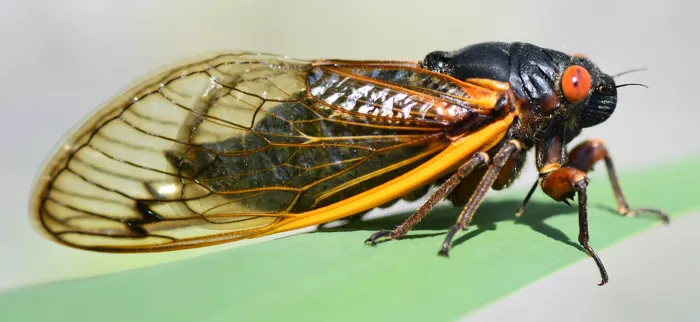
Chremistica ribhoi
The World Cup Brood of C. ribhoi will emerge in Meghalaya, India in 2026.
What about cicadas with an annual lifecycle?
The usual Annual cicadas will emerge in the usual places, Asia, Europe, Africa, Oceana (Australia, New Zealand, Pacific islands), North America, Central America, and South America, at the usual times in varying amounts year over year.
2026 Cicada publications so far....
What are Cicadas?
Cicadas (Insecta: Hemiptera: Cicadidae) are "true bug" insects, best known for the songs sung by most, but not all, male cicadas. Males sing by flexing their tymbals, which are drum-like organs found in their abdomens. Small muscles rapidly pull the tymbals in and out of shape. The sound is intensified by the cicada's mostly hollow abdomen.
An illustration of cicada tymbals from C.L. Marlatt's The Periodical Cicada showing the tymbal of a Magicicada. A photo of a Magicicada tybal from the outside:

Female and some male cicadas will also make a sound by flicking their wings, but it isn't the same as the sound for which cicadas are known. Listen to some of the songs cicadas sing.
Cicadas belong to the order Hemiptera, suborder Auchenorrhyncha, superfamily Cicadoidea, and families Cicadidae (the vast majority of cicadas) or Tettigarctidae (only two species). There are five subfamilies of Cicadidae: Derotettiginae, Tibicininae, Tettigomyiinae, Cicadettinae, and Cicadinae. Leafhoppers, spittlebugs, and jumping plant lice are close relatives of the cicada. Hemiptera insects are different from other insects in that both the nymph and adult forms have a beak (aka rostrum), which they use to suck fluids called xylem from plants. This is how they both eat and drink.
A Magicicada cassini is drinking from a tree. Its beak is in the blue circle:

The body of a cicada is composed of a head, thorax & abdomen. The head features two antennae, two compound eyes, three simple eyes (ocelli), and a clypeus that connects the beak to the head (the clypeus looks like the grill of a combustion vehicle). The thorax features two sets of wings (forewings & hindwings), six sets of legs, spiracles for breathing, opercula covering the tympana ("eardrums"), and in males of species that have them, tymbals & tymbal covers. The abdomen features tergites (dorsal) & sternites (ventral), more spiracles for breathing, and reproductive organs. Cicadidae and Tettigarctidae have major differences in anatomy, which you can learn about here.
What does a cicada look like?
They look like this Neotibicen superbus aka Superb cicada found in Arkansas, Kansas, Louisiana, Missouri, New Mexico, Oklahoma, and Texas:
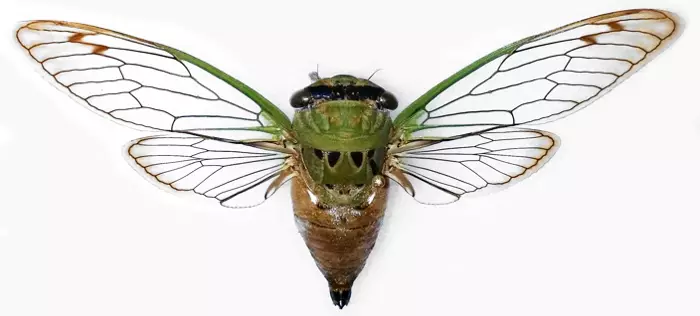
Cicadas are insects with six legs, two antennae, two compound eyes, 3 simple eyes, 2 pairs of wings, a beak for drinking, opercula (covering their auditory chambers), and at least one method of making noise (most males have tymbals).
The Root of the Word Cicada
The Latin root of the word for cicada is cicada. Cicadas are called semi in Japan, cigale in France, and cigarra in Spain. Names for cicadas in countries around the world. The pronunciation of the word cicada depends on your local dialect. You can say “si-kah-da” or “si-kay-da”.
Cicada Life Cycle
Cicadas begin life as a rice-shaped egg, which the female deposits in a groove she makes in a tree limb, using her ovipositor. The groove provides shelter and exposes the tree fluids, which the young cicadas feed on. These grooves can kill small branches. When the branches die and the leaves turn brown, it is called flagging.
Once the cicada hatches from the egg it will begin to feed on the tree fluids. At this point, it looks like a termite or a small white ant. Once the young cicada is ready, it crawls from the groove and falls to the ground where it will dig until it finds roots to feed on. It will typically start with smaller roots of grass plants and work its way up to the roots of its host tree. Depending on the species, the cicada will stay underground from 2 to 17 years. Cicadas are active underground, tunneling, feeding, and not sleeping or hibernating as commonly thought.
After a long 2 to 17 years, cicadas emerge from the ground as nymphs. Nymphs climb the nearest available vertical surface (usually a plant) and begin to shed their nymph exoskeleton. Free of their old skin, their wings will inflate with fluid (hemolymph) and their adult skin will harden (sclerotize). Once their new wings and body are ready, they can begin their brief adult life.
Adult cicadas also called imagoes, spend their time in trees looking for a mate. Males sing (or otherwise vibrate the air or their surroundings), females respond, mating begins, and the life cycle begins again.
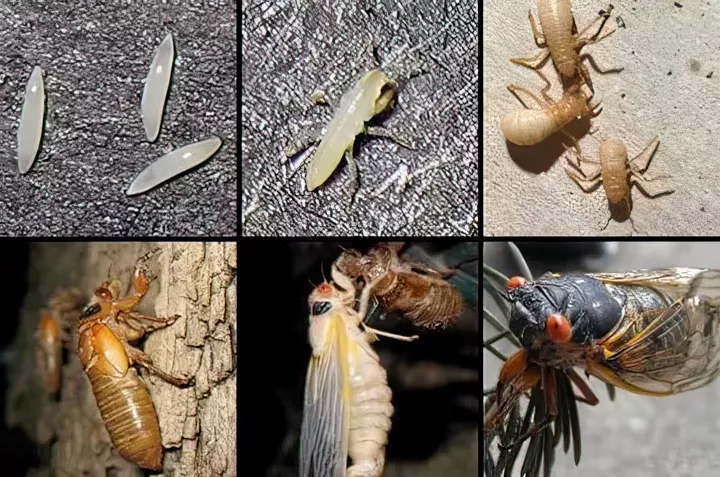
Top row, left to right: cicada egg (Roy Troutman), freshly hatched nymph (Roy Troutman), second and third instar nymphs (Elias Bonaros). Bottom row, left to right: fifth instar nymph, teneral adult, adult. (Cicada Mania):
Different Types of Life Cycles
There are three types of cicada life cycles:
- Annual: Cicada species with annual life cycles emerge every year, for example, Swamp Cicadas (Neotibicen tibicen) emerge every year in the United States, and Green Grocers (Cyclochila australasiae) emerge every year in Australia.
- Periodical: Cicadas species with periodical life cycles emerge together after long periods, for example, Magicicada septendecim will emerge every 17 years (Find out where they'll emerge next). Magicicada periodical cicadas are organized into Broods, which correspond to the series of years in which they will emerge. Only periodical cicadas are organized by Roman-numeral Broods.
- Protoperiodical: Cicada species with protoperiodical life cycles might emerge every year, but every so many years they emerge together in large numbers, like certain Okanagana and Playpedia depending on factors like proximity to other species and rainfall accumulations (Chatfield-Taylor 2020).
How Many Cicadas Are There?
There are over 190 varieties (including species & subspecies) of cicadas in North America and over 3,390 varieties of cicadas around the world. This number grows each year as researchers discover and document new species. Cicadas exist on every continent but Antarctica.
The Largest Cicada:
The world's largest species of cicada is the Megapomponia imperatoria, which is native to Malaysia. The largest species in North America is Megatibicen grossus (auletes), aka the Northern Dusk Singing Cicada. Other notably large cicadas include the Bear Cicada of Japan (Cryptotympana facialis), and Tacua speciosa of south-east Asia.
Megapomponia imperatoria:

The Loudest Cicadas:
The world's loudest cicada is the Brevisana brevis, a cicada found in Africa that reaches 106.7 decibels when recorded at a distance of 50cm (~20"), according to researcher John Petti.
The Megatibicen pronotalis walkeri (formerly known as Tibicen walkeri) is the loudest cicada in North America and can achieve 105.9 decibels, measured at 50cm.
That said, Australian species of cicadas, like the Double Drummer (Thopha saccata) are said to approach 120 (deafening) decibels at close range. It is unknown how many decibels Thopha saccata can create at 50cm.
Double Drummer aka Thopha saccata:

More info about the loudest cicadas.
The Longest Cicada Life Span:
The most well-known cicadas in North America are Magicicada periodical cicadas, aka "locusts", which have amazingly long 17 or 13-year lifecycles. Magicicada cicadas have been documented to emerge after 22 years. Read more: How long do cicadas live?
What is Cicada Mania or Cicadamania?
Aside from the name and brand of this website, Cicada Mania, or Cicadamania, is an extreme, excessive, absorbing or abnormal enthusiasm for cicada insects.
Cicada Mania, for most, lasts as long as a cicada emergence: about four to six weeks. The shock, sights, sounds, sensations and even smells of hundreds to millions of screaming, flying insects appearing all at once in a neighborhood is more than enough to drive a person into a state of Cicada Mania.
Cicada Mania, for some, becomes a life-long condition, resulting in “Cicada Maniacs” hoarding humungous collections of cicada specimens and memorabilia, taking vacations for mapping and photographing cicadas, and spending untold hours of time creating cicada websites, videos and social media posts.
On one end of the Cicada Mania spectrum, we have folks who are absolutely terrified of cicadas. Many are unwilling to leave their homes. Those who are brave enough to venture out of their homes fill their ears with ear plugs, wear protective netting and carry umbrellas for self-defense. We must comfort these folks, try to temper their fears, and let them know that a cicada emergence only lasts six weeks, at most.
At the other end of the spectrum, Cicada Mania manifests exactly like enthusiasm for a rock band or pop star, with people throwing parties, celebrations and parades, creating visual art, poetry and songs, forming clubs and societies, and wearing cicada t-shirts or cicada “cosplay” costumes. During some darker moments, some Cicada Maniacs even cook and eat cicadas.
Here at Cicadamania.com, we embrace Cicada Mania in all its forms and manifestations.