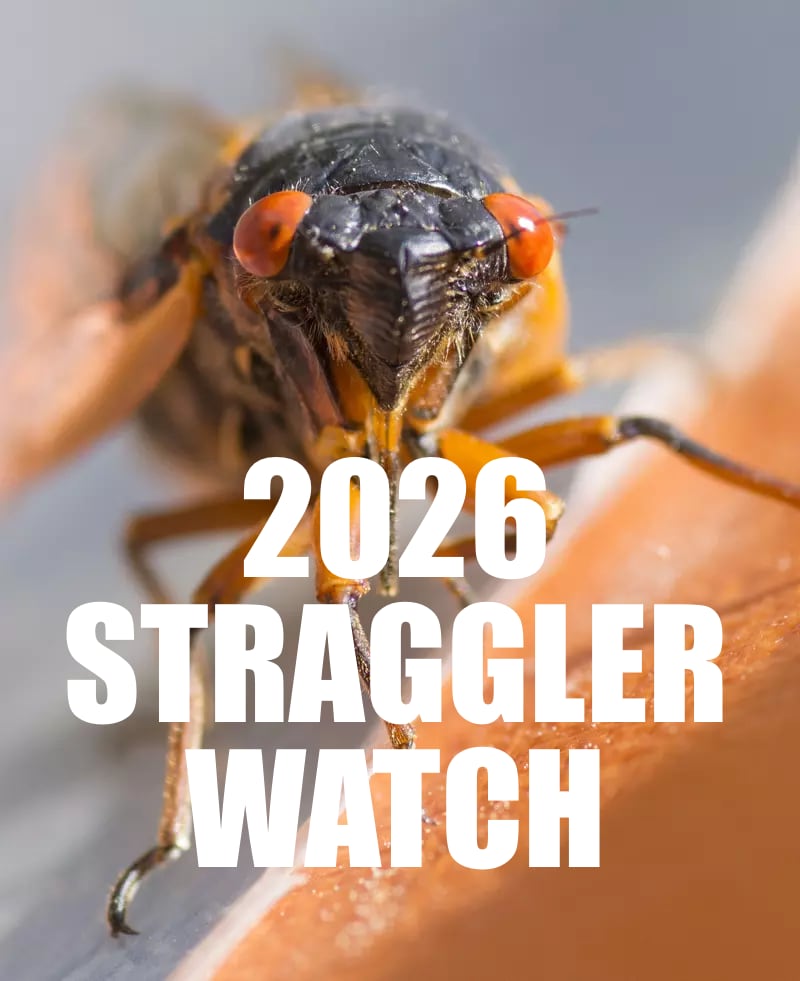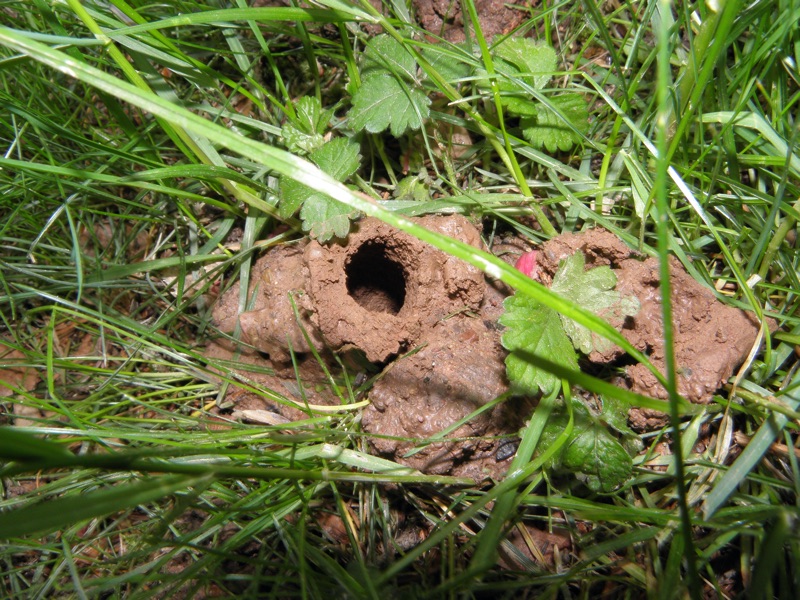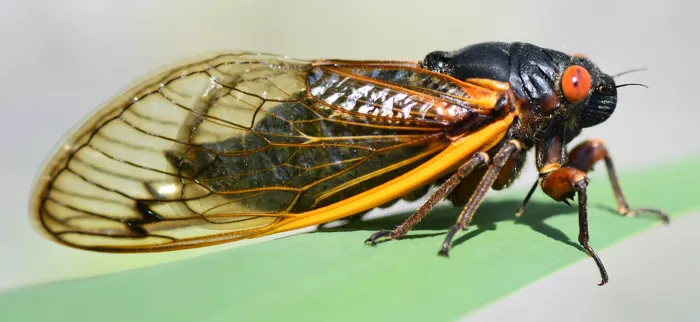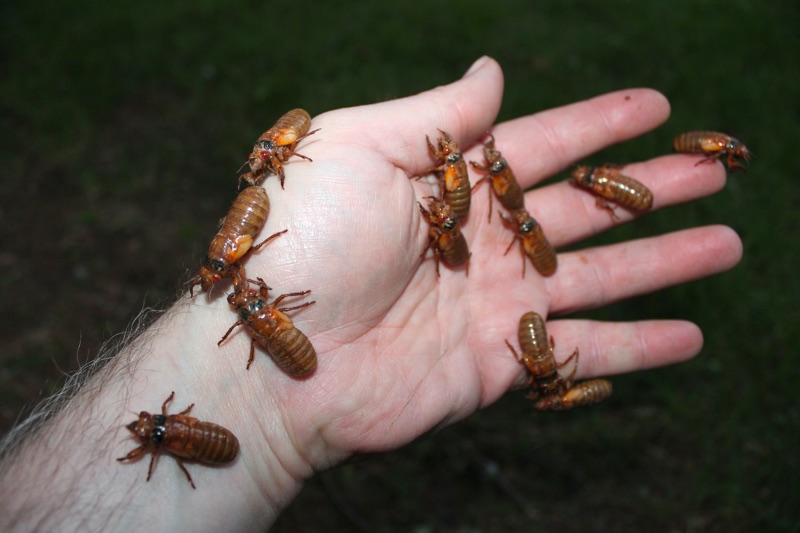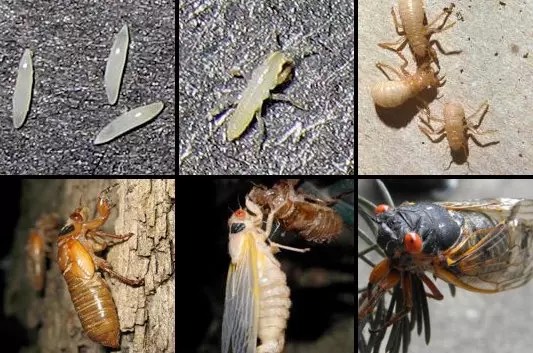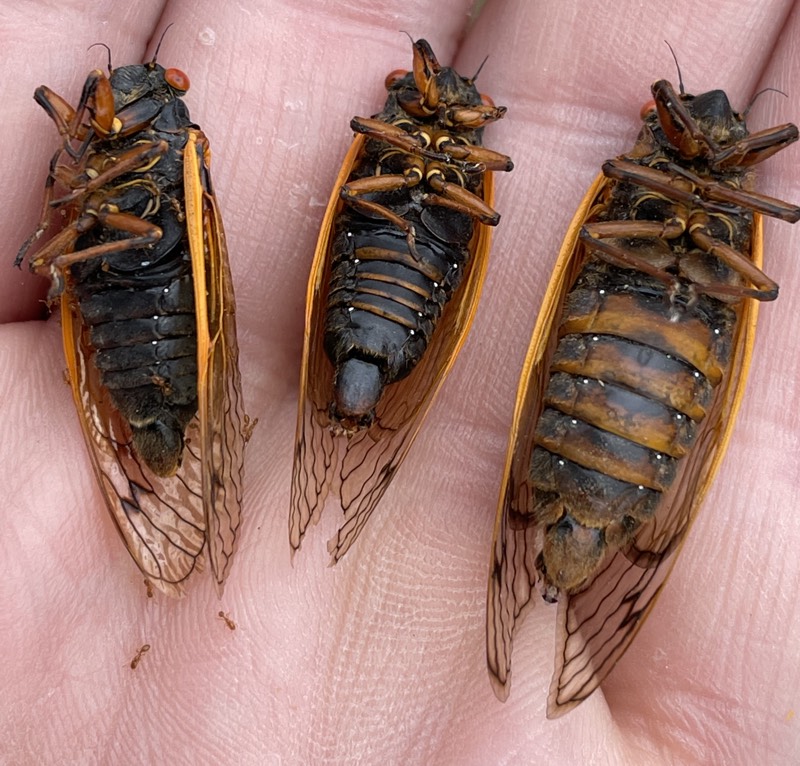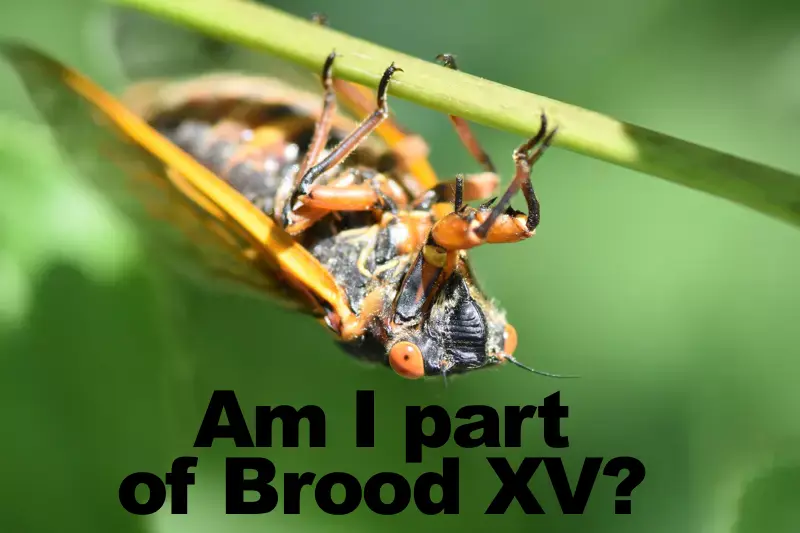
Update (6/10/2026): As much as I would love to say that there is a Brood XV in the Fanwood, New Jersey area, it appears that Magicicada cicadas appearing in 2026 are members of Brood II emerging 4-years early. We did find holes and exuvia (skins) in the Fanwood area (see iNaturalist), but no adult cicadas and no singing. There were no massive numbers of cicadas, singing, mating, and ovipositing. Brood XV is a myth based on Brood II straggling.
Magicicada periodical cicadas are categorized into broods (see brood chart). Each brood has a unique 17 or 13-year interval of time where cicadas hatch, burrow into soil, tunnel underground feeding off roots for 99% of their life, emerge as nymphs, molt, fly, gather, scream, and reproduce.
Brood II has been emerging every 17 years possibly for millennia. The last times it emerged was in 2013, 1996, 1979, 1962… minus 17 years … back as far as we know. The next time Brood II cicadas will emerge is in 2030.
Sometimes broods “straggle” though. A number of Magicicada will emerge four years earlier than expected, deviating and potentially breaking away from the rest of the brood. In theory, if stragglers are abundant enough, they can form what is called a “shadow brood”, as long as their offspring survive and perpetually reproduce. A shadow brood of Brood II, based on 4-year stragglers, would become Brood XV(15), and would emerge in 2026. There’s more information about stragglers and “spurious broods” on the UCONN Cicada site.
This year, 2026, while we’re looking for 4-year Brood II stragglers we will also look for evidence of an established Brood XV. There are credible reports by cicada researchers Chris Simon and Elias Bonaros that Brood XV may exist in New Jersey in Union County, specifically Fanwood, NJ. Conceivably, an instance of Brood XV could form anywhere Brood II exists — if you’re in Brood II territory, expect the unexpected.
We will definitely be looking for Brood XV this spring. Update: UCONN is referring to this possible brood as Brood XV (Shadow).
So, how can we tell that there is a legitimate Brood XV in place rather than ordinary Brood II stragglers? The key will be the abundance of cicadas. A Brood XV population should resemble a typical on-schedule Brood II population: hundreds to thousands of shed skins (exuvia), hundreds to thousands of adults, chorusing and not just individuals singing alone, noticeable mating and egg laying; a Brood XV should last 2-4 weeks. Ordinary Brood II stragglers should arrive in far fewer numbers: dozens per acre not thousands, individual songs but no choruses, little to no mating or egg laying; birds should pick off most of the stragglers so they will not last long. While it is possible to have a pure straggling event that seems full brood emergence event (see Princeton in 2017 for Brood X stragglers), most of the time you’ll find one or two adults per suburban yard.
Here are some related comments from way back in 2009 discussing Brood II stragglers and a possible Brood XV:
Our NJ town (30 miles west of Manhattan) is covered in Magicicadas. Can they be straggers when the entire town is covered in them? Here are some photos I took today: Photo Album
Comment by Charlene — May 22, 2009 [AT] 6:49 pm
Charlene, yes, they’re stragglers even though there are so many. They’re stragglers by virtue of the fact that they’re arriving 4 years early.
Comment by Dan — May 22, 2009 [AT] 7:02 pm
Thanks to Charlene’s post I went to Fanwood. found 7 tenerals and captured one nymph which will eclose here in the comfort of my home. Heard some light M. septendecim choruses. did not see any M. cassini or M. septendecula. Some trees where covered with at least 100 exuvia. Some had none. The question is have we seen the maximum yet or is it just starting? Please keep an eye out for further emergence sites here in the North East.
Comment by Elias — May 25, 2009 [AT] 1:10 pm
Update on my mini colony that is being kept alive in a Butterfly pavilion. One young male started to sing today. The amplitude is very low. Also a female in the cage responded with wing flick signalling. Brought home 8 from New jersey, 6 still alive. Today is Day #4. Next couple of days may need to look in Staten island or back to Fanwood. Anyone have any other reports? I know the weather is terrible. We need some sunshine!!
Comment by Elias — May 28, 2009 [AT] 8:17 pm
Notes:
- It is theorized that all broods are shadow broods of another brood. Brood II <-- Brood VI <-- Brood X <-- Brood XIV. When Magicicada straggle in enormous numbers they can form new broods offset by 4 or 1 years, which is why we have 13-year broods (mostly in the warmer south) and 17-year broods (mostly in the colder, glacier-prone north) with the difference being 4 years. Read: K S Williams, C Simon. 1995. The Ecology, Behavior, and Evolution of Periodical Cicadas. Annual Review Entomology. 40:269-295. https://doi.org/10.1146/annurev.en.40.010195.001413
- Broods are named and numbered using Roman Numerals. C.L. Marlatt devised this naming convention. The letter I = 1, II = 2, III = 3, IV = 4, V = 5, VI = 6, VII = 7, VIII = 8, IX = 9, X = 10, XIII = 13, XIV = 14, XIX = 19, XXII = 22, XXIII = 23. 17-year broods are named I-XVII (1-17) and 13-year broods are named XVIII-XXX (18-30), though many do not exist.
- 17-year broods, twelve exist (I, II, III, IV, V, VI, VII, VIII, IX, X, XIII, XIV), one is extinct (XI) and four missing broods (XII, XV, XVI, XVII) either never existed or went extinct before recorded history.
- Of the thirteen possible 13-year broods, three exist (XIX, XXII, XXIII), one is extinct (XXI) and nine either never existed or went extinct (XVIII, XX, XXIV, XXV, XXVI, XXVII, XXVIII, XXIX, XXX)
- Only a pair of 13-year and 17-year broods can emerge in the same year. XIII and XIX co-emerged in 2024.Two or more 17-year broods cannot emerge in the same year. Two or more 13-year broods cannot emerge in the same year.
- Whenever I write about brood numbering or the fact that 17 and 13 are prime numbers, I feel like Scott Steiner explaining the mathematic possibility of beating him.


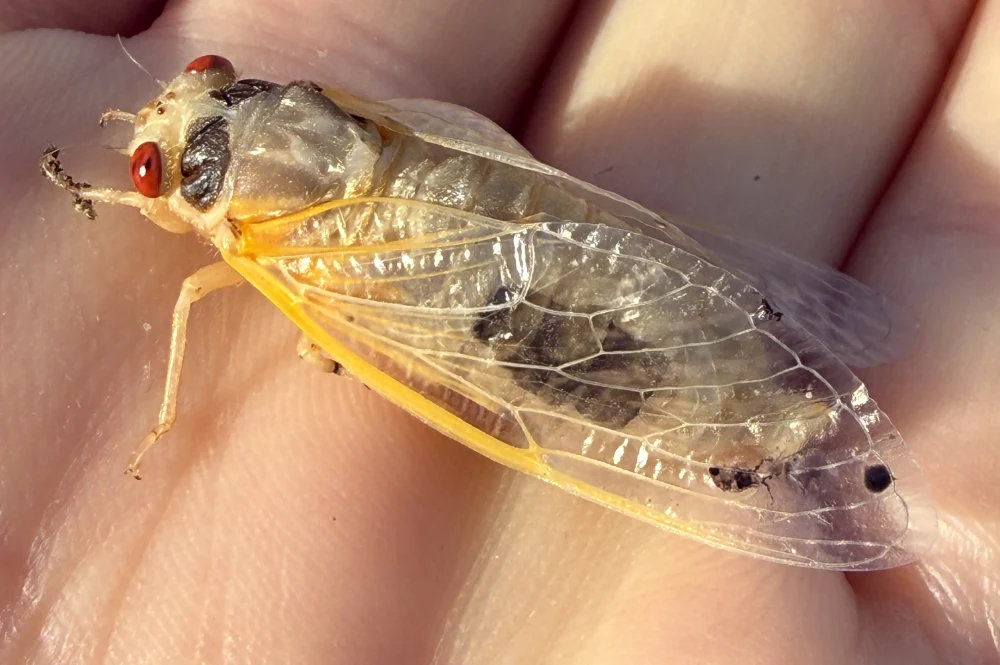
 Photo ©