Google
 
www.cicadamania.com Web

Dedicated to cicadas, the most amazing insects in the world.

June 28, 2008

Notes on the Locusta; Septentrionalis americanae decem septima

Filed under: Magicicada — Dan @ 6:30 pm

I found another old cicada document, this one is called “Notes on the Locusta; Septentrionalis americanae decem septima“. It was published in 1839, and written by Nathaniel Potter. I haven’t read it yet, but it would be interesting to compare it to C.L. Marlatt’s Periodical Cicada bulletin (1898), and documentation written in the 1990s and 2000s.

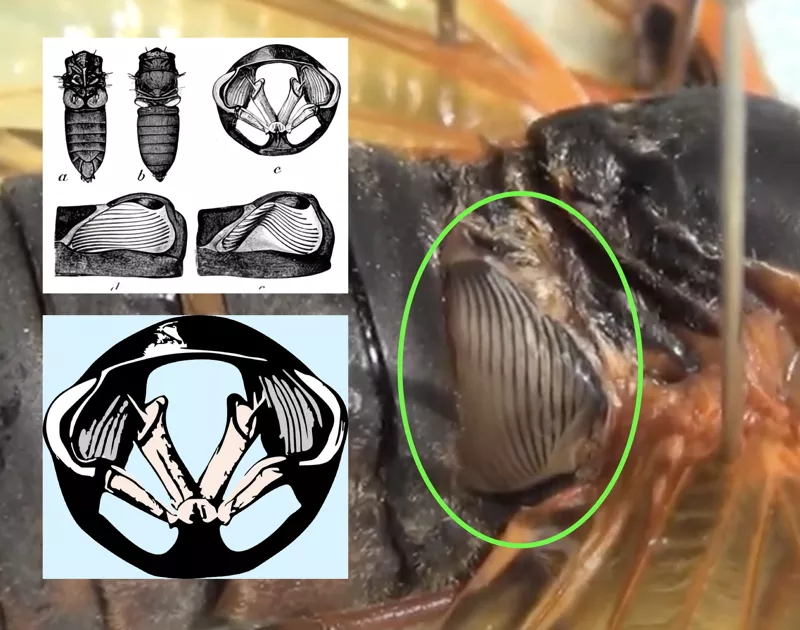
Here’s a nice illustration from Potter’s book:

Notes on the Locusta; Septentrionalis americanae decem septima

Notes on the Locusta; Septentrionalis americanae decem septima

What is the purpose of cicadas?

Filed under: Magicicada — Dan @ 11:35 am

Here’s a question we get a lot: “what is the purpose of cicadas?” It can be a loaded question, but I think people just want a concrete answer to justify the magnitude of the unusual (why only once every 17 years, why so many) or annoying (inconvenience, noise, ornamental tree damage) aspects of the 17 year cicadas. Every living thing has reason for existing, a niche to fill, a role to play, a purpose — let’s consider how cicadas fit it to the big picture.

It helps to consider perspective when considering purpose. I’ll break purpose down into 4 groups, for this: critters, fungi, trees and people. Critters first, because their relationship with cicadas is the easiest to explain.

The cicada’s purpose in terms of critters:

Cicadas provide a link in the food chain between trees and critters, which I’ll define as any animal that will eat a cicada. Critters love cicadas, and a 17 year cicada emergence is the single greatest feast of their lives. It’s like 17 years of Christmas, Thanksgiving and birthday parties rolled into one incredible month.

Trees feed off the sun and nutrients in the soil, cicadas feed off the trees, critters eat cicadas, and alpha predators (wolves, foxes, bears, cats, game fish, people) eat critters. The massive release of food and energy that comes from a cicada emergence results in an explosion of critter populations, which in turn results a boon for alpha predators as well.

The cicada’s purpose in terms of fungi:

I’m not a fungi expert, but I’m pretty sure different species of fungi have a grand time digesting dead cicada bodies once they’ve died and begin to rot (I’m sure the same is true for bacteria, and microscopic critters). Fungi, of course, become another link in the food chain.

There is one fungus, the Massospora cicadina fungus, that really love cicadas. The Massospora cicadina spreads via cicada mating, and destroys the cicadas entire abdomen in a matter of days. If you’re a Massospora cicadina, from your perspective, the cicadas purpose is to provide you with nourishment and a home. Gruesome, but true.

The cicada’s purpose in terms of trees:

Periodical cicadas are parasites of trees, more specifically of deciduous trees (leaves fall off in the fall) native to the region in which the periodical cicadas exist (maples, oaks, ash, etc.). The term parasite has negative connotations, but in the grand scheme of things parasites can benefit their hosts, or other species by keeping their hosts in check.

Cicadas provide trees a service by pruning the weak branches of a tree. Cicadas lay eggs in the branch, weak branches wither and die (”flagging”), and the tree benefits from that by not having to waste energy on a weak or diseased branch.

Cicadas also do the trees a service by dying, and releasing a vast amount of nutrients back into the soil. When the cicadas die, it’s like dumping bags of fertilizer around the roots of the trees. The extra nutrients should result in an spurt in tree growth and seed production the following spring, which would result in and increase in tree populations (and acorns, which critters love to eat).

A small percentage of small, weak trees will die during each emergence, particularly non-native species (like imported ornamentals). This can be frustrating for people concerned with the landscaping on their property, but in terms of trees in general, it’s not as bad as it seems. The fertilizing and pruning cicadas perform will actually benefit the older trees in such a way that will encourage them to produce more seeds the following year. Any loss of trees will be balanced by gains the following years. Also cicadas may do native trees a favor by weakening or killing non-native ornamental trees, which compete for the native tree’s food.

The cicada’s purpose in terms of people:

Cicadas are a food source. Many people around the world eat cicadas, and not just “on a dare”, but as a delicacy or staple food. Cicadas have made more than one appearance on Bizarre Foods with Andrew Zimmern for instance. See Weird Meat’s post: Cicadas in Jinan for an example and description of cooked cicadas. Native American peoples also ate cicadas too — cicadas are a global and historical taste sensation.

Cicadas provide people with a job. Those people include professors and researchers like Gene Kritsky or John Cooley, scientists, and landscapers.

Cicadas provide people, including me, with a hobby. There’s a lot worse things you can do with your time.

Cicadas provide artists and musicians with inspiration. There’s bands (check out my friends on MySpace ) and albums named after cicadas, and many songs inspired by cicadas.

Cicadas defending America? Could be. The Navy is researching cicadas according to the Massachusetts Cicadas site.

Cicadas provide memories. If you think about it, we people don’t have all that many milestone experiences in our lives: we have our first day at school, graduations, we get our first car, weddings, we buy your first house, children are born, loved ones pass away, special vacations, and maybe we experience a flood, fire or other unfortunate but remarkable event. A periodical cicada emergence is remarkable because it not only places a memorable milestone in the time line of our lives, it places a series of them; a series of milestones, 17 years apart, and not only within our lives, but linking our historical time lines to the time lines of your children, and grandchildren. Gene Kritsky calls cicadas the insects of history, and I think you can understand why.

May 24, 2008

Cicada video to inspire you

Filed under: Brood X, Brood XIII, Magicicada — Dan @ 7:58 pm

So far I’ve only found one 17 year cicada video on YouTube, so I want to inspire everyone to video your cicadas and post them on Youtube or Revver or wherever. There’s even more videos on this page. Roy’s videos a professional quality, so make sure you watch those.

Brood X in Princeton NJ. This video is particularly cool because you can hear the cicada song loud and clear.

A rare white eyed 17 year cicada:

Here’s my best of 2007: video 1, video 2, video 3.

May 7, 2008

The Brood XIV emergence has begun

Filed under: Brood XIV, Magicicada — Dan @ 9:10 am

Folks, we just got word from Gene Kritsky that an adult was reported emerging in Maderia, Ohio today. The emergence has begun; expect large numbers of cicadas to start appearing within the next 10 days in most areas. Get your cameras, camcorders, audio recording devices and fishing rods ready.

From Gene:

I had my first report of an adult periodical cicada emerging in Madeira, a suburb of Cincinnati today. So the early ones are starting.

Read the news story.

May 3, 2008

Matt Berger’s Cicada Experiment Continues

Filed under: Brood XIV, Magicicada, Matt Berger — Dan @ 8:11 am

Earlier I wrote about Matt Berger’s experiment to coerce a nymph to emerge as an adult in captivity. The experiment worked.

Here’s the latest pictures. The cicada has assumed its final, black-colored adult form:

Photobucket

Photobucket

May 2, 2008

C.L. Marlatt’s Periodical Cicada bulletin online

Filed under: Magicicada — Dan @ 4:35 am

The USDA National Agriculture Library has published the full 148 page bulletin from 1898 titled The periodical cicada: an account of Cicada septendecim, its natural enemies and the means of preventing its injury : together with a summary of the distribution of the different broods.

The document is viewable as images or in PDF form, and features an abundance of information, and excellent, now public domain illustrations (like those below).

Illustration from Marlatt

Illustration from Marlatt

April 30, 2008

The first adult Magicicada

Filed under: Brood XIV, Magicicada, Matt Berger — Dan @ 9:28 pm

Matt Berger was able to coerce a cicada nymph to enter the adult phase (instar) by raising it indoors (where it is warmer). Congratulations to Matt!

I took a Brood XIV nymph i found under a rock about a week ago, put some soil in a pot, poked a cicada sized hole in the soil and let the cicada burrow in. I wanted to see if I could make them emerge early. I put it in my house where it is warm. It worked! I now have a male (im guessing M. cassini) that just emerged from that hole and shed his skin and is now drying. Probably the first Magicicada to emerge all year! Earliest emergence I have ever heard of (even if it was assisted). Thought it might be interesting for Cicadamania.
Here are some pictures!

Here’s the nymph:

Photobucket

Here’s the adult leaving the nymph skin:

Photobucket

Here’s the teneral adult, still white in color (I will turn black soon enough):

Photobucket

April 27, 2008

Cicada Links and Video to hold you over… part two

Filed under: Brood XIV, Cicadas Misc., Magicicada — Dan @ 8:07 am

Gene Kritsky awaiting their noisy return:

UPI: Scientist awaits cicadas’ noisy return

Gene Kritsky, a professor of biology at the College of Mount St. Joseph, said this year most of the bugs are expected to appear in the area east of Interstate 71.

The Enquirer Cicadas making noisy return

Gene Kritsky, a professor of biology at the College of Mount St. Joseph, says in a news release that cicadas are coming to eastern Cincinnati this May.

Video:

5 WLWT: Cicadas Return. Video features a meteorologist presenting general information about the emergence.

NECN.com: Cicada pheomenon interview with entomologist Doug Fraser. Very good.

A Kentucky article:

News Channel 5: Cicadas ready to reappear in Kentucky after 17 years

Gene Kritsky, a cicada expert at the College of Mount St. Joseph in Cincinnati, says their appearance will be spotty. That could be caused by a number of factors, including development that has dramatically changed landscapes since the early 1990s.

A Cape Cod artlce:

Cape Cod Times: Creeped out by creepy-crawly season on Cape

Periodical cicadas went underground on the Cape 17 years ago, and have been living off tree sap ever since. Experts expect them to emerge from their holes all at once, probably on a night in early May. They can number in the millions per acre, and cling to any vertical surface after coming from their holes, to molt, then fly up into the tree tops to mate.

April 24, 2008

Is the soil 65 degrees yet?

Filed under: Brood XIV, Magicicada — Dan @ 8:07 pm

Hey folks, The Mount’s Cicada Web Site is monitoring the ground temperature in the Cincinnati area. Today it was up to 59.8ºF. Why is that important you ask? Well, once the soil temperature hits 65ºF the cicadas will emerge. Just 5ºF to go, and yes, cicadas will emerge from sunny areas before shaded areas because the soil will be warmer. (thanks Gene)

BTW, the Cincinnati press is finally catching on that another emergence is about to happen (I think they’re a bit jaded from Brood X). Here’s a video news clip from 5 in Cincy (thanks Roy).

April 23, 2008

Cicada Links and Video to hold you over…

Filed under: Brood XIV, Magicicada — Dan @ 5:51 pm

Here’s a video news cast from YouTube called Cicadas invade CapeCast. I assume “Cape” refers to Cape Cod. Good information in video form.

Charleston Daily Mail: After 17 years, cicadas set to reappear for a few noisy weeks:

Cicadas will start appearing in southern West Virginia - including much of Kanawha County - starting in May. They have black bodies about an inch and a half long, red beady eyes and a shrill song.

Cape Cod Times: Cicadas stage return after 17 years :

“They’re a phenomenon,” said Miller, the golf course superintendent at The Golf Club at Southport in Mashpee. His job is all about controlling bugs, but Miller sees no harm done by the cicadas who feed on watery tree sugars.

Penn.com: Scientists abuzz about cicadas:

“The amazing thing is that there have not been very good records kept on Brood XIV in Pennsylvania,” said Marten Edwards, an entomologist at Allentown’s Muhlenberg College.

Edwards is among a team of insect experts planning to use Global Positioning Systems to document this year’s emergence. National Geographic is supporting the work through a grant to the University of Connecticut, university biology professor John Cooley said.

Evansville Courier & PressCicada season Red-eyed insects scheduled to appear in late April:

It may be extra noisy around trees located across Kentucky this year due to Brood XIV of the Periodical Cicada. All of Kentucky, except for the Purchase Areas, should expect some activity form the periodical cicada this year.

Towers: Seasonal cicadas to infiltrate Southern Seminary in May :

Once every 17 years a species of periodical cicada pop out of the ground in numbers too big to be ignored, often at densities of 10,000 to 100,000 per acre.

Home and Garden with John Marra: The Cicada: Nature’s Pruning Machine. Includes video!!!

First of all, how would you like for someone to come to your landscape and prune your trees free of charge? That’s not a chance happening but something that will happen whether or not you agree.

The free pruning service will be in the form of insects. Yep, I said insects, more specifically the 17 Year Periodical Cicada or Locust as some people call them.

Kentucky.com: Cicadas begin cyclic racket:

We’ve had drought and floods, and now, a plague of locusts.

OK, the billions of noisy, red-eyed teenagers emerging soon from the ground beneath your feet aren’t really locusts, although they often are mistakenly called that.

Periodical Cicadas is a classic cicada website that explains most of the information you need to know all in one page, with lots of great photos. It’s one of my favorites.

and

Regardless of the fact that there are not periodical cicadas emerging in the Chicago area this year, the Chicago Cicadas blog is still tracking them.

Next Page »

Back to the Homepage for more totally awesome cicada news