Categories
Brood II Magicicada Periodical Periodical Stragglers

In search of Brood XV (15)

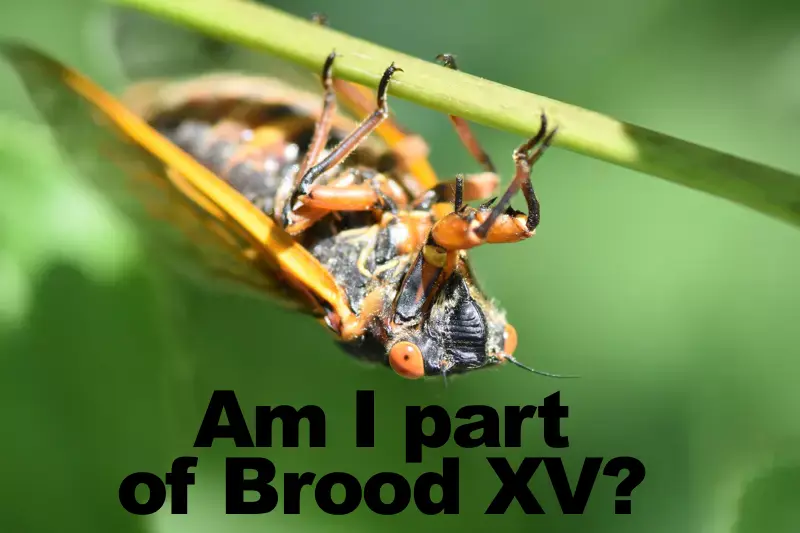
Am I part of Brood XV?

Magicicada periodical cicadas are categorized into broods (see brood chart). Each brood has a unique 17 or 13-year interval of time where cicadas hatch, burrow into soil, tunnel underground feeding off roots for 99% of their life, emerge as nymphs, molt, fly, gather, scream, and reproduce.

Brood II has been emerging every 17 years possibly for millennia. The last times it emerged was in 2013, 1996, 1979, 1962… minus 17 years … back as far as we know. The next time Brood II cicadas will emerge is in 2030.

Sometimes broods “straggle” though. A number of Magicicada will emerge four years earlier than expected, deviating and potentially breaking away from the rest of the brood. In theory, if stragglers are abundant enough, they can form what is called a “shadow brood”, as long as their offspring survive and perpetually reproduce. A shadow brood of Brood II, based on 4-year stragglers, would become Brood XV(15), and would emerge in 2026. There’s more information about stragglers and “spurious broods” on the UCONN Cicada site.

This year, 2026, while we’re looking for 4-year Brood II stragglers we will also look for evidence of an established Brood XV. There are credible reports by cicada researchers Chris Simon and Elias Bonaros that Brood XV may exist in New Jersey in Union County, specifically Fanwood, NJ. Conceivably, an instance of Brood XV could form anywhere Brood II exists — if you’re in Brood II territory, expect the unexpected.

We will definitely be looking for Brood XV this spring. Update: UCONN is referring to this possible brood as Brood XV (Shadow).

So, how can we tell that there is a legitimate Brood XV in place rather than ordinary Brood II stragglers? The key will be the abundance of cicadas. A Brood XV population should resemble a typical on-schedule Brood II population: hundreds to thousands of shed skins (exuvia), hundreds to thousands of adults, chorusing and not just individuals singing alone, noticeable mating and egg laying; a Brood XV should last 2-4 weeks. Ordinary Brood II stragglers should arrive in far fewer numbers: dozens per acre not thousands, individual songs but no choruses, little to no mating or egg laying; birds should pick off most of the stragglers so they will not last long. While it is possible to have a pure straggling event that seems full brood emergence event (see Princeton in 2017 for Brood X stragglers), most of the time you’ll find one or two adults per suburban yard.

Here are some related comments from way back in 2009 discussing Brood II stragglers and a possible Brood XV:

Our NJ town (30 miles west of Manhattan) is covered in Magicicadas. Can they be straggers when the entire town is covered in them? Here are some photos I took today: Photo Album

Comment by Charlene — May 22, 2009 [AT] 6:49 pm

Charlene, yes, they’re stragglers even though there are so many. They’re stragglers by virtue of the fact that they’re arriving 4 years early.

Comment by Dan — May 22, 2009 [AT] 7:02 pm

Thanks to Charlene’s post I went to Fanwood. found 7 tenerals and captured one nymph which will eclose here in the comfort of my home. Heard some light M. septendecim choruses. did not see any M. cassini or M. septendecula. Some trees where covered with at least 100 exuvia. Some had none. The question is have we seen the maximum yet or is it just starting? Please keep an eye out for further emergence sites here in the North East.

Comment by Elias — May 25, 2009 [AT] 1:10 pm

Update on my mini colony that is being kept alive in a Butterfly pavilion. One young male started to sing today. The amplitude is very low. Also a female in the cage responded with wing flick signalling. Brought home 8 from New jersey, 6 still alive. Today is Day #4. Next couple of days may need to look in Staten island or back to Fanwood. Anyone have any other reports? I know the weather is terrible. We need some sunshine!!

Comment by Elias — May 28, 2009 [AT] 8:17 pm

Notes:

  • It is theorized that all broods are shadow broods of another brood. Brood II <-- Brood VI <-- Brood X <-- Brood XIV. When Magicicada straggle in enormous numbers they can form new broods offset by 4 or 1 years, which is why we have 13-year broods (mostly in the warmer south) and 17-year broods (mostly in the colder, glacier-prone north) with the difference being 4 years. Read: K S Williams, C Simon. 1995. The Ecology, Behavior, and Evolution of Periodical Cicadas. Annual Review Entomology. 40:269-295. https://doi.org/10.1146/annurev.en.40.010195.001413
  • Broods are named and numbered using Roman Numerals. C.L. Marlatt devised this naming convention. The letter I = 1, II = 2, III = 3, IV = 4, V = 5, VI = 6, VII = 7, VIII = 8, IX = 9, X = 10, XIII = 13, XIV = 14, XIX = 19, XXII = 22, XXIII = 23. 17-year broods are named I-XVII (1-17) and 13-year broods are named XVIII-XXX (18-30), though many do not exist.
  • 17-year broods, twelve exist (I, II, III, IV, V, VI, VII, VIII, IX, X, XIII, XIV), one is extinct (XI) and four missing broods (XII, XV, XVI, XVII) either never existed or went extinct before recorded history.
  • Of the thirteen possible 13-year broods, three exist (XIX, XXII, XXIII), one is extinct (XXI) and nine either never existed or went extinct (XVIII, XX, XXIV, XXV, XXVI, XXVII, XXVIII, XXIX, XXX)
  • Only a pair of 13-year and 17-year broods can emerge in the same year. XIII and XIX co-emerged in 2024.Two or more 17-year broods cannot emerge in the same year. Two or more 13-year broods cannot emerge in the same year.
  • Whenever I write about brood numbering or the fact that 17 and 13 are prime numbers, I feel like Scott Steiner explaining the mathematic possibility of beating him.
Categories
Fiji Periodical Raiateana Stamps Tacuini (Cryptotympanini)

The Nanai Cicadas of Fiji are back after 8-years! Fiji is issuing stamps to celebrate

The Nanai cicadas (Raiateana knowlesi (Distant, 1907)) of Fiji are back after 8-years, and Fiji is issuing stamps to celebrate their emergence.

Update! If you want to see what the Nanai look like, visit the Cicada Discussion, Science and Study Group on Facebook and view Elias Bonaro’s 9/22 post.

Nanai cicadas are special because they have an 8-year periodical cycle. They are found in the hills of Viti Levu island of the Fiji archipelago. They are also special because of the Legend of The Nanai and their importance to Fijian culture.

2025 Nanai Stamps

2025 Nanai stamps will be available from Post Fiji Pte Limited. They start shipping on the 25th of September (new date). See this BROCHURE – THE NANAI EMERGENCE for more information.

FDC - The Nanai Emergence

Nanai brochure cover

Nanai Cicadas Stamps from 2009

Here’s an image of Nanai stamps from 2009 (or maybe 2010):

Nanai stamps

More information about the Nanai

How do the Nanai (Raiateana knowlesi) compare to other cicadas around the world

The Nanai are similar to Magicicada cicadas in the United States in that they have precise periodic lifecycles. Nanai have 8-year cycles and Magicicada have 13 or 17-year cycles.

The Nanai are similar to North American Dog-Day cicadas, European Lyristes plebejus, and the Tacua speciosa of Malaysia & Indonesia, in that they belong to the same Tribe (Tacuini) and share similar anatomy like hidden tympani (the noise makers).

Categories
Magicicada Periodical

The cicada emergence is over. Now what?

“Will you miss me when I’m gone?”
end of the line

As I write this, the Brood XIX emergence is all but over, and Brood XIII has about two weeks left to go.

So what’s next? Well, I’ll tell you.

Upload your photos to iNaturalist and the Cicada Safari app

You can help cicada researchers by uploading your photos to iNaturalist or the Cicada Safari app.

iNaturalist is excellent for all animals — plus plants and fungi — not just cicadas. You will find yourself using it all year long. Cicada Safari is specifically for cicadas.

Learn about Annual species of cicadas

There are more to cicadas that just Periodical cicadas.

Cicadas exist on every continent except for Antarctica, and in every State in the U.S. except for Hawaii and Alaska!

Learn about the most-common cicadas that live in the same areas as periodical cicadas, and then learn about the variety of cicadas found around the world.

Preserve your cicada specimens

Saving cicada skins (molts/shells) and wings is easy. Just keep them dry.

Preserving Periodical cicadas can be challenging because their eye colors fade and because they’re fatty and smell.

If you want to preserve eye colors, keeping them in alcohol seems to work best.

Some people dip them in acetone to mitigate the smell from decaying fat, but I’ve never tried it.

Otherwise, keep them dry and in a cedar box. I use silica gel packs to keep them dry. Cedar repels small insects that will eat your cicada collection. Moth balls work as well to keep tiny insects away from your collection.

If you want to pin your cicadas, so the wings are spread out, you have to do it while the cicadas are still moist. Plenty of places have supplies, like Carolina Biological Supply. I’ve softened hard cicadas by placing them in Tupperware/Rubbermaid containers with moist paper towels and a moth ball to prevent mold.

Make a scrapbook of your cicada memories

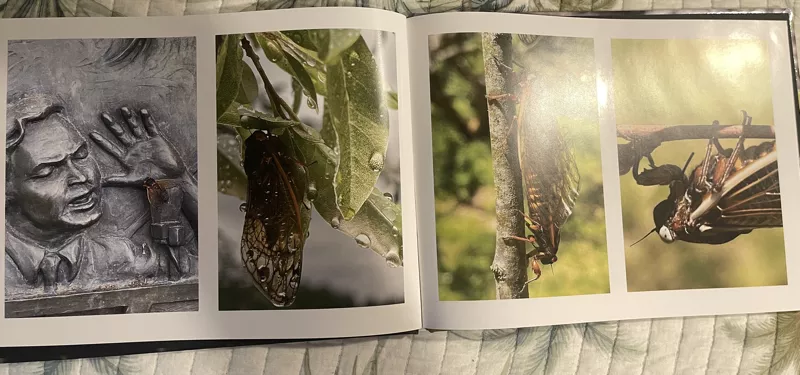
Make a scrapbook or photo album of your cicada memories.

This is something I do every year, though I tend to mix it up with non-cicada photos as well.

photo album

Categories
Brood XIV Magicicada Periodical

Brood XIV (14) Cicadas will emerge in 2025 in twelve states

It’s a Wrap! Periodical cicada Brood XIV (14) emerged in the spring of 2025 in Georgia, Kentucky, Indiana, Massachusetts, North Carolina, New Jersey, New York, Ohio, Pennsylvania, Tennessee, Virginia, West Virginia.

New Jersey was a bust (no observances), experts decided to remove Maryland from the brood range, the first reported adult happened in Leicester, NC on 4/22, and Tennessee had the most observances.

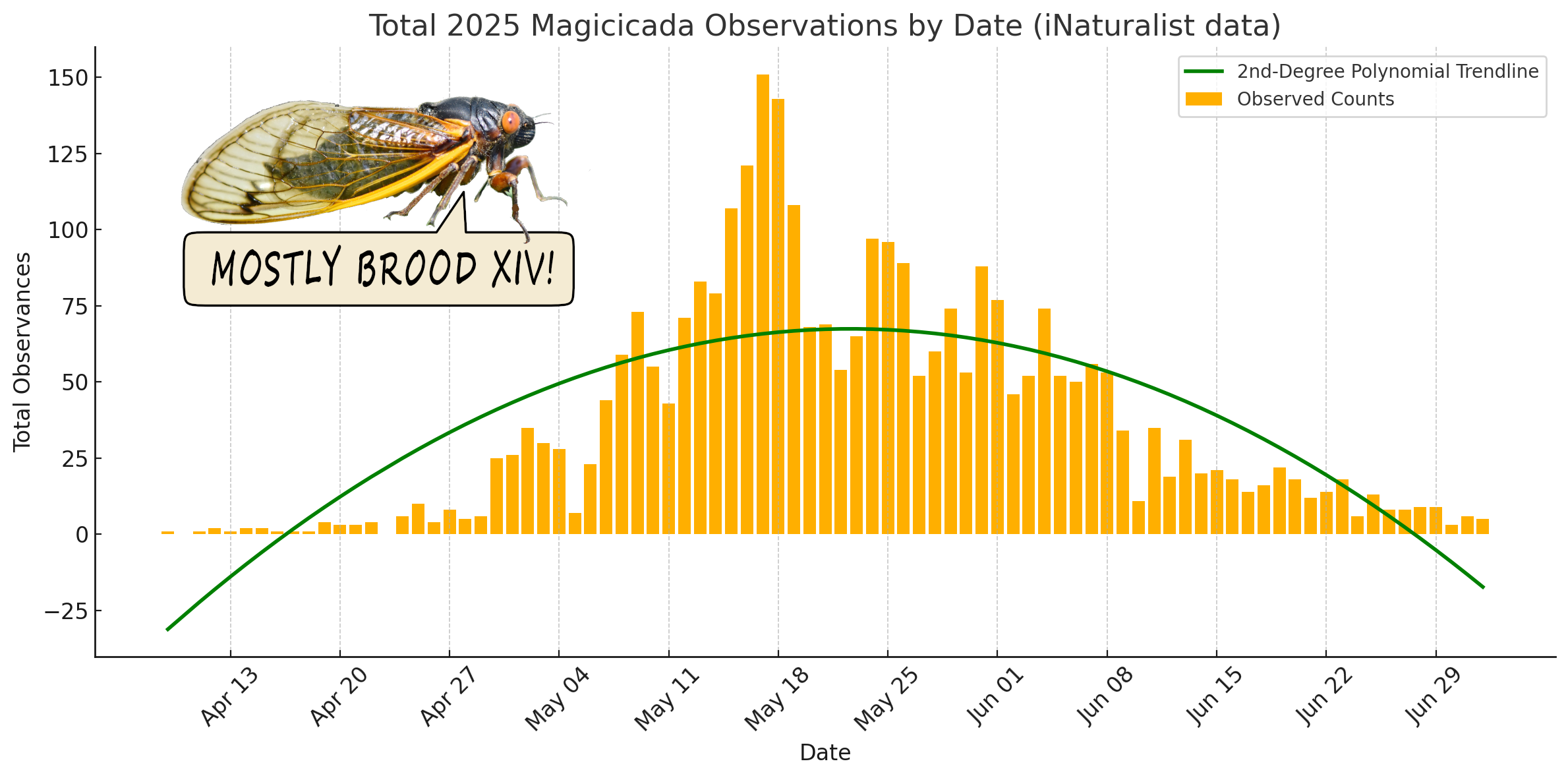
Here’s what the emergence looked like over time, across the U.S. (includes a sprinkling of straggler data):
2025 Magicicada iNaturalist

What:

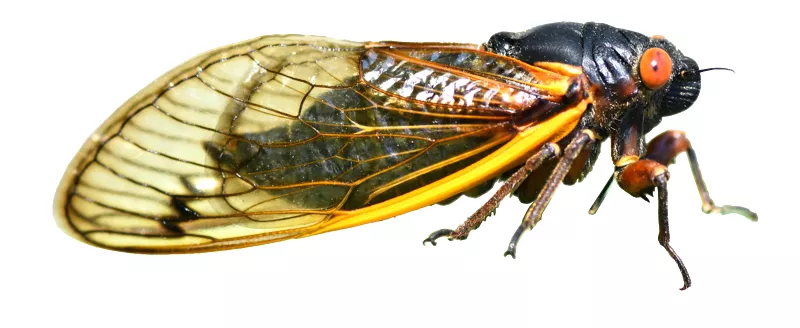
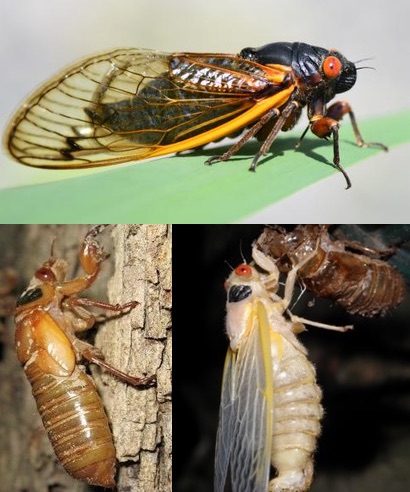
Millions of these Magicicada cicada insects:

Adult, Nymph Molting
Top: Adult. Bottom left: Nymph. Bottom right: Molted cicada.

When:

Usually beginning in May and ending in late June. These cicadas emerge approximately when the soil 8″ beneath the ground reaches approximately 64 degrees Fahrenheit. Above ground temperatures in the 70’s-80’s help warm the soil to that point. A warm rain will often trigger an emergence.

Other tips: these cicadas will emerge after the trees have grown leaves, and, according to my own observation, around the same time Iris flowers bloom.

Where*:

Georgia: iNaturalist Live Map (22 Observations). Counties: Fannin, Lumpkin, Rabun, Union. Cicadas have been reported using the Cicada Safari app in the Lake Burton area. Update: the emergence is underway.

Georgia’s populations are difficult to access. I have heard that Magicicada septendecula dominate. Update: just nymphs reported so far, but I bet adults have emerged.

Indiana: iNaturalist Live Map (105 Observations). We’re talking the southern part of Indiana, by the Ohio River. Counties: Crawford, Harrison, Perry. The first reported adult cicadas were found in Corydon on 5/16. Update: the emergence is underway.

Kentucky: iNaturalist Live Map (1,413 Observations). We’re talking most of Kentucky east of U.S. Route 41, with major hot-spots along the Ohio river. Counties: Anderson, Barren, Bath, Bell, Bourbon, Boyd, Bracken, Campbell, Carter, Clinton, Edmonson, Fayette, Franklin, Floyd, Gallatin, Grant, Hardin, Harrison, Henderson, LaRue, Laurel, Leslie, Logan, Madison, McCreary, Montgomery, Nelson, Nicholas, Pendleton, Pike, Pulaski, Rowan, Scott, Shelby, Whitley. Cities: Adairville, Bowling Green, Corbin, Flemingsburg, Frankfort, Greensburg, Hazard, Jeffersontown (J-Town), Louisville, Radcliff, Richmond, Valley Station. The first reported adult cicada was found in Whitley City, KY on 5/2. Update: the emergence is underway.

Massachusetts: iNaturalist Live Map (1,235 Observations). Counties: Barnstable, Plymouth. Locations: (western half of) Cape Cod. The first reported adult cicadas were found in Sandwich on 5/17. Update: the emergence is underway.

New Jersey: iNaturalist Live Map (0 Observations). We’re talking southern New Jersey, where the Jersey Devil lives (he might have ate them all up). Counties: Atlantic, Camden, Ocean. Cities: Linwood, Manchester Township, Winslow Township. Update: nothing yet, just a Brood X straggler in Princeton.

New Jersey’s population may have gone extinct. 🙁

New York: iNaturalist Live Map (129 Observations). We’re talking Long Island. Counties: Nassau, Suffolk. New York cities: East Setauket and Dix Hills (thanks Elias Bonaros). The first reported adult cicadas were found in Coram and Setauket on 5/15. Update: the emergence is underway.

Here’s a Facebook group for Long Island Cicadas.

North Carolina: iNaturalist Live Map (1,351 Observations). We’re talking western North Carolina, particularly areas heavily impacted by Hurricane Helene. It will be interesting to see if the cicadas were impacted as well, as flooding may have washed away their underground tunnels and habitat. Counties: Buncombe, Burke, Caldwell, Catawba, Henderson, McDowell, Mitchell, Wilkes. North Carolina cities: Asheville, Haw Creek, East Asheville, Moravian Falls, north-west of Nashville, Wilkesboro. The first reported adult cicada was found in Leicester, NC on 4/22. Update: the emergence is underway.

Ohio: iNaturalist Live Map (1,402 Observations). We’re talking south-western Ohio, with the hottest spots just east of Cincinnati. This is the homeland of cicada-experts Gene Kritsky and Roy Troutman, and world-famous botanist Matt Berger. Counties: Adams, Brown, Butler, Clermont, Clinton, Gallia, Hamilton, Highland, Ross, Warren. Cities: Batavia, Blue Ash, Cincinnati area, Indian Hill, Loveland, Maderia, Mariemont, Milford, Miami Twp. The first reported adult cicadas were found in Rio Grande and Bainbridge on 5/8. Update: the emergence is underway.

Roy Troutman let us know that some cicadas where still emerging up until July 1st. Heaving flooding earlier in the year may have delayed their emergence, due to reluctance to emerge from the safety of their water-proof cells.

Pennsylvania: iNaturalist Live Map (647 Observations). We’re talking central Pennsylvania, and random locations toward the east.Adams, Berks, Blair, Cambria, Centre, Clearfield, Clinton, Cumberland, Huntingdon, Lackawanna, Luzerne, Lycoming, Mifflin, Montour, Northumberland, Snyder, Union. Pennsylvania cities: Bear Gap, Elverson. The first reported adult cicada was found in Morgantown on 5/8.

Tennessee: iNaturalist Live Map (1,640 Observations). We’re talking north of Nashville, north-west of Chattanooga and in random places in the eastern half of the state. Counties: Bledsoe, Blount, Campbell, Carter, Cheatham, Claiborne, Cocke, Coffee, Cumberland, Davidson, Grainger, Grundy, Hancock, Hawkins, Jefferson, Marion, Putnam, Roane, Robertson, Rutherford, Sevier, Sumner, Unicoi, Williamson. Cities: Cades Cove, Goodlettsville, Hampton, Muddy Pond. The first reported adult cicada was found in Nashville on 4/25. Update: the emergence is underway.

Virginia: iNaturalist Live Map (205 Observations). We’re talking western Virginia, and mostly the part tucked under Kentucky. Counties: Botetourt, Lee, Russell, Scott, Smyth, Tazewell, Wise. The first reported adult cicada was found in near Campbell on 4/25. Update: the emergence is underway. Brood X stragglers are emerging near D.C.

West Virginia: iNaturalist Live Map (139 Observations). We’re talking the area west of Interstate 77 (I-77), bordered by Kentucky and Ohio. Counties: Cabell, Kanawha, Mason, Mingo, Putnam, Wyoming. West Virginia cities: Huntington. The first reported adult cicada was found in in Panther State Forest on 5/4. Update: the emergence is underway.

*City data comes from May 2008 and June 2008 blog comments. County locations are historical and may no-longer be accurate.

Experts (Gaye Williams, State Entomologist of Maryland, John Cooley of UCONN) have confirmed that there will be no Brood XIV cicadas for Maryland. That said, there will be some stragglers from Brood X. You can look for reports of stragglers using this iNaturalist map.

More Maps and Location Tips!

  1. Cicadas @ UCONN has the most up to date maps. Zoom in and look for the images of cicadas.
  2. Try Dr. Gene Kritsky’s new book: The Pilgrims’ Promise: The 2025 Emergence of the Periodical Cicada Brood XIV
  3. Not sure about your town? Ask someone in your community who lived there 17 years ago.
  4. Join the Magicicada 2025 Brood XIV project on iNaturalist.com.
  5. Download the Cicada Safari App and find and report cicadas.
  6. View the latest posts from the Cicada Safari App on a map!

* Although county locations may no longer be accurate, I like to keep them on the page in case someone discovers a small, secret or unknown population of these cicadas. People might be disappointed, but we want to know for sure that the cicadas are (or are not) thriving in historical locations. This is the cicada researcher’s dilemma: either focus on the guaranteed/sure shot locations for the general public to enjoy, or include the obscure, relic locations so we do not miss out on rare cicada sightings. Cicadas @ UCONN talks about the relationship between the different broods — Brood XIV and Brood X are closely related geographically and genetically. You might find a Brood X straggler emerging 4 years late, and mistake it for Brood XIV. If a large number (large enough to sustain future emergences) of Brood X makes the 4-year “JUMP” to be in synch with Brood XIV, they technically become Brood XIV (and the reverse is true).

Got Massospora?

Have you seen any cicadas with Massospora infections. Professor Matt Kasson of WVU wants your Massospora-infected Magicicada cassini and septendecula cicadas (but not septendecim). Email mtkasson@mail.wvu.edu if you have one to share!
Professor Matt Kasson wants your Massospora-infected Magicicada cassini and septendecula cicadas (but not septendecim). Email mtkasson@mail.wvu.edu if you have one to share.

2025 Map… so far (5/27)

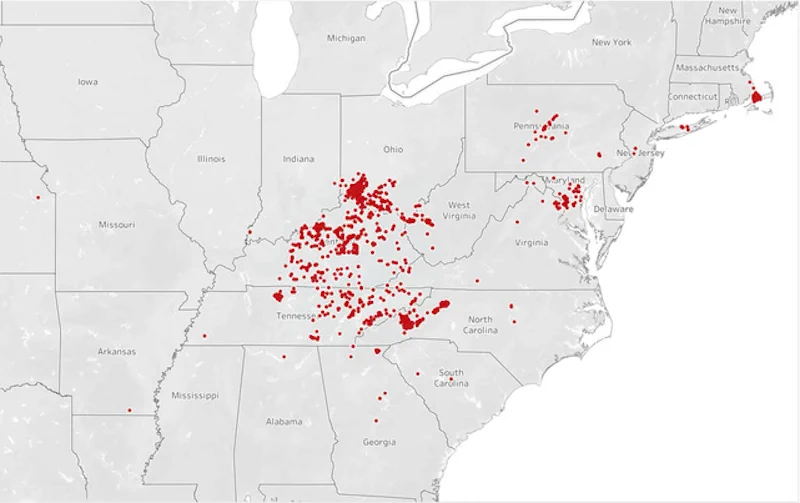
Dr. Gene Kritsky of the creator of the Cicada Safari app sent us this map of 2025 Magicicada emergences to date. It contains both Brood XIV and stragglers from other broods.

1907 Map

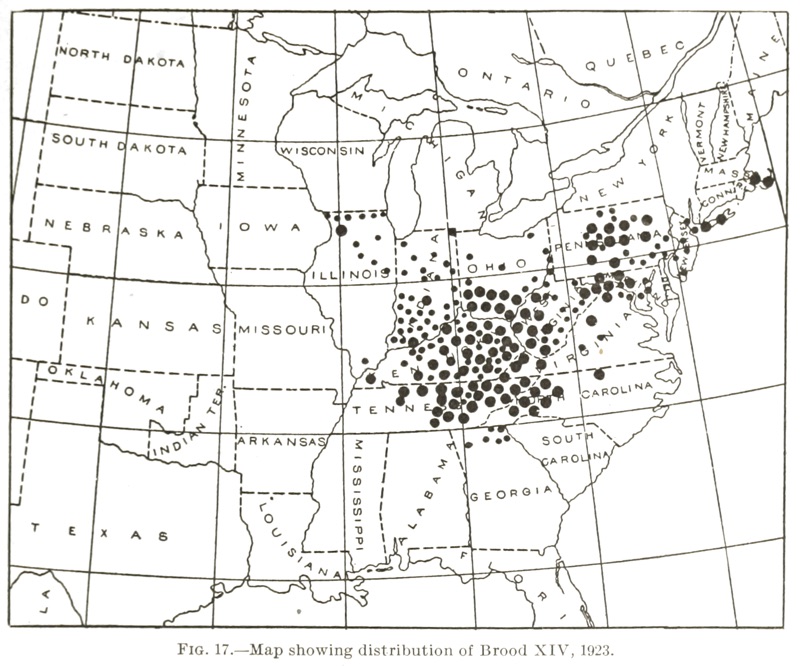
This map comes from the 1907 publication Marlatt, C.L. 1907. The periodical cicada. Washington, D.C.: U.S. Dept. of Agriculture, Bureau of Entomology.

Marlatt 1907 14 Brood XIV

Here is a map of all Broods from the Cicadas @ UCONN site

Zoom in and click the pins to see which Brood it represents. Brood XIV is green. (May not work on older devices.)

More facts and fun:

YouTube Playlist of Brood XIV Cicadas from 2008

Categories
Audio, Sounds, Songs Magicicada Periodical

Can periodical cicadas cause hearing damage?

People ask, “Can periodical cicada singing damage hearing”? It all depends on how long you expose yourself to their song, and how close your ears are to the insect. Invest in some quality ear plugs if you are concerned. Consult a medical professional, of course.

Periodical cicada choruses are often in the 80–85db range, which the CDC says “You may feel very annoyed” and “Damage to hearing possible after 2 hours of exposure”:

80-85

If you spend a long time outside during a chorus, your ears will probably ring for hours after. That is my personal experience.

Placed directly on a microphone, I have observed periodical cicadas get as loud as 111.4db. According to the CDC, that is close enough to cause hearing damage in less than 2 minutes. Do not place male cicadas on your ear! Do not put your head right next to the tree branches where they’re singing.

111.4db

111.4db

Check out this video of Magicicada sound levels measured by an EXTECH 407730 Sound Level Meter:

How to avoid hearing them?

  1. Stay indoors
  2. Buy earplugs or headphones that block external sound
  3. Avoid their peak singing times, between 10 am and 5 pm. Before 10 am and after 5 pm are also the best times to do yard work to avoid them.

I’ve exposed myself to hundreds of hours of cicada songs. I’ve also gone to hundreds of concerts and listened to a lot of rowdy music over the years. My hearing is not great, but it is probably not due to cicadas.

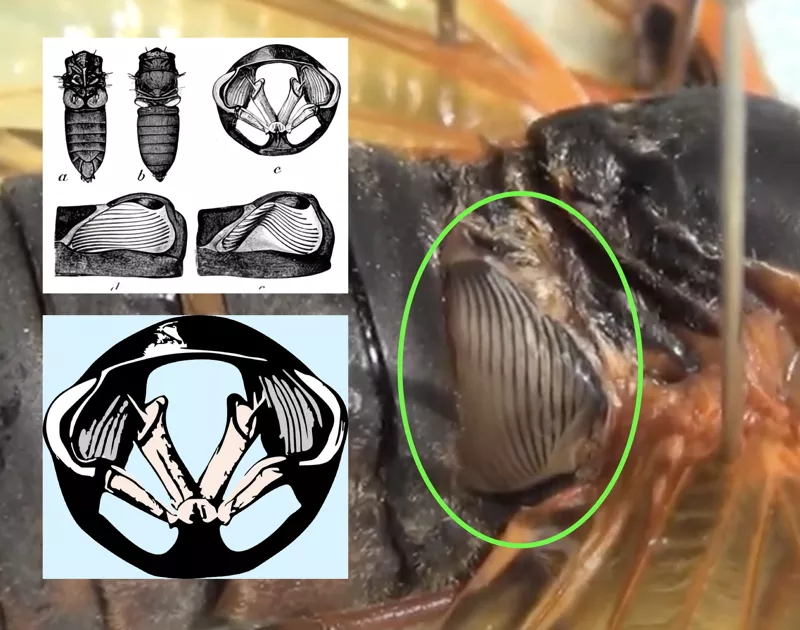
It is worth mentioning that only male cicadas sing. Females make noise by flicking their wings, but they are not as loud as the males. Males have organs called tymbals that vibrate creating their signature sound.

Here are illustrations and a photo of a Magicicada’s tymbals. They have one on each side of their body:
tymbals

So what is the loudest cicada? According to the University of Florida Insect Book of World Records, “The African cicada, Brevisana brevis (Homoptera: Cicadidae) produces a calling song with a mean sound pressure level of 106.7 decibels at a distance of 50cm.” The loudest cicada in the United States, using the same methodology, is Diceroprocta apache (Davis) at 106.2db at 50cm.

I need to take measurements of Magicicada from 50cm to make a comparison. The measurements I’ve taken are in the midst of a large chorus with cicadas about a meter to 20 meters away, which falls in the 80-85db range; or directly on the mic, which gets into the 109-111db range. Your results may vary.

Categories
Magicicada Nymphs Periodical

How to tell if a Magicicada periodical cicada nymph is ready to molt

How can you tell if a Magicicada periodical cicada nymph is ready to molt?

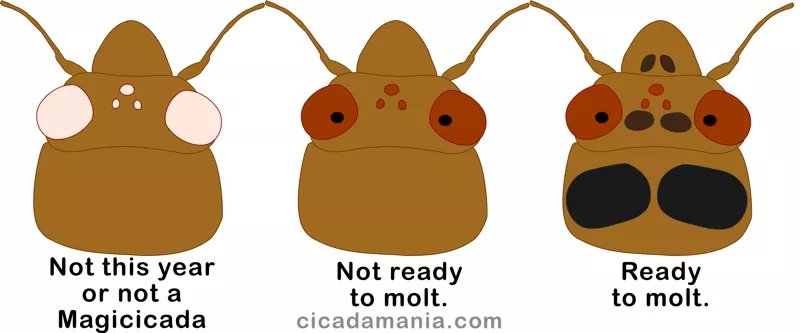
Answer: look for two black spots on its back (technically the cephalothorax). They look like they are wearing aviator sunglasses pushed up on their forehead!

A diagram that shows when a nymph is ready to molt.

I do not know the official name for these spots, but they seem to be related to the pigment that turns the cicadas black after they molt. They may scare away predators that think the spots are big eyes!

Here are a few ideas for a name for them:
obscuras maculas
mutatione macularum

Categories
Brood XIII Brood XIX Magicicada Periodical

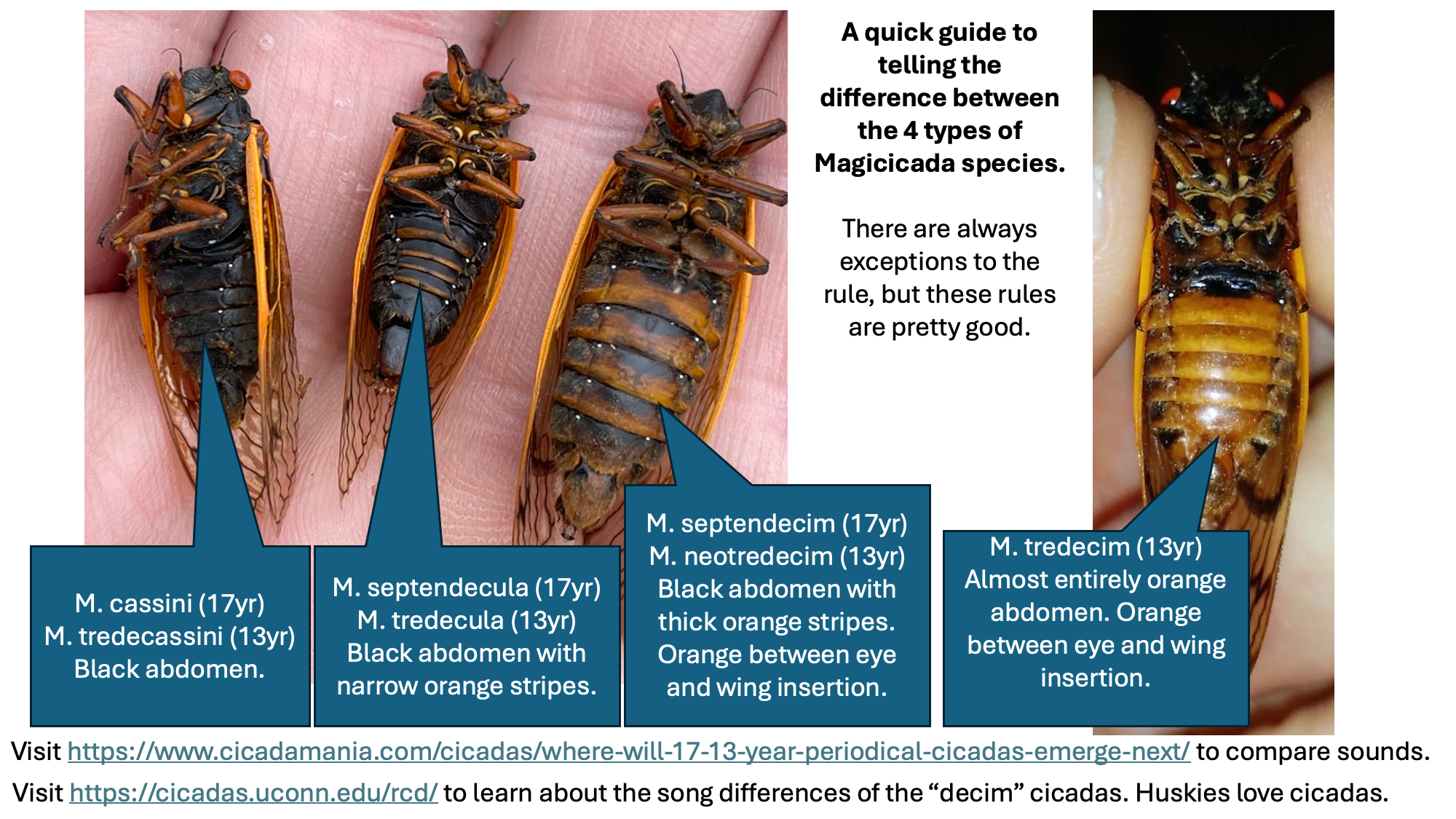
A quick way to tell the difference between the 7 periodical cicadas species

Here is a quick way to tell the difference between the 7 periodical cicada species:

Download this chart. Click/tap for a larger version:

The songs of Magicicada cassini (17-year) and Magicicada tredecassini (13-year) are essentially identical:

M. cassini:

M. tredecassini:

The songs of Magicicada septendecula (17-year) and Magicicada tredecula (13-year) are essentially identical:

M. septendecula (©Joe Green):

M. tredecula:

The songs of Magicicada septendecim (17-year), M. neotredecim (13-year), and Magicicada tredecim (13-year) are essentially identical. M. neotredecim varies the sound of its call in the presence of M. tredecim.

M. septendecim:

M. neotredecim (© Insect Singers)

M. tredecim (© Insect Singers)

And/or watch this video:

Then read this and listen to the sound files on the page: Where will 17 & 13 Year Periodical Cicada Broods emerge next?

Categories
Books Brood XIII Brood XIX Magicicada Periodical

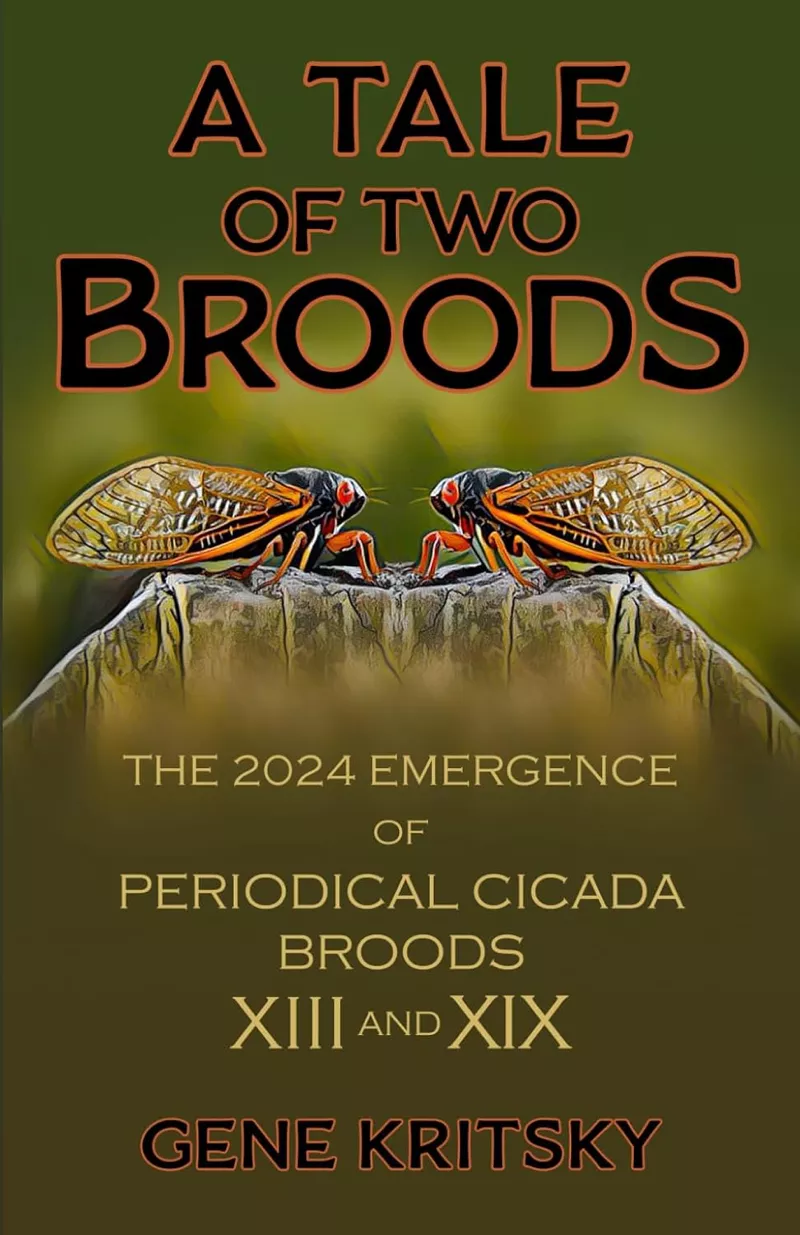
New Brood XIX and XIII Cicada Book by Dr. Gene Kritsky

Cicada researcher and communicator Dr. Gene Kritsky has a new book about Brood XIX and XIII which are both emerging in the spring of 2024: A Tale of Two Broods: The 2024 Emergence of Periodical Cicada Broods XIII and XIX. It is available in paperback and Kindle formats.

A Tale of Two Broods: The 2024 Emergence of Periodical Cicada Broods XIII and XIX

Other posts about Dr. Gene Kritsky on this site:

  1. An Interview with Gene Kritsky
  2. Gene Kritsky’s new cicada site and Brood XIV news
  3. Periodical Cicadas: The Brood X Edition by Gene Kritsky
  4. Gene’s App: Cicada Safari app for tracking Magicicada periodical cicadas
Categories
Books Magicicada Periodical

Cicadapocalypse a graphic novel about periodical cicadas by Roger McMullan

Roger McMullan has a new graphic novel about periodical cicadas called Cicadapocalypse. You can obtain a copy from Roger’s online store.

As I understand it, “the book is intended as an introduction to periodical cicadas for curious kids during a cicada emergence by creating a fictional narrative around the cicadas rather than hitting them over the head with facts”. A cicada emergence through the eyes of some shocked and surprised cartoon squirrels.

It looks fun to me.

cicadapocalypse

Categories
Brood II Edward Johnson Elias Bonaros John Cooley Magicicada Periodical Roy Troutman

Roy Troutman’s 2013 Brood II cicada photos, gallery 3

When Roy Troutman visited New Jersey and New York in 2013 for Brood II he took a lot of great cicada photos.

Here is a sample of the best.
Click the images for a larger version.
Also visit Gallery #1 and Gallery #2.

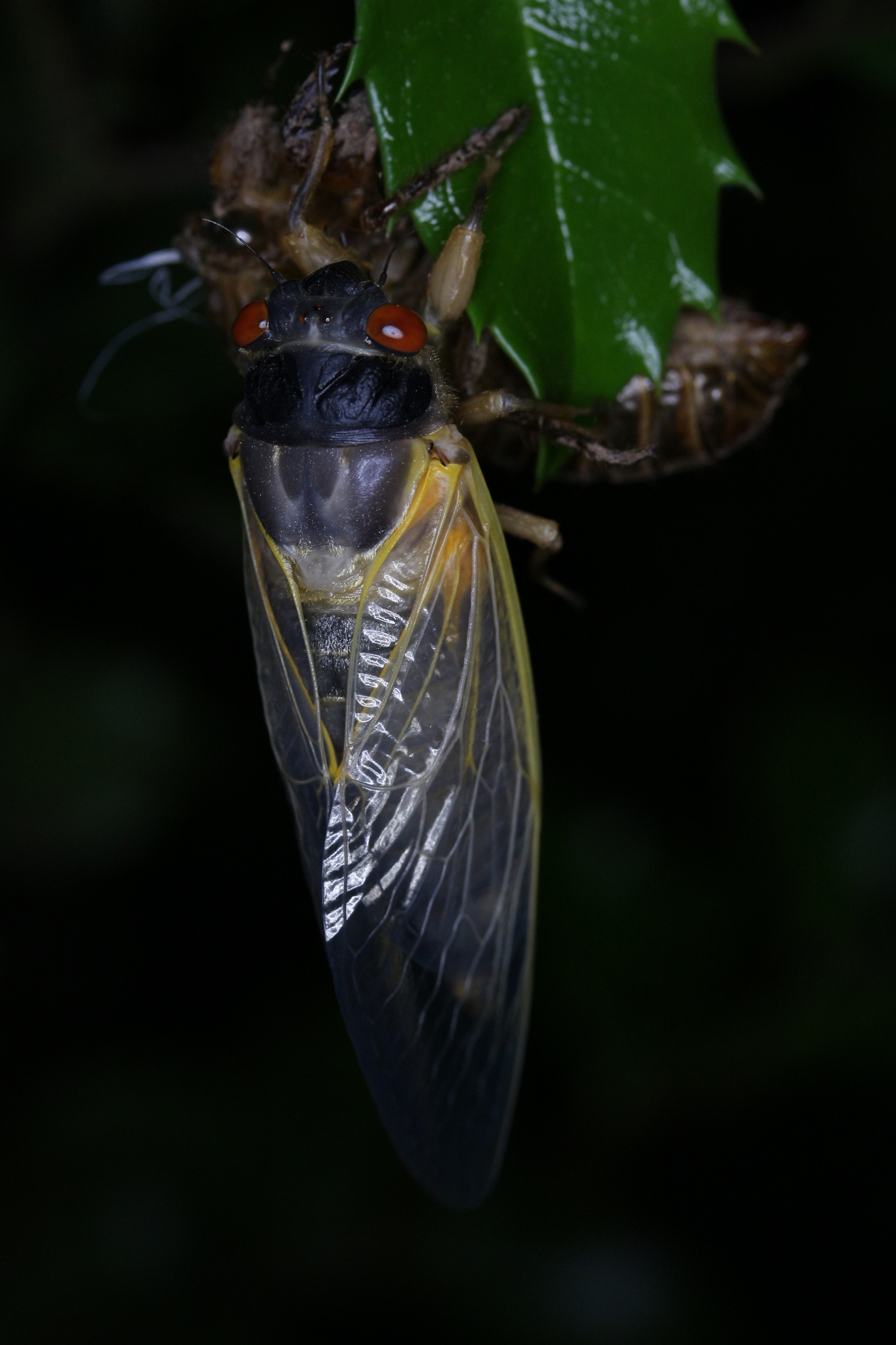
Magicicada molting by Roy Troutman

Magicicada with exuvia by Roy Troutman

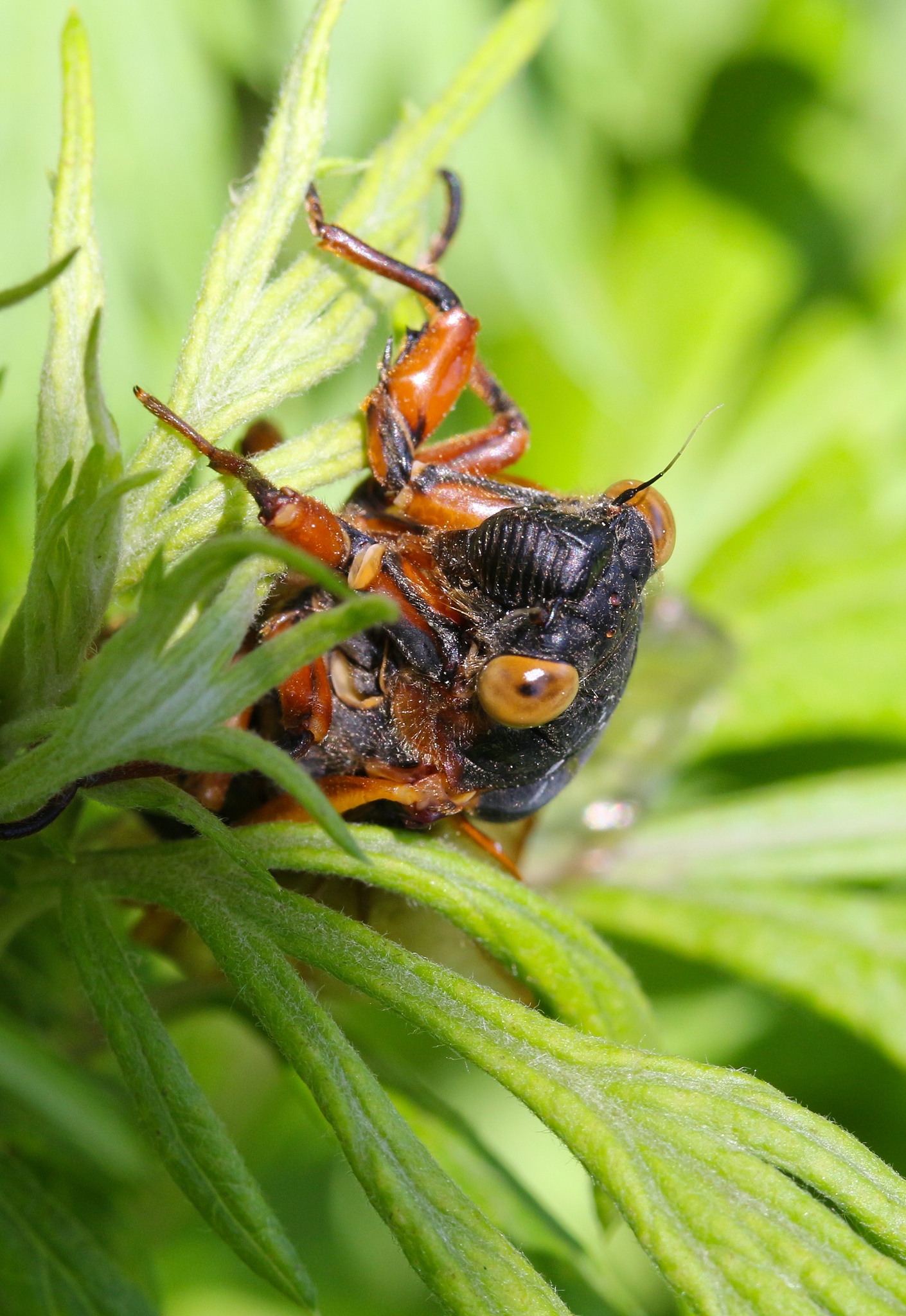
Mustard eyed Magicicada septendecim by Roy Troutman

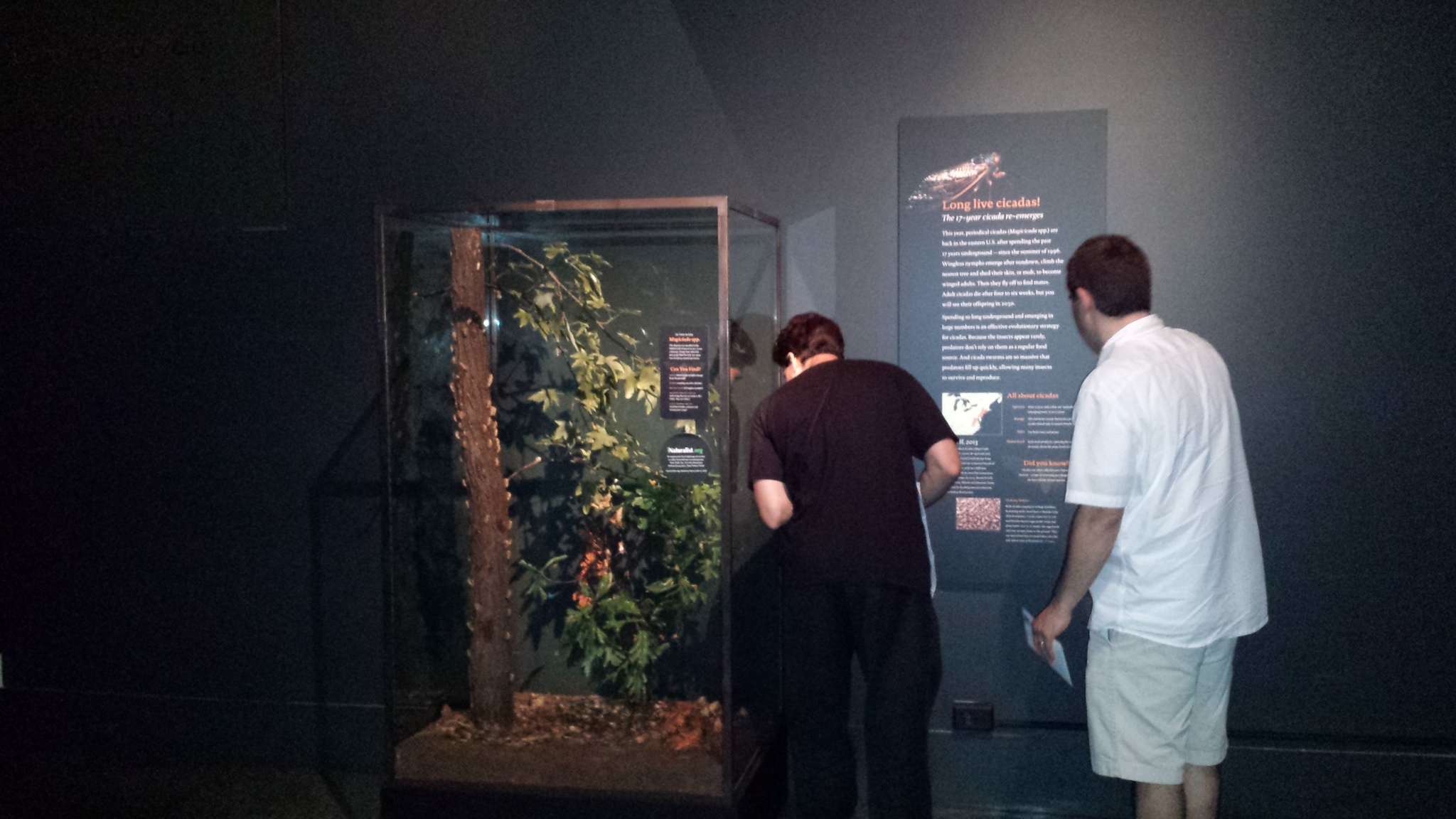
Roy Troutman and Elias Bonaros at the Periodical Cicada display at the American Museum of Natural History, photo by Michelle Troutman
Roy Troutman, John Cooley, Ed Johnson and Dan Mozgai

Roy Troutman, John Cooley, Ed Johnson and Dan Mozgai
Roy Troutman and Elias Bonaros at the Periodical Cicada display at the American Museum of Natural History by Michelle Troutman

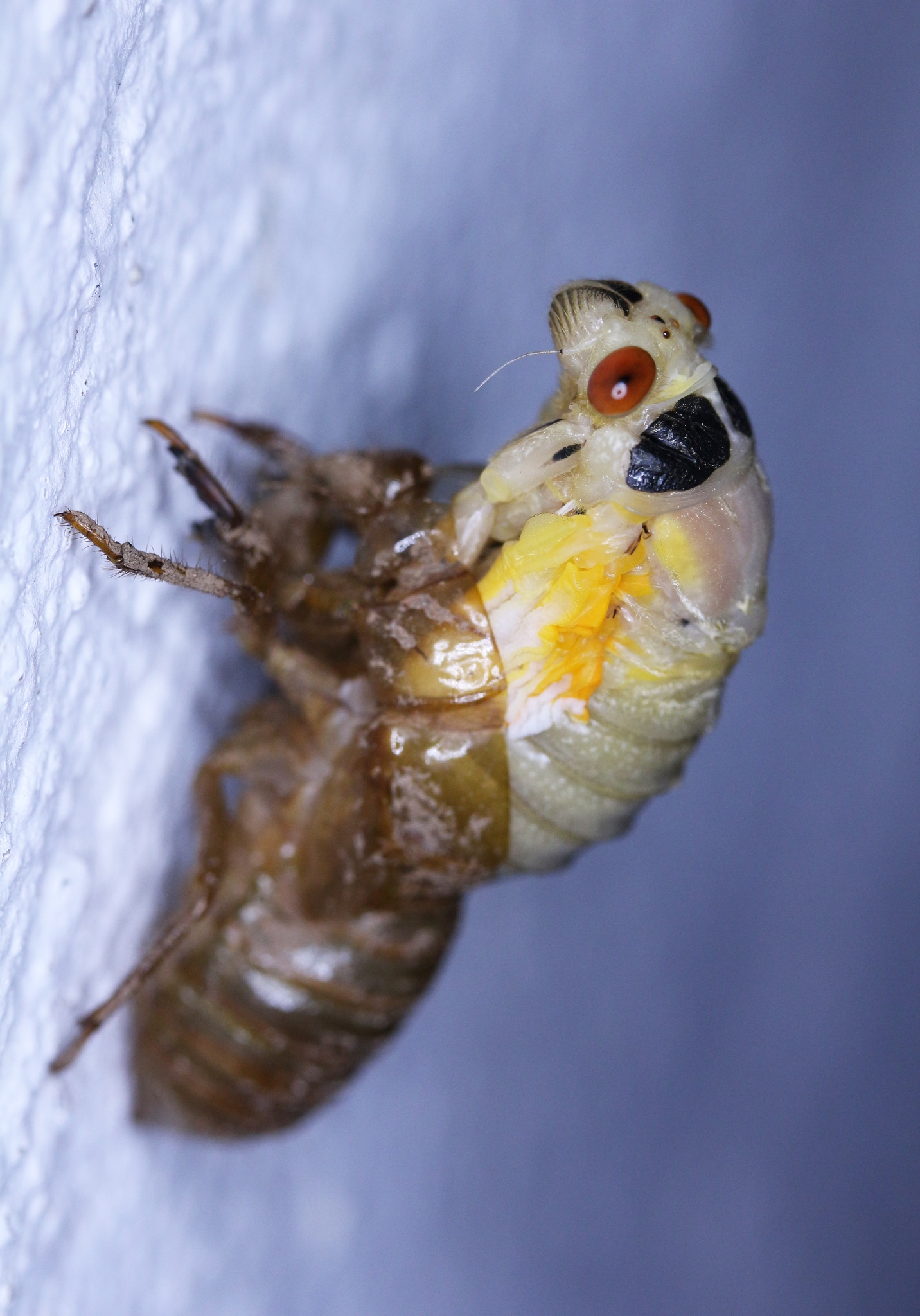
Teneral Magicada by Roy Troutman