Categories
Brood III Magicicada Periodical

Brood III, The Iowan Brood, Will Emerge in 2014

Brood III will next emerge in 2031.

This page was last updated in 2014.

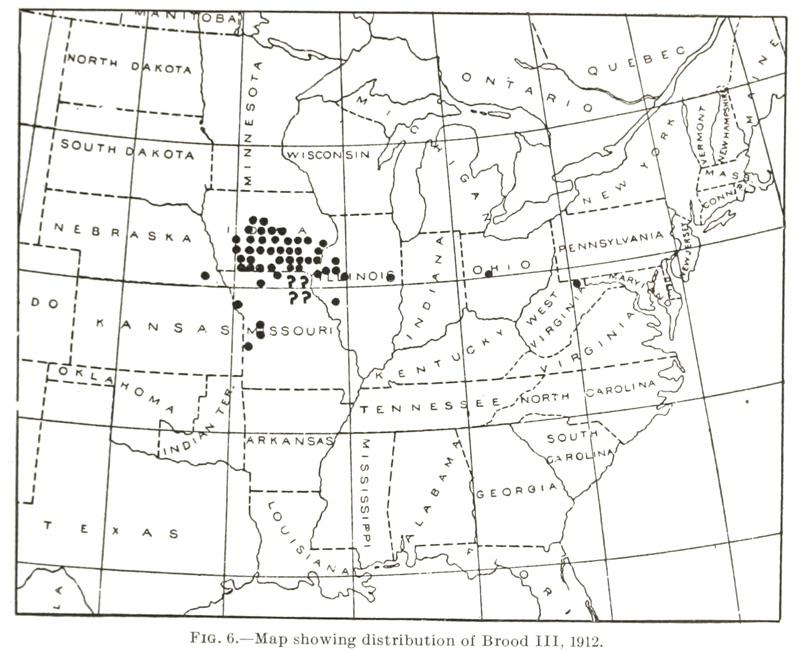
Magicicada Brood III (3), the Iowan Brood, will emerge in Iowa, Illinois, and Missouri, in the spring of 2014.

Update for 6/18: It has been great to see so many people are enjoying the emergence. I bolded the names of the counties below, where people have reported emergences in the comments.

Update for 5/31: Cicadas have been reported in Dallas, Union, and Warren counties in Iowa, and Mercer County in Missouri.

Update for 5/30: Greg Holmes reported on the Entomological-Cicadidae Yahoo Group that Donald Lewis, entomologist at Iowa State University, has a report of periodical cicadas from north of Burlington, IA. With air temperatures in the mid 80s for the next 6 days, the soil should be warm enough to coax more cicadas from the ground. Rain may slow the emergence, though.

Some Brood III facts:

  • Brood III Magicicadas have a 17-year life cycle.
  • The last time Brood III emerged was 1997.
  • All three 17-year species will emerge: M. septendecim, M. cassini, and M. septendecula.

According to the Cicada Central Magicicada Database(RIP):

  • Iowa will likely experience Brood III in Appanoose, Boone, Decatur, Des Moines, Hamilton, Henry, Lee, Louisa, Lucas, Mahaska, Van Buren, Washington counties.
  • There are literature records (typically older, and not substantiated by recent evidence) that the cicadas will also emerge in the counties: Adair, Adams, Audubon, Cass, Cedar, Davis, Greene, Guthrie, Iowa, Jasper, Jefferson, Johnson, Keokuk, Madison, Marion, Marshall, Monroe, Muscatine, Polk, Poweshiek, Ringgold, Story, Taylor, Union, Wapello, Warren, Wayne and Webster.
  • Plus reports from Clarke, Dallas County!
  • Missouri literature records: Adair, Harrison, Harrison, Henry, Johnson, Lewis, Macon, Marion, Platte, Putnam,Vernon
  • Illinois: Adams, Brown, Cass, Fulton, Hancock, Henderson, Knox, McDonough, Peoria, Pike, Schuyler, Warren, and maybe (literature records) Champaign, Greene, and Mason.

1907 Map from Marlatt, C.L.. 1907. The periodical cicada. Washington, D.C. : U.S. Dept. of Agriculture, Bureau of Entomology.

Marlatt 1907 03 Brood III

Categories
Magicicada Periodical Periodical Stragglers

Lookout for Stragglers in 2014

If you follow Cicada Mania, you’ve probably heard about the regularly scheduled emergences in Louisiana and Mississippi (Brood XXII); in Iowa, Missouri and Illinois (Brood III); and the (micro) brood in Ohio and Kentucky, BUT, there could be other Magicicada emerging around the USA.

Magicicada cicadas often straggle from the times they are expected to emerge. This can happen due to overcrowding (too many cicadas underground can delay the development and emergence of some). It could also be a natural thing they do — maybe some accelerate from a 17 year to 13 year life cycle, or back, to form new populations or as a strategy for survival. Most of the time they straggle in 1 year or 4 year intervals. Here is were I would expect to see stragglers.

  • Brood II 1-year (late) stragglers in CT, GA, MD, NC, NJ, NY, OK, PA, VA
  • Brood IV 1-year (early) stragglers in IA, KS, MO, NE, OK, TX
  • Brood XXIII 1-year (early) stragglers in AR, IL, IN, KY, LA, MO, MS, TN
  • Brood VII 4-year (early) stragglers in NY


Check our broods page
for more precise locations and information.

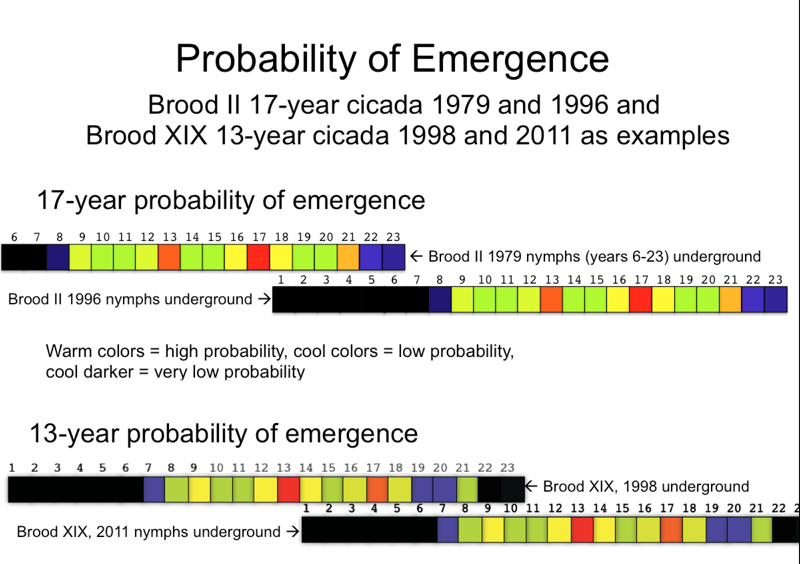
This chart, courtesy of Chris Simon, details the probability for straggling:

Probability of Straggling chart from Chris Simon

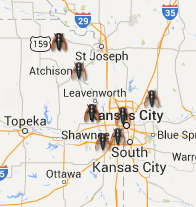
If you see any stragglers, report them to Cicadas @ UCONN (formerly Magicicada.org), so they can be mapped and studied. It looks like some Brood IV stragglers are showing up in the Kansas City area!

Kansas City

Of course, we’re only talking about the black & orange & red-eyed Magicicada here…
Magicicada septendecim

…not other species like Tibicen or Okanagana.

Categories
Brood XXII Gene Kritsky Magicicada Periodical Roy Troutman

13-Year Cicadas to Emerge in Ohio & Kentucky in 2014

Magicicadas with a 13-Year life-cycle are emerging in Ohio & Kentucky, along the Ohio river, in 2014. This particular group of periodical cicadas last emerged in 2001 and 1988.

July 17th: I got confirmation from Dave Marshall and John Cooley that the ‘decim in the brood are Magicicada tredecim!

June 5th: Roy Troutman and I completed 3 days of cicada mapping in Ohio and Kentucky. This map includes our findings, Gene Kritsky’s findings and sightings submitted to Gene from local residents.

June 4th: Audio of a Magicicada tredecula call from the Ohio/Kentucky brood.

June 3rd: I spent the last last two days looking for cicadas in Ohio and Kentucky with Roy Troutman. Mostly ‘cassini, some ‘decula, and a very small amount of ‘decims. We found ‘cassini chorusing in Mason, KY, in the west, and so far as south as Neurls Run, KY. JoAnn White & Monte Lloyd’s paper 17-Year cicadas emerging after 18 years: A new brood?1 mentioned emergences in the Mason location, going back to 1975 (three 13 year generations ago).

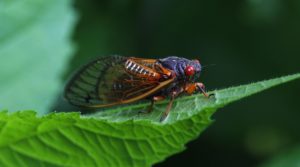
2014 Ohio M tredecassini adult on leaf by Roy Troutman

May 31th: Cicadas are reported to be “loud and plentiful” in the Germantown KY area, as well as, Harrison county KY.

May 30th: Roy Troutman confirmed that ‘decula, ‘cassini and ‘decim type Magicicada have emerged in Ohio.

May 23th: Gene Kritsky wrote to let us know that “the emergence is now in full swing” in Ohio and Kentucky.

May 15th: Roy Troutman sent us a set of photos from Crooked Run Nature Preserve in Chilo, Ohio.

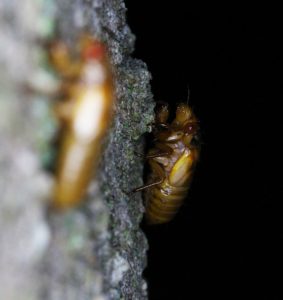
13 Year Nymph on tree by Roy Troutman taken in Chilo Ohio in 2014

May 14th: Roy Troutman has reported that the emergence began last night in Chilo, OH according to a Clermont County Parks director. Cool weather this week (in the thirties!) will likely prevent more cicadas from emerging until next week (highs in 80s).

April 30th: Scientists ask for public’s help verifying cicadas hidden brood. Note: if you send your photos in to Dr. Kritsky, make sure Geo-Tag (Android) or Camera Location Services (iPhone) is turned on.

April 28th: Roy Troutman discovered cicada turrets, confirming the 2014 emergence of these cicadas.

More:

I know what you’re thinking: are these cicadas part of Brood XXII? Time and research will tell. Brood XXII emerges in Louisiana and Mississippi, which are geographically isolated from Ohio & Kentucky, so the two groups of cicadas are likely to be genetically distinct (belonging to different mitochondrial haplotype groups at least). That said, Brood II, which emerges mostly along the east coast of the U.S., also emerges in Oklahoma, which is geographically isolated from the rest of that brood. So, the Ohio/Kentucky cicadas could logically be part of brood XXII.

Back in 2001 Roy Troutman, Les Daniels and Gene Kritsky reported this group of cicadas to Cicada Mania. Les reported both cassini and decim.

My guess is these cicadas are somehow descended from Brood X or Brood XIV 17-year cicadas, and that if they are 13-year cicadas.

I wrote Roy for a list of towns where these cicadas emerged in 2001, and he said:

Chilo, OH
Cold Springs, KY
Higginsport, OH
Neville, OH
New Richmond, OH
Point Pleasant, OH
Ripley, OH
Utopia, OH
Woodland Mound Park, Cinncinati, OH


View OH/KY 13 Year Brood in a larger map

Check out the paper 1 White, J., and M. Lloyd. 1979. 17-Year cicadas emerging after 18 years: A new brood? Evolution 33:1193-1199. It was the first to document this odd brood of cicadas, although it did not mention the 13 year periodicity.

Categories
Anatomy Periodical

Cicada Myths

Cicada Myth Busters

There are many myths (widely held but false beliefs or ideas) about cicadas. Time to bust some cicada myths.

Myth 1: Cicadas are sleeping when they are underground.

There’s a popular meme that [mis]states the following “if cicadas can sleep for 17 years and then wake up only to scream and reproduce so can i”. The actual tweet doesn’t say “reproduce”, but I want to keep it clean.

American periodical cicadas aren’t sleeping the entire 17 years they’re underground. Much of the time they’re digging tunnels and building feeding cells, tapping into roots and feeding, vying with other cicadas for space along a crowded root system, growing (they experience four phases or instars while underground), avoiding unfavorable conditions like flooding, and possibly actively avoiding predators like moles and voles. Yes, cicadas can sleep — or at least the insect version of sleep called torpor — but they are definitely not asleep for 17 years.

That said cicadas do spend their time screaming (the males) and procreating once above ground.

Myth 2: All cicadas have a 17 year life cycle.

This is false. Only three species, out of the thousands of cicada species in the world, have a 17-year life cycle: Magicicada septendecim, Magicicada cassini, and Magicicada septendecula.

Myth 3: All cicadas have periodical life cycles and synchronized emergences.

This is false. Only seven species in the United States (belonging to the genus Magicicada), and a few species in Asia (belonging to the genus Chremistica 1) have been confirmed to have periodical life cycles and synchronized emergences.

All other species of cicadas emerge annually, although in some years they are more plentiful than in others.

Myth 4: All cicadas live a prime number of years.

Many cicadas live a prime number of years, but some do not. Chremistica ribhoi, the World Cup cicada, has four year life cycle.

Myth 5: A long, periodical, prime number life cycle has allowed American periodical cicadas to avoid gaining a predator.

American periodical cicadas have avoided gaining an animal predator that specifically predates them, but they haven’t avoided a fungus. Massospora cicadina is a fungal parasite of Magicicada cicadas.

Male Magicicada septendecim infected with Massospora cicadina fungus

That said, just about any animal will eat an American periodical cicada, so they definitely get eaten. They get eaten a lot.

Myth 6: Cicadas make their well-known sound by stridulation, like crickets, grasshoppers & katydids.

It is true that some cicadas can make noise by stridulation, making sound by rubbing body parts.

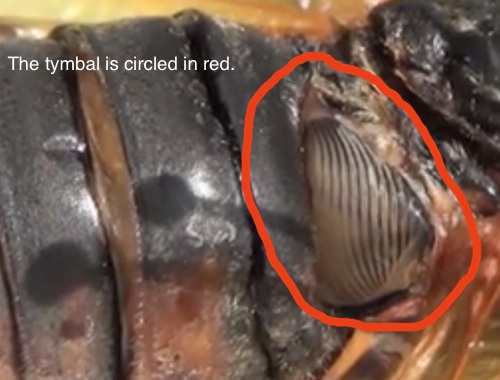
However, and this is a huge “however”, the sound cicadas are known for is made by organs found in male cicadas called tymbals. Tymbals are a pair of ribbed membranes, that produce the cicada’s sound when they are flexed in and out by muscles. The mechanism is like the popping sound made when the plastic of a soda pop bottle is flexed in and out.

Tymbal

Cicadas can also make sound by flicking or clapping their wings.

Myth 7: Cicadas eat vegetation.

This is false. Cicadas lack the mouthparts to chew and swallow vegetable matter. Your tomatoes are safe around cicadas. Rather than eating solid food, cicadas ingest xylem, which is a type of tree sap that cicadas drink through their straw-like mouthparts.

Myth 8: American periodical cicadas are locusts.

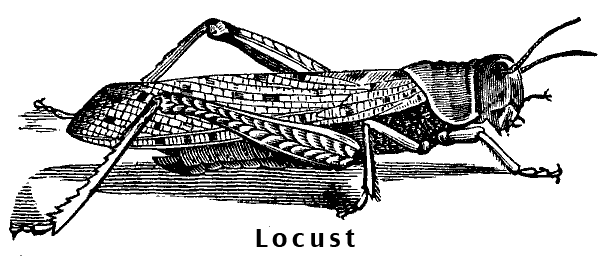
Cicadas are not locusts. Locusts are a form of grasshopper. People confuse cicadas with locusts because both insects aggregate in massive numbers.

This is an image of a locust:
Locust

Characteristic Locust Cicada
Order Orthoptera Hemiptera
Hind Legs Giant hind legs for jumping Hind legs about the same size as other legs; great for climbing and perching.
What they eat Everything green they can find to eat Xylem sap
They’re in your town All the plants in your town have been stripped bare Cool UFO movie soundtrack sounds during the day

Myth 9: If you see a W appear in a cicada’s wings it means there will be a war. If you see a P, there will be peace.

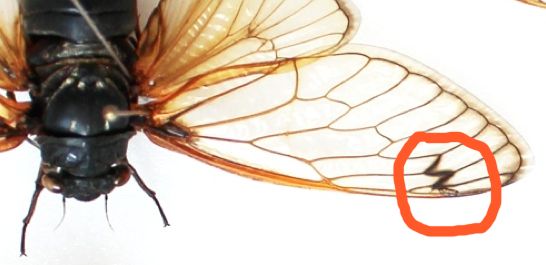
This is the most mythical of cicada myths and has no basis in fact. That said, here’s the W:

W in cicada wing

Myth 10: Cicadas only emerge during the Summer

This is not true. Many cicadas emerge outside of summer months.

Summer in the northern hemisphere is June 20-September 22, and in the southern hemisphere December 21-March 20 (although, I see references that say Sep 1 – November 30 in Australia).

Many species of cicadas emerge and peak before June 20th in the United States, including Magicicada periodical cicadas, and favorites of fly fishers like Okanagana and Platypedia. I see a lot of cicada merchandise (shirts, tote-bags) that claim Magicicada broods emerge in the summer, but this is 100% false. They are Spring cicadas.

The cicada season in Australia usually begins in September with the emergence of Bladder Cicadas, making it a springtime cicada.

1 Hajong, S.R. 2013. Mass emergence of a cicada (homoptera: cicadidae) and its capture methods and consumption by villagers in the ri-bhoi district of Meghalaya. Department of Zoology, North-Eastern Hill University, Shillong — 793 022, Meghalaya, India.

Categories
Brood XXII Magicicada Periodical Roy Troutman

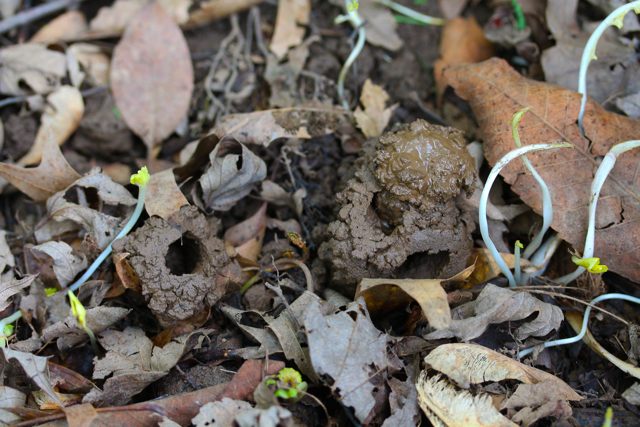
Periodical Cicada Turrets Spotted in Chilo, OH

Roy Troutman spotted and photographed periodical cicada turrets in Chilo Lock 34 Park in Chilo, OH. We expect 13 year cicadas to emerge in Ohio and Kentucky this year, and this is proof it will happen.

Chilo Lock 34 Park

This group of cicadas is not officially aligned with a Brood, but given enough research, documentation and population samples, I imagine they’ll be aligned with Brood XXII (although they might be genetically different from the cicadas in LA and MS). TBD.

Categories
Brood II Magicicada Periodical

M. cassini in Connecticut

A news story came out in November reporting that M. cassini appeared in areas of Connecticut where they were not expected during the Brood II emergence this year. This must have been a 2013 highlight for cicada researchers in the Connecticut area.

Categories
Film Periodical

Cicada – The Insect Methuselah

I picked up a film on 16mm (what they showed to kids in school before VHS tapes were popular) called Cicada – The Insect Methuselah. I would love to see it, but I don’t have a 16mm projector (who does?) The film is presumably about 17/13 Year cicadas. I held the film up to a light, and it indeed features the Magicicada species.

The film was produced by the Moody Institute of Science in 1955, and I assume they still hold the copyright to the film. It is 12 minutes in length.

Update: Roy Troutman contacted us to let us know that this video footage can be found in another video: The Mystery of The Three Clocks, which you can watch here:

The most impressive thing about the video is the anatomical model of the cicada. I wish I had one (but I might have to go back to the 50’s to get one).

Categories
Brood III Brood VII Brood XXII Periodical Stragglers

Looking forward to the 2014 periodical cicada emergences

Magicicada I am excited about the 17 and 13 year cicada emergences expected in 2014.

Here is what we can look forward to:

  • Brood XXII, the Baton Rouge brood. This brood of 13 year Magicicada will emerge in Louisiana and Mississippi. When they emerge depends on the weather, but probably April to May.
  • Brood III, The Iowan Brood. This brood of 17 year Magicicada will emerge in Iowa, Illinois and Missouri. This emergence will likely peak in June, depending on the weather.
  • A 13 Year cicada emergence in Ohio and Kentucky. This group of 13 Year Magicicada hasn’t officially been associated with a brood. May-June is my guess.
  • Stragglers from Broods II, IV, XXIII, and VII might emerge next year (see our brood chart for locations). The best bet will be Brood VII stragglers. Brood VII is located in upstate NY (June).

I’m looking forward to taking some vacation time and tracking cicadas. Brood XXII is a good excuse to visit New Orleans (even if it isn’t on the cicada map).

Fun fact: Brood III and XXII won’t emerge in the same year again until the year 2235.

Categories
Brood II Magicicada Periodical Video

A look back at the 2013 Brood II Periodical Cicada Emergence

2013 has been an awesome year for cicadas. Here’s a look back at my favorite Brood II moments.

  1. My 17 Year Cicada sneakers:
    nikeid
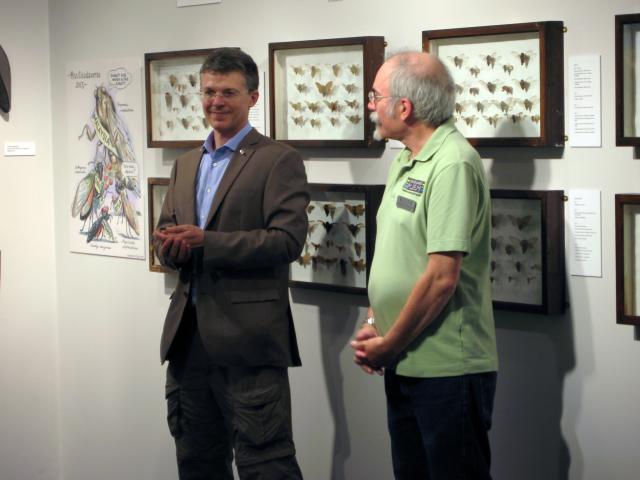
  2. The They’re Baaack! Return of the 17-year Cicadas exhibit at The Staten Island Museum.
  3. Meeting Ed Johnson of the Staten Island Museum.
  4. Being interviewed by and appearing in Wired Magazine.
  5. This April Fools Day joke (that no one believed).
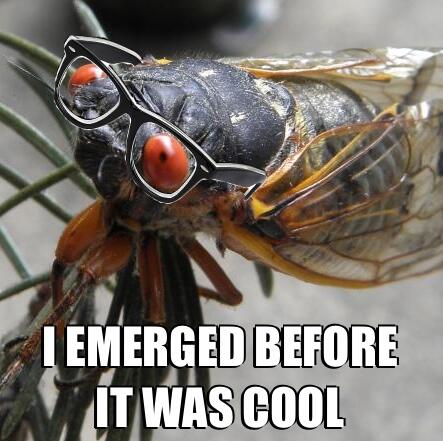
  6. Hipster Cicada
    hipster cicada
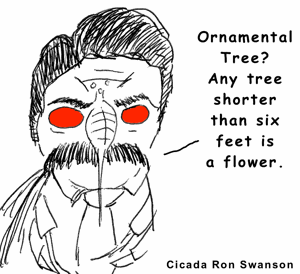
  7. Cicada Ron Swanson
    Cicada Ron Swanson
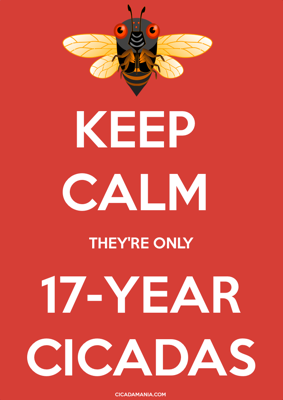
  8. Keep Calm, They’re only 17 Year Cicadas
    Keep Calm
  9. Getting 7,500 visits from Reddit in a single day (April 7th).
  10. Finding the first nymph on April 16th under a garden slate, not ready to emerge.
  11. Finding the first cicada chimneys on May 10th.
  12. Giving a presentation about cicadas at musician/naturalist/philosopher/professor David Rothenberg’s “Richard Robinson: Song of the Cicada (World Premiere), Insect Music, based on the calls, chirps and clicks of various insects” event in New York City.
  13. Finding and photographing Magicicada septendecula, thanks to Elias Bonaro’s keen hearing.
  14. My sister’s chihuahua discovering a cicada nymph.
    chihuahua cicada
  15. Cicada tracking in New York state.
  16. An interview with Sonja Beeker of the German radio program Neonlicht.
  17. The Oklahoma Brood II emergence. A lot of us didn’t expect it, but Oklahoma residents did. Add another state to the Brood II map!
  18. Shooting lots of cicada video for the site
  19. Observing the Magicicada cassini’s “musical chairs” calling and flying routine, captured in this photo by Roy Troutman.
  20. Having Roy and Michelle Troutman visit New Jersey (I think Michelle enjoyed the beach more than the cicadas).
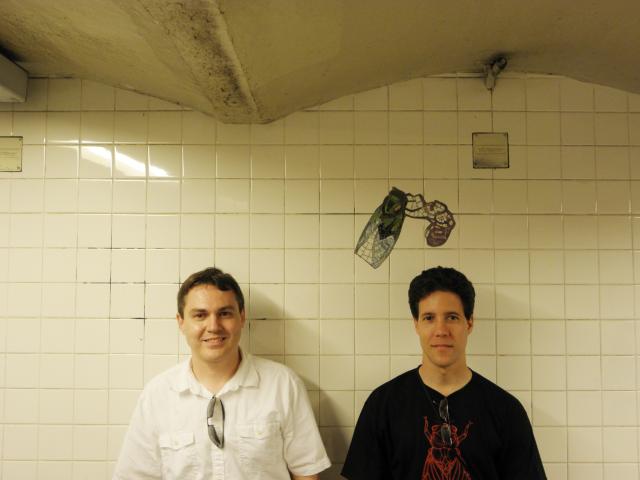
  21. Going cicada hunting with Roy Troutman and Elias Bonaros
    Elias and Roy
  22. The Joy of Six Legged Sex event at the Staten Island Museum, featuring John Cooley and Ed Johnson. Roy, Michelle, Elias and David Rothenberg were also in attendance.
    John Cooley and Ed Johnson speaking at the Staten Island Museum Six Legged Sex event by Roy Troutman
  23. Going cicada hunting in Staten Island with Elias and Chris Simon.
  24. Going cicada hunting with John Cooley, David Rothenberg, and a crew from the New York Times, and ending up at my folk’s place in Metuchen.
  25. Fighting back against companies that sell pesticide to kill cicadas.
  26. Discovering that the periodical cicadas along the shore of Staten Island survived Superstorm Sandy.
  27. Meeting cicada filmmaker Sam Orr.
  28. All the reports, comments, Tweets, and cicada photos sent to us by Cicada Mania readers. You make it all worthwhile.
  29. The Finneytown, Ohio acceleration… technically not Brood II, but…
  30. All the cool cicada community science opportunities presented by magicicada.org, the Simon Lab, the Urban Buzz Project, Gene Kritsky and Radiolab.

I’m looking forward to the Brood III and XXII emergences next year, but I don’t know if they’ll be as fun as Brood II 2013.

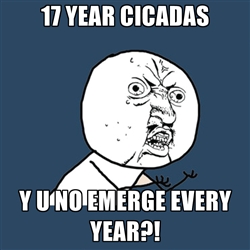
17 year cicadas y u no?

Categories
Brood II Magicicada Periodical

Where’s the cicadas?

At this point in the 2013 Brood II emergence, all the cicadas that will emerge, have emerged. I’m sorry to say that if periodical cicadas have not emerged in your yard/neighborhood/town, they won’t. This is frustrating for people who heard that the cicadas would emerge in their state or those who looked at a brood map and assumed their neighborhood fell within the area shown on the map.

People in Pennsylvania, for example, heard that cicadas would arrive in their state, but unfortunately, the cicadas only occupy a small banana-shaped region in the east of the state:

Pony tail on New Jersey

If you look at one of the older maps for Brood II, it looks like the state of New Jersey is covered, however, each dot might represent only one sighing in one specific area. These old maps are useful, but they can be misleading (more on maps later in this article).

map example

Back in 2004, after Brood X emerged, I wrote an article called: What Happened: the Magicicada No-Show of 2004. The information in that article is relevant for Brood II as well.

The truth is periodical cicadas do not occupy every square acre of a state in which they are expected to emerge. Even in towns where they do emerge, they are rarely present in every acre or block of those towns. Why? Well, either they were eliminated in the areas where they once were found (due to urban sprawl, pesticides, weather-related events, etc), or they simply were never there in the first place. New threats like extreme weather (flooding and tree destruction by tropical storms) and tree-destroying invasive species (like the emerald ash borer) will continue to shrink cicada habitat areas.

It is important, for future emergences, that the press/media and cicada websites provide more accurate information about the location of the cicadas. The cicada sighting information people provide to Cicadas @ UCONN (formerly Magicicada.org) is very important because it will lead to better maps and more accurate sighting information.

One thing I’m glad that I did this year was to provide a page that listed specific towns in New Jersey where cicadas could be expected. I wish I did one for every state in the Brood II area [but Cicada Mania is not my day job, and there are only so many hours in a day].

That said, we never want to discourage people from looking for periodical cicadas in areas we don’t expect them to exist. Last year unexpected Brood I cicadas emerged in Tennessee. This year periodical cicadas unexpectedly emerged in Oklahoma. A lot of us were hoping cicadas would show up in Central Park in Manhattan, but they didn’t (however, I didn’t personally walk every acre of the park).

So, what can you do to help?

  • If you’re a member of the press/media (yes that includes bloggers and tweeters), make sure you get precise locations from cicada experts.
  • Report cicada and flagging sightings to Cicadas @ UCONN (formerly Magicicada.org) so we have better records of the emergence.
  • Help cicada research by participating in a cicada community science project.
  • Help preserve the current cicada habitat. Preserve trees. Avoid pesticides. Don’t wipe out another forest to add yet another redundant giant store.

A consolation for people who missed out on the 17 year cicadas: there are about 160 species of annual cicadas in North America. They’re usually harder to find and catch, but you can still hear and capture them if you put some time and effort into it.