Categories
Annette DeGiovine Elias Bonaros Neotibicen

Neotibicen latifasciatus – the South Jersey Shore Screamer

This is a Neotibicen latifasciatus (Davis, 1915) commonly known as the Coastal Scissor Grinder, locally known as a Yodeling Cedar Sucker in Florida and Beach Banshee in North Carolina 3:

Dorsal view of two latifasciatus males

See more photos.

The holotype — a single type specimen on which the description of a new species is based — for the cicada Neotibicen latifasciatus was gathered from Cold Spring, Cape May County1. I feel that N. latifasciatus needs a common name indicative of Cape May, New Jersey. Here are my ideas:

  1. Cape May Crooner
  2. Cape May Crier
  3. Cape May Car Alarm
  4. Shore Shrieker
  5. Woodbine Warbler
  6. South Jersey Shore Screamer

The last one is my favorite (changed it to South ;))

N. latifasciatus is a cicada found along the east coast of the United States, and is known for its preference for cedar trees. It can be found in New Jersey, Maryland, North Carolina, Virginia2, Florida and points in between3. Its affinity for cedar trees (plus its distinct call) makes it relatively easy to locate and capture — if you’re willing to get a little messy climbing through the thick & sticky branches of a cedar tree. A thin mist of sap from the cedar seems to coat the wings of these cicadas, and it’s worth mentioning that their wings are often torn and ragged, probably resulting from the thick cedar foliage.

When William T. Davis first described N. latifasciatus in 19154, he described it as a variety of Cicada pruinosa (now Neotibicen pruinosus pruinosus). This is understandable, since they sound very much alike, and look alike except for the the white bands on the sides of the latifasciatus, some other minor morphological differences, and habitats. pruinosus, latifasciatus, winnemanna, linnei, canicularis, and robinsonianus are collectively known as the Green [Neo]tibicen Species3 or simply “the Green Group”.They’re called Green because much of their heads, collars, pronotums and mesonotums are green in color.

On Saturday, August 20th, 2016, I met Elias Bonaros and Annette DeGiovine-Oliveira in Middle Township, Cape May County to search for latifasciatus. I arrived before they did and located a relatively quiet road lined with cedar trees, filled with screaming latifasciatus. From the outside cedars resemble twisting green fire; on the inside they’re a mess of tightly-packed, dirty branches — perfect for an insect to hide. The road and trees were surrounded by briny marshland, less than a mile from the Atlantic Ocean. Other than cicadas, there were an abundance of annoying greenhead flies (Tabanus nigrovittatus), and not annoying at all katydids. The temperature was in the mid 80s, the air was humid, the sun was brutal, and the flies thought I was delicious. In the 5 hours we spent photographing and gathering specimens, I drank a gallon of water. Elias handled cicada procurement duties, and Annette and I recorded the cicadas’ song and habitat.

Here’s a video summary of our adventure:

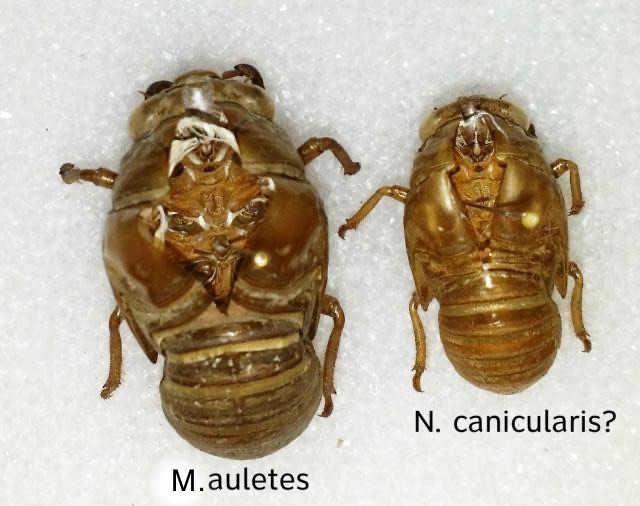
After a satisfying lunch, I went looking for other locations and found a very different but prime in-land location with taller cedar (Red and White varieties) in Woodbine Borough. There we found many exuvia, which we did not find at the other location, and heard not only latifasciatus, but also N. linnei, N. tibicen tibicen, N. canicularis, and N. auletes. Around 9pm, and almost 12 hours of cicada field-work, I called it quits. Elias and Annette stuck around and were able to observe molting latifasciatus.

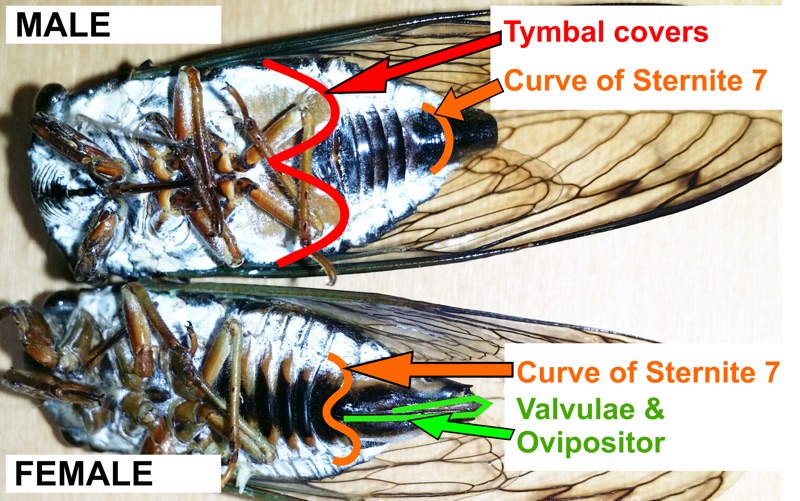
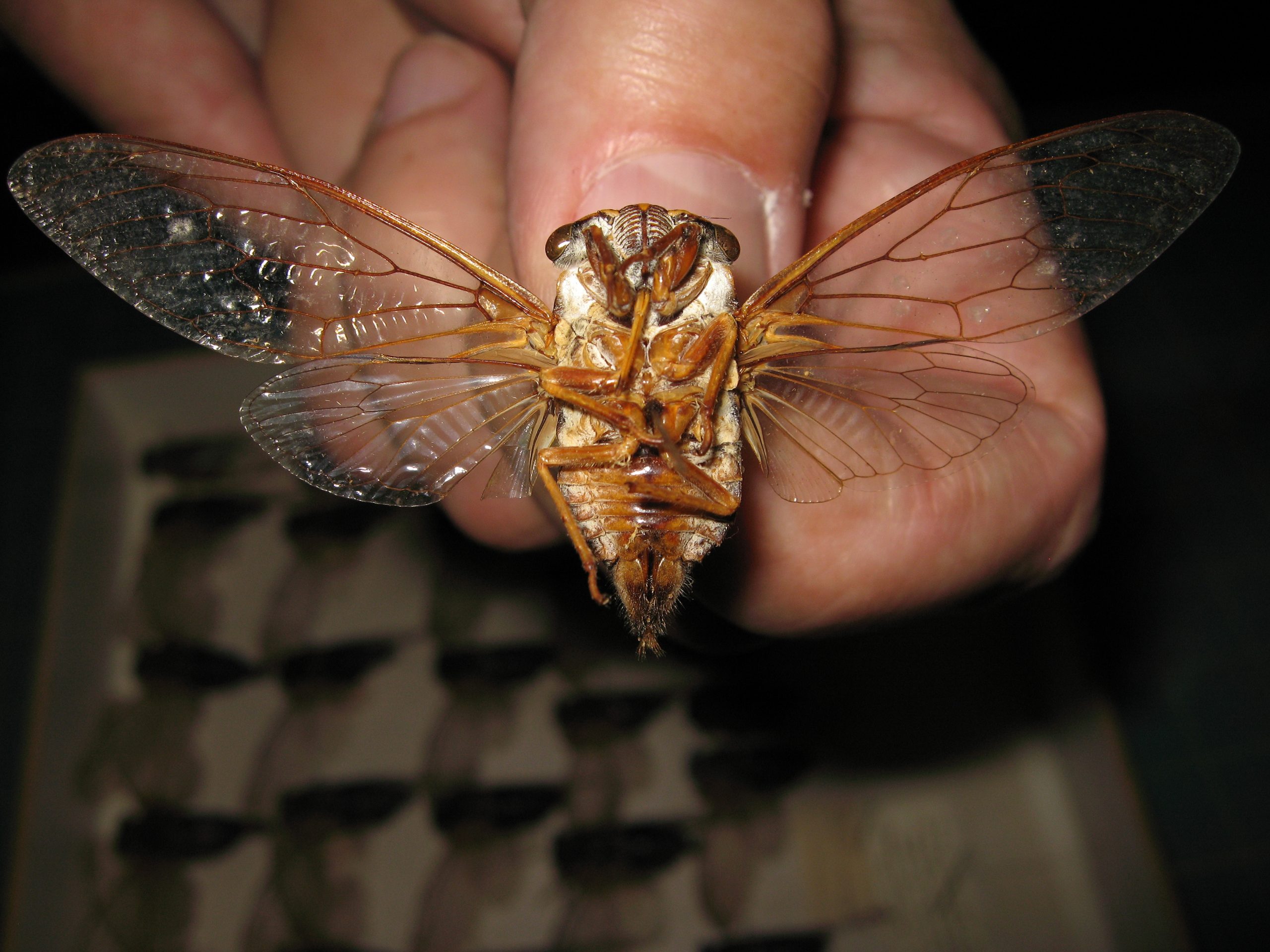
The ventral side a male Neotibicen latifasciatus:
Neotibicen latifasciatus abdomen

This cicada was captured using the “clap” method of netting cicadas. This method involves two people using two nets, surrounding the cicada so it can’t find an escape path.

I would be remiss if I did not mention how delightful the people of Cape May County are. All the folks we encountered were pleasantly curious or encouraging about our cicada research activities. They also have “Custard” shops instead of Ice Cream shops.

Also check out Annette’s YouTube channel for video of the latifasciatus habitat and song.

1 Sanborn AF, Phillips PK. 2013. Biogeography of the Cicadas (Hemiptera: Cicadidae) of North America, North of Mexico. Diversity 2013, 5, 166-239.

2 Sanborn AF, Heath MS. 2012. The Cicadas (Hemipetera: Cicadoidea: Cicadidae) of North America North of Mexico. Entomological Society of America. 45.

3 BugGuide Species Neotibicen latifasciatus page.

4 Davis WT. 1915a. Notes on some cicadas from the eastern and central United States with a description of a new variety of Cicada pruinosa. Journal of the New York Entomological Society 23: 1—10. (see the North American Cicadas page)

Categories
Neotibicen

Neotibicen linnei from Middletown, NJ

One of my favorite things to do during the summer is look for cicadas during my lunch break.

Here’s a Linne’s Cicada I grabbed off a tree. It was not happy, as you might imagine, so went straight into a very loud alarm squawk.

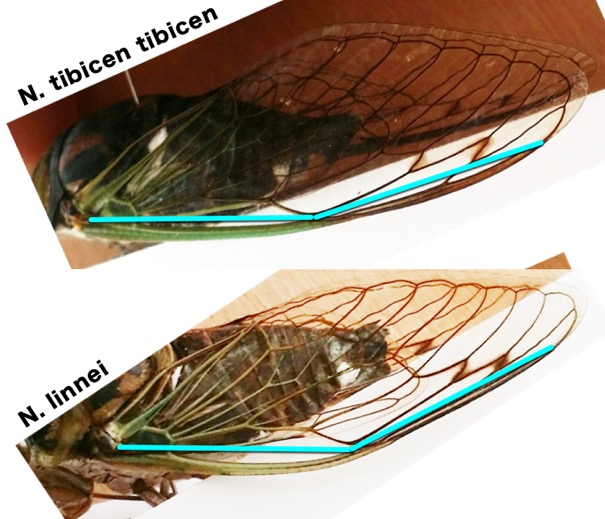
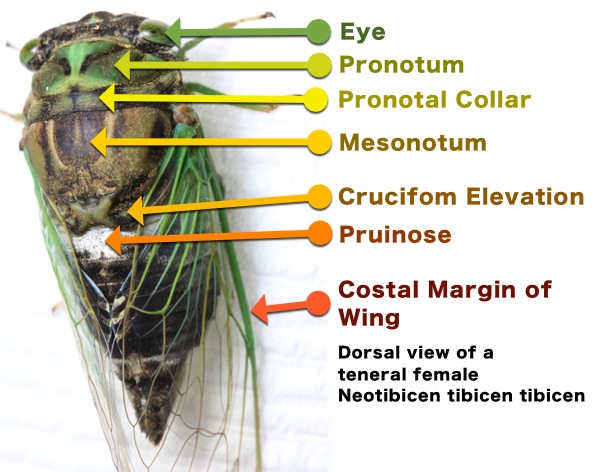
There are many cicadas in the eastern U.S. that look like Linne’s Cicada but some clues that it is a Linne’s are the green collar, a bend in the coastal margin of the wing, dark coloration down the center of its abdomen, and only two white pruinose spots on its dorsal side.

N. linnei

More posts to come this week.

Categories
Neotibicen

Watch a Swamp Cicada shed its skin

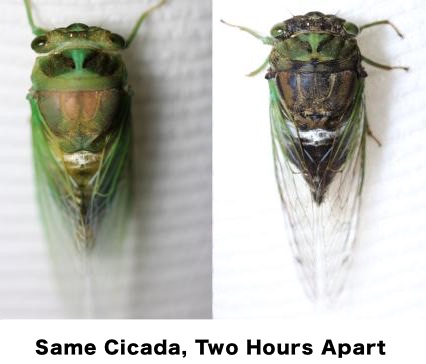
Here’s a video I made this week. It is a Neotibicen tibicen tibicen (formerly Tibicen chloromera) shedding its skin as it enters the final phase of its development. The video is in 4K HD, but you have to fuss with the YouTube interface to see it at that resolution (good luck). Each frame represents a 30 sec time span.

Spoilers:

At 18 seconds its head pops out of its old skin.

At 27 seconds it frees its wings.

At 51 seconds it flips and unfurls its wings.

At 85 seconds it moves its wings into place.

At 100 seconds you can see pigment pulse through the cicadas mesonotum:

meso

Here’s another video from last night:

Categories
Annette DeGiovine Elias Bonaros Neotibicen

Annual Cicada Hunt in Manchester, New Jersey

Neotibicen auletes

Since 2013 I’ve met Elias Bonaros and Annette DeGiovine in Manchester, New Jersey to search for the cicada Neotibicen auletes. It has become an annual tradition.

M. auletes is the largest cicada in the Americas, they have a particularly arresting call, and are a beautiful lime green when recently molted. They are definitely worth taking the time to find.

Locating and observing cicadas in northern States can be particularly vexing because they are far less abundant, and much of their habitat has been eliminated to make way for the ever-growing, densely-packed human population. It is a treat any time we can find and observe a living cicada specimen up-close. If you’re the type who likes to travel to observe cicadas, New Jersey is not a great place to start on the east coast. Southern states, starting at North Carolina to Florida are your best bets, in terms of species diversity and abundance. If you’re a collector, be aware of local laws — for instance, collecting in Florida is completely forbidden.

This year’s adventure began around 7:15pm when I arrived at the mini-mall where Caballero’s Pizzeria is located (Manchester, NJ on Route 70). Part of the tradition is to have a few slices of pizza, and after four years the owner knows who we are. The mini-mall the pizzeria is located in is bordered on the right by a sandy-soil pine & oak forest, and in front by two small groves of tall oaks & pines. Oddly, the ground of these groves has been covered with a back mesh tarp, which completely prevents underbrush growth. This doesn’t seem to deter cicadas from emerging, but I’m skeptical that future generations of cicadas will find the smaller plant roots they need during the early stages of life.

At 7:15pm the small and beautiful Neocicada hieroglyphica cicadas were singing from many trees in groves and forest (they would continue singing to around 9pm, well past sunset). Around 7:30pm Neotibicen linnei began to join them.

Elias and Annette arrived shortly before sunset, around 8pm, giving them time and daylight to scout the grounds for deceased adult specimens and exuvia (molted skins); oddly none were found. Neotibicen auletes calls at dusk, right after sunset. On queue multiple N. auletes began calling from the trees in the groves and forest, like a soloist overpowering the lesser vocalists and instruments around him, N. auletes are the divas of the New Jersey cicada opera.

Elias photographing an auletes:
Elias Bonaros

Teneral Neotibicen auletes 3

Teneral Neotibicen auletes 4

Teneral Neotibicen auletes

No exuvia or dead N. auletes was found, but the many calls we heard were encouraging. Once night fell we began to search the local area for emerging nymphs and molting adults. After a long search Elias found a single female auletes molting on the side of a school. Three hours of searching only yeilded one cicada — for those who have experienced periodical cicada emergences, or those who live in areas with an abundance of annual species, a lone cicada would be very disappointing. For Elias, Annette and I, finding a lone (locally) rare cicada, was not disappointing at all.

The funniest moment of the night came when a local policeman asked us if we were hunting Pokemon! Of course we were not — we were hunting cicadas. A little harder to explain, and probably more fun.

Video from the trip:

Previous Manchester NJ auletes adventures:

Categories
Audio, Sounds, Songs Neotibicen Tacuini (Cryptotympanini) U.S.A. William T. Davis

Neotibicen lyricen virescens Davis, 1935 aka Costal Lyric Cicada

Neotibicen lyricen virescens Davis, 1935

Song type: Call


Source: ©Insect Singers | Species: N. lyricen virescens

Name, Location and Description

Classification:

Family: Cicadidae
Subfamily: Cicadinae
Tribe: Cryptotympanini
Subtribe: Cryptotympanina
Genus: Neotibicen
Species: Neotibicen lyricen
Sub-species: Neotibicen lyricen virescens Davis, 1935
Sub-species: Neotibicen lyricen lyricen (De Geer, 1773)
Sub-species: Neotibicen lyricen engelhardti (Davis, 1910)

List of sources

  1. Full Binomial Names: ITIS.gov
  2. Common names: BugGuide.net; The Songs of Insects by Lang Elliott and Wil Herschberger; personal memory.
  3. Locations: Biogeography of the Cicadas (Hemiptera: Cicadidae) of North America, North of Mexico by Allen F. Sanborn and Polly K. Phillips.
  4. Descriptions, Colors: personal observations from specimens or photos from many sources. Descriptions are not perfect, but may be helpful.

Notes:

  • Some descriptions are based on aged specimens which have lost some or a lot of their color.
Categories
Audio, Sounds, Songs Neotibicen Tacuini (Cryptotympanini) U.S.A. William T. Davis

Neotibicen robinsonianus Davis, 1922 aka Robinson’s Annual Cicada or Robinson’s Cicada

Neotibicen robinsonianus Davis, 1922 aka Robinson’s Annual Cicada or Robinson’s Cicada

Song type: Call


Source: ©Insect Singers | Species: N. robinsonianus

Name, Location and Description

Classification:

Family: Cicadidae
Subfamily: Cicadinae
Tribe: Cryptotympanini
Subtribe: Cryptotympanina
Genus: Neotibicen
Species: Neotibicen robinsonianus Davis, 1922

List of sources

  1. Full Binomial Names: ITIS.gov
  2. Common names: BugGuide.net; The Songs of Insects by Lang Elliott and Wil Herschberger; personal memory.
  3. Locations: Biogeography of the Cicadas (Hemiptera: Cicadidae) of North America, North of Mexico by Allen F. Sanborn and Polly K. Phillips.
  4. Descriptions, Colors: personal observations from specimens or photos from many sources. Descriptions are not perfect, but may be helpful.

Notes:

  • Some descriptions are based on aged specimens which have lost some or a lot of their color.
Categories
Audio, Sounds, Songs David Marshall Kathy Hill Neotibicen Tacuini (Cryptotympanini) U.S.A.

Neotibicen similaris apalachicola Marshall and Hill, 2017

Neotibicen similaris apalachicola Marshall and Hill, 2017.

Song type: Call


Source: ©Insect Singers | Species: N. similaris apalachicola

Name, Location and Description

  • Cicada Name: Neotibicen similaris apalachicola Marshall and Hill, 2017
  • Short Name: N. similaris apalachicola
  • Where it is found: FL, AL, GA
  • Maps: Map
  • Description: Black & brown pronotum, black collar, black brown, & dark green mesonotum, black abdomen dorsal side, green coastal margin of wing transitioning into brown, pruinose on ventral side.
  • Eye Color: Black
  • Pronotal Collar Color: Mostly black
  • Song: Insect Singers

Classification:

Family: Cicadidae
Subfamily: Cicadinae
Tribe: Cryptotympanini
Subtribe: Cryptotympanina
Genus: Neotibicen
Species: Neotibicen similaris
Sub-species: Neotibicen similaris apalachicola Marshall and Hill, 2017
Sub-species: Neotibicen similaris similaris (Smith and Grossbeck, 1907)

List of sources

  1. Full Binomial Names: ITIS.gov
  2. Common names: BugGuide.net; The Songs of Insects by Lang Elliott and Wil Herschberger; personal memory.
  3. Locations: Biogeography of the Cicadas (Hemiptera: Cicadidae) of North America, North of Mexico by Allen F. Sanborn and Polly K. Phillips.
  4. Descriptions, Colors: personal observations from specimens or photos from many sources. Descriptions are not perfect, but may be helpful.

Notes:

  • Some descriptions are based on aged specimens which have lost some or a lot of their color.
Categories
Audio, Sounds, Songs Neotibicen Tacuini (Cryptotympanini) U.S.A.

Neotibicen similaris similaris (Smith and Grossbeck, 1907) aka Similar Dog-Day Cicada

Neotibicen similaris similaris (Smith and Grossbeck, 1907)

Photo

Neotibicen similaris
Photo © Coleman Cobbs.

Video Playlist

Playlists contain multiple videos found on YouTube.

Name, Location and Description

Classification:

Family: Cicadidae
Subfamily: Cicadinae
Tribe: Cryptotympanini
Subtribe: Cryptotympanina
Genus: Neotibicen
Species: Neotibicen similaris
Sub-species: Neotibicen similaris similaris (Smith and Grossbeck, 1907)
Sub-species: Neotibicen similaris apalachicola Marshall and Hill, 2017

List of sources

  1. Full Binomial Names: ITIS.gov
  2. Common names: BugGuide.net; The Songs of Insects by Lang Elliott and Wil Herschberger; personal memory.
  3. Locations: Biogeography of the Cicadas (Hemiptera: Cicadidae) of North America, North of Mexico by Allen F. Sanborn and Polly K. Phillips.
  4. Descriptions, Colors: personal observations from specimens or photos from many sources. Descriptions are not perfect, but may be helpful.

Notes:

  • Some descriptions are based on aged specimens which have lost some or a lot of their color.
Categories
Audio, Sounds, Songs Neotibicen Tacuini (Cryptotympanini) U.S.A. William T. Davis

Neotibicen tibicen australis (Davis, 1912) aka Southern Swamp Cicada

Neotibicen tibicen australis (Davis, 1912) aka Southern Swamp Cicada aka Southern Dusky-Winged Cicada.

Song type: Call


Source: ©Insect Singers | Species: N. tibicen australis

Name, Location and Description

Classification:

Family: Cicadidae
Subfamily: Cicadinae
Tribe: Cryptotympanini
Subtribe: Cryptotympanina
Genus: Hadoa
Species: Neotibicen tibicen
Sub-Species: Neotibicen tibicen australis (Davis, 1912)
Sub-Species: Neotibicen tibicen tibicen (Linnaeus, 1758)

Notes from Davis 1918, MISSISSIPPI CICADAS, WITH A KEY TO THE SPECIES OF THE SOUTHEASTERN UNITED:

Collar all green or nearly so, as well as the pronotum and mesonotum sayi var. australis (Davis).

sayi = Neotibicen tibicen.

The variety australis Davis, which is much greener colored, occurs not uncommonly in parts of Florida and Georgia, and should be found in Mississippi.

Link to Davis 1918.

Notes from Sanborn, Allen F., Phillips, Polly K. & Gilllis, Philip, 2008, The Cicadas of Florida (Hemiptera: Cicadoidea: Cicadidae), pp. 1-43 in Zootaxa 1916 on page 13.

The subspecies has a primarily green mesonotum, pronotum and pronotal collar with reduced black markings (fig. 140) instead of the black and fulvous areas on the pronotum and mesonotum (fig. 131)

Links: The Cicadas of Florida (Hemiptera: Cicadoidea: Cicadidae), Tibicen tibicen subsp. australis Davis.

List of sources

  1. Full Binomial Names: ITIS.gov
  2. Common names: BugGuide.net; The Songs of Insects by Lang Elliott and Wil Herschberger; personal memory.
  3. Locations: Biogeography of the Cicadas (Hemiptera: Cicadidae) of North America, North of Mexico by Allen F. Sanborn and Polly K. Phillips.
  4. Descriptions, Colors: personal observations from specimens or photos from many sources. Descriptions are not perfect, but may be helpful.

Notes:

  • Some descriptions are based on aged specimens which have lost some or a lot of their color.
Categories
Neotibicen Tacuini (Cryptotympanini) Tibicen

The Smaller Neotibicen

This is my third, and possibly final, article on identifying Neotibicen, using the information on this website. Read the other articles, Identifying Neotibicen and Megatibicen (formerly Neotibicen).

Identifying the smaller Neotibicen is no easy task — with two exceptions.

The two easy ones are:

1) Neotibicen superbus, aka the Superb Cicada, because it looks like no other cicada in this group. It is pea green with bright yellow arches on its mesonotum. No other Neotibicen shares that coloration. No other cicada in the group sounds quite like it either.
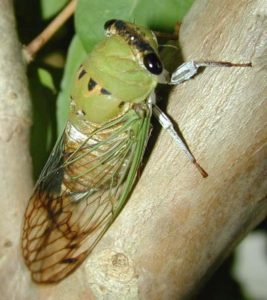
Neotibicen superbus photo by Sloan Childers from 2005. Round Rock, Texas.
Photo by Sloan Childers from 2005.

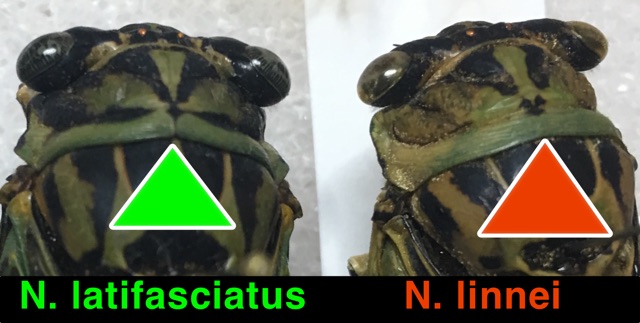
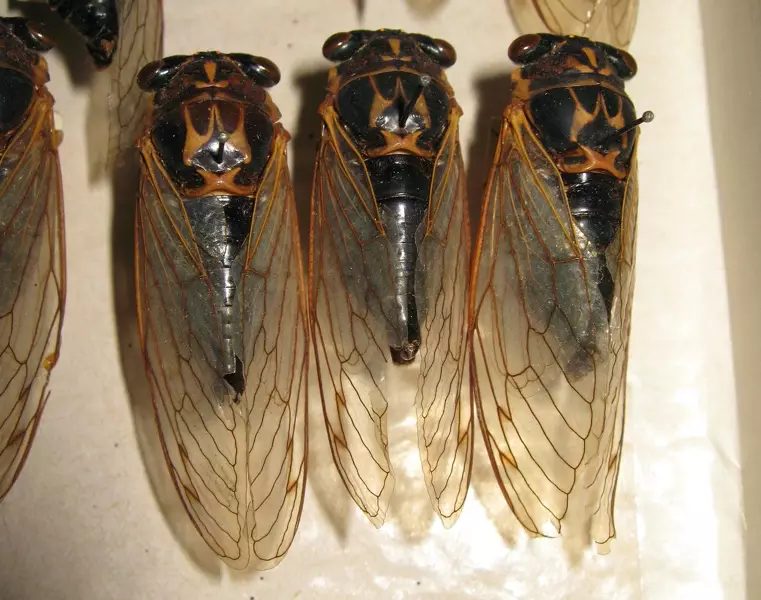
2) Neotibicen latifasciatus, aka Coastal Scissors Grinder Cicada, because it has a white X (pruinose) on its back. Otherwise, it looks like four other cicadas, kinda like four more, and sounds like three others.

While I’ve never heard an actual scissor being sharpened with a grinder, it must sound like the repetitive, rhythmic, short grinding sounds like cicada makes. Grind, Grind, Grind, Grind.
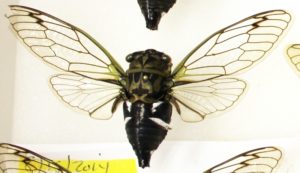
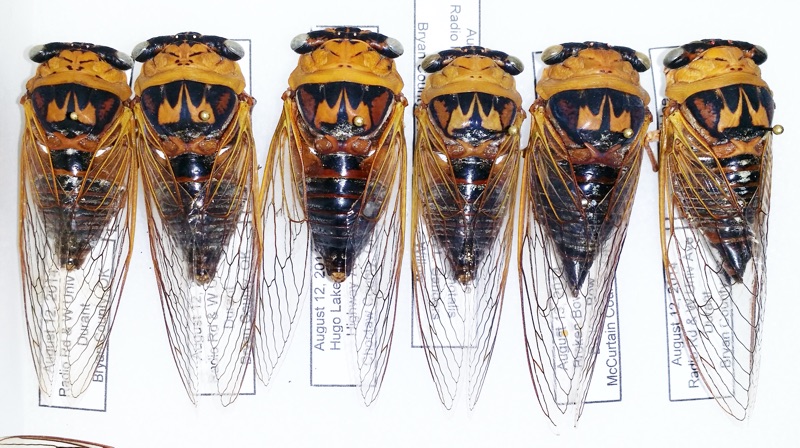
Neotibicen latifasciatus from Bill Reynolds collection
Photo by me of Bill Reynolds’ collection.

The rest of the small Neotibicen closely resemble each other enough to make many scratch their heads in wonder. BugGuide.net organizes these cicadas into four groups4: the “Green Tibicen Species” (Tibicen is the old genus name for these cicadas), “Southern Dog-day Cicadas”, “Swamp Cicadas”/”The chloromerus Group”, and the “Lyric Cicadas”/”The lyricen Group”. I’ll use these groups for this article for consistency sake. These groups are also closely related genetically1, although Neotibicen similaris, which BugGuide puts under “Southern Dog-day Cicadas”, is a bit of an outlier1. Tables below might be a bit overwhelming — but they help to accurately align the similarities between these cicadas.

As you browse this page, if you click the cicada’s name you’ll be brought to a page that features more information about that cicada, including sound files, location information, links to other websites, and often more photos and video. When in doubt: visit the BugGuide Dog Day Cicada page.

The Green Neotibicen

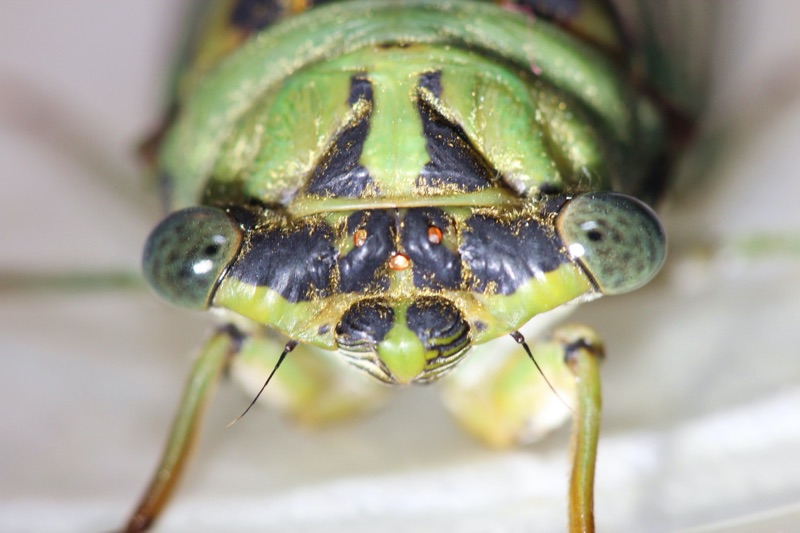
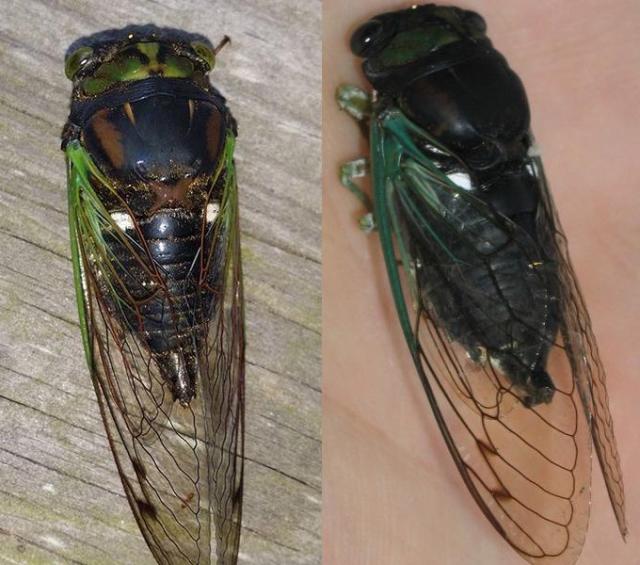
These Neotibicen all share green markings on their pronotum, mesonotum, and pronotal collars. Find a Neotibicen with a green collar, and there’s a good chance it is one of these. As you can see, these insects are well camouflaged for adult life in trees.
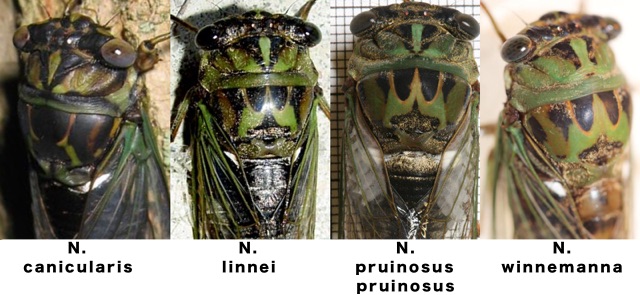
Green Neotibicen
Photo credits l to r: Roy Trountman, Tom Lehmkuhl , Paul Krombholz, me.

From Davis 1918 =”Dorsum (top) of abdomen shining black with a broad pruinose (white, frosty) mark each side on segment three; blackened area on the underside of abdomen more in the nature of an even stripe”.

Cicada Sounds Like Looks Like Looks Kind of Like
N. canicularis (Harris, 1841) aka Dog-day Cicada

The canicularis varies the most in terms of coloration. Some are very dark, with more black than green, and others have an even amount of green and black.
Sounds like an angle grinder tool grinding something.
N. auriferus
N. davisi davisi
N. davisi harnedi
N. auriferus
N. davisi davisi
N. davisi harnedi
N. latifasciatus
N. linnei
N. pruinosus pruinosus
N. robinsonianus
N. winnemanna
N. latifasciatus (Davis, 1915) aka Coastal Scissor(s) Grinder Cicada

If the cicada has a white X on its back, it is a latifasciatus.
Repetitive, rhythmic, call – like someone repeatedly running a scissor over a grinding wheel (I suppose).
N. pruinosus fulvus
N. pruinosus pruinosus
N. winnemanna
N. linnei
N. pruinosus pruinosus
N. robinsonianus
N. winnemanna
N. auriferus
N. canicularis
N. davisi davisi
N. davisi harnedi
N. linnei (Smith and Grossbeck, 1907) aka Linne’s Cicada

Known for the bend of their wing.

Linne’s cicada’s call builds up — a crescendo — peaks, and then fades back down.
N. tibicen australis
N. tibicen tibicen

It sounds like the N. tibicen species, but unlike them, it calls from high in the trees.
N. latifasciatus
N. pruinosus pruinosus
N. robinsonianus
N. winnemanna
N. auriferus
N. canicularis
N. davisi davisi
N. davisi harnedi
N. pruinosus fulvus Beamer, 1924 aka Yellow morph of Scissor Grinder.

This cicada should look like the other cicadas in this table, but its coloring is more yellow than green, like a teneral Scissor Grinder.
N. latifasciatus
N. pruinosus pruinosus
N. winnemanna
N. pruinosus pruinosus (Say, 1825) aka Scissor(s) Grinder

The Scissor Grinder looks a lot like Linne’s Cicada but their wing doesn’t have the bend that Linne’s Cicada has. The Scissor Grinder also seems to have more of an orange coloration to the “arches” on its mesonotum.
Its call is like N. latifasciatus, but it is faster paced.
N. latifasciatus
N. pruinosus fulvus
N. winnemanna
N. latifasciatus
N. linnei
N. robinsonianus
N. winnemanna

N. auriferus
N. canicularis
N. davisi davisi
N. davisi harnedi
N. robinsonianus Davis, 1922 aka Robinson’s Annual Cicada or Robinson’s Cicada

Robinson’s Cicada looks like Linne’s Cicada with less of a wing bend, and a different call.
Its call is kind of like N. latifasciatus, but much more raspy.
N. latifasciatus
N. linnei
N. pruinosus pruinosus
N. winnemanna

N. auriferus
N. canicularis
N. davisi davisi
N. davisi harnedi
N. winnemanna (Davis, 1912) aka Eastern Scissor(s) Grinder

Like the Scissor Grinder, the Eastern Scissor Grinder seems to have more of an orange hue to the arches on its mesonotum, perhaps even more so than the Scissor Grinder.
Its call is similar to the Scissor Grinder.
N. latifasciatus
N. pruinosus fulvus
N. pruinosus pruinosus
N. latifasciatus
N. linnei
N. pruinosus pruinosus
N. robinsonianus
N. auriferus
N. canicularis
N. davisi davisi
N. davisi harnedi

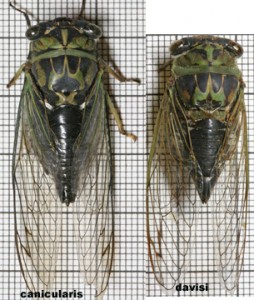
Neotibicen davisi & canicularis by Paul Krombholz
Neotibicen canicularis (Green Group) and Neotibicen davisi (Southern Dog Day Group) compared. Photo by Paul Krombholz

Southern Dog Day

Cicada Sounds Like Looks Like Looks Kind of Like
N. auriferus (Germar, 1834) aka Plains Dog-day Cicada

Coloration varies from rusty browns to greens.
Sounds like an angle grinder tool grinding something.
N. canicularis
N. davisi davisi
N. davisi harnedi
N. davisi davisi
N. davisi harnedi
N. canicularis
N. latifasciatus
N. linnei
N. pruinosus pruinosus
N. robinsonianus
N. winnemanna
N. davisi davisi (Smith and Grossbeck, 1907) aka Davis’ Southeastern Dog-Day Cicada

The davisi comes in a wide variety of colors: from rusty browns to greens.
Sounds like an angle grinder tool grinding something.
N. auriferus
N. canicularis
N. davisi harnedi
N. auriferus
N. davisi harnedi
N. canicularis
N. latifasciatus
N. linnei
N. pruinosus pruinosus
N. robinsonianus
N. winnemanna
N. davisi harnedi Davis, 1918

Looks like Davis’ Southeastern Dog-Day Cicada but with slight differences in the wings.
Sounds like an angle grinder tool grinding something.
N. auriferus
N. canicularis
N. davisi davisi
N. auriferus
N. davisi davisi

N. canicularis
N. latifasciatus
N. linnei
N. pruinosus pruinosus
N. robinsonianus
N. winnemanna
N. superbus (Fitch, 1855) aka Superb Dog-Day Cicada

This cicada is the most unique looking: solid green with prominent yellow arches on its back.
Its call is so unique, you’ll have to listen to it and decide what it sounds like.
N. similaris (Smith and Grossbeck, 1907) aka Similar Dog-Day Cicada

This cicada is similar to the Neotibicen tibicen species in shape (hump back) and coloring.
N. tibicen tibicen

Swamp Cicadas / Morning Cicadas

Swamp Cicadas are often the easiest cicadas to find because they prefer to stay in the lower branches of trees. Listen for one, and you’ll likely be able to spot it in the tree above you.

Cicada Sounds Like Looks Like Looks Kind of Like
N. tibicen tibicen (Linnaeus, 1758) aka Swamp Cicada

Swamp Cicadas are are known for their rounded, humped back. Their coloration varies from mostly black & some green to black, brown and green. Their collar is usually black, but can include green.
N. tibicen tibicen – From Davis 1918: “Central area of the abdomen not black beneath, often pruinose, as well as the long opercula. Collar black, often with a greenish spot on each side near the outer angles.”
N. tibicen australis – From Davis 1918: “Central area of the abdomen not black beneath, often pruinose, as well as the long opercula. Collar all green or nearly so, as well as the pronotum and mesonotum.”
Its call builds up — a crescendo — peaks, and then fizzles out.
N. linnei
N. tibicen australis
N. tibicen australis N. similaris
N. tibicen australis (Davis, 1912) aka Southern Swamp Cicada

Southern Swamp Cicadas look like Swamp Cicadas, but they are more colorful. Their collars are often green & black.
Its call builds up — a crescendo — peaks, and then fizzles out.
N. linnei
N. tibicen tibicen
N. tibicen tibicen N. similaris

Lyric compared to Swamp Cicada

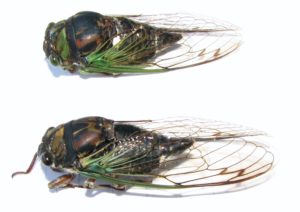
Swamp and Lyric Cicada
Top: Swamp Cicada; Bottom: Lyric Cicada. Note the more rounded shape of the Swamp Cicada’s mesonotum, and its green eyes; and the flatter shape of the Lyric cicada’s mesonotum, and its black eyes. Photo by me.

Lyric Cicadas

The Lyric Cicadas all look physically similar, but their coloration is unique enough to tell them apart. They usually have brown/black collars, which makes it easy to tell them apart from the “Green” Neotibicen. They also resemble the Swamp Cicadas, but Lyric cicadas have flatter mesonotums.

Two Dark Lyric Cicadas on Left, and a Lyric Cicada on the Right.
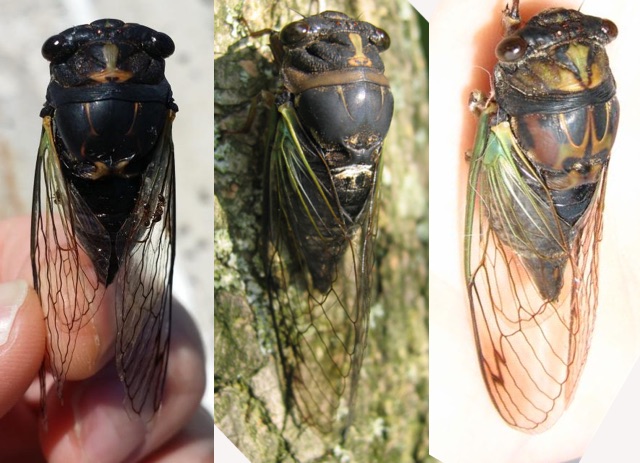
Lyric cicadas compared
Photos L or R: Dan M, Roy Troutman, Dan M.

Cicada Sounds Like Looks Like Looks Kind of Like
N. lyricen engelhardt (Davis, 1910) aka Dark Lyric Cicada

The Dark Lyric Cicadas have the darkest coloration of all the Lyric cicadas. Their mesonotum is almost entirely dark brown/black. They have a “soda-pop pull-tab” or keyhole shape on their pronotum.
Its sound is like an angle grinder tool steadily grinding a slightly uneven surface.
N. lyricen lyricen
N. lyricen virescens
N. tibicen tibicen
N. lyricen lyricen
N. lyricen virescens
N. lyricen lyricen (De Geer, 1773) aka Lyric Cicada

The Lyric cicada, like most small Neotibicen, has a green, black & brown camouflage look, but the key is Lyric cicadas typically have black collars.
Its sound is like an angle grinder tool steadily grinding a slightly uneven surface.
N. lyricen engelhardti
N. lyricen virescens
N. tibicen tibicen
N. lyricen engelhardti
N. lyricen virescens
N. lyricen virescens Davis, 1935 aka Coastal Lyric Cicada

The Coastal Lyric cicadas can be distinguished from other Lyric cicadas by their vibrant turquoise-green colors.
Its sound is like an angle grinder tool steadily grinding a slightly uneven surface.
N. lyricen engelhardti
N. lyricen lyricen
N. tibicen tibicen
N. lyricen engelhardti
N. lyricen virescens

1Molecular phylogenetics, diversification, and systematics of Tibicen Latreille 1825 and allied cicadas of the tribe Cryptotympanini, with three new genera and emphasis on species from the USA and Canada (Hemiptera: Auchenorrhyncha: Cicadidae) by Kathy B. R. Hill, David C. Marshall, Maxwell S. Moulds & Chris Simon. 2015, Zootaxa 3985 (2): 219—251. Link to PDF.

3 Cicadas of the United States and Canada East of the 100th Meridian.

4Bug Guide.net’s Dog Day Cicadas Page.

###

I will update & augment this article over time.

For more information about these cicadas, visit the North American Cicadas page .