
Tuscon Cicadas
What a beautiful page !!! Can’t wait until 7 and 13 yr old sons get home from yr-round school so they can see this. In the last week they have beome cicada-maniacs. I must admit that I’ve always the chills at the thought of touching a live cicada, but there’s nothing like a seven yr old carrying them around the house to make you see the light. He brought in one with a cactus thorn in it’s leg and now I feel like the mouse pulling the thorn from the lion’s paw. I’m sure they won’t hurt me now because I was able to overcome my fear and be a good samaritan. I realize now, how lovely the song is that they sing. Thanks for all the information.
— Lynn 😉 Tucson
P.S. The cicadas are also keeping Patches (our dalmation who defends the yard from all local creatures) busy so the horned lizards and tarantulas can have some peace. (6/16)
The Love Vac
I was cleaning up the cars yesterday (6/13) here in St. Louis, MO and the cicadas fell in love with my Shop Vac. Must be the noise is similar to their mating call. They are very much on the wane now after one heck of a population explosion (you can actually carry on a conversation in the back yard now), but >they came out of hiding to check out that Hunk of a vac.
— Lee (6/15)
Happy Cicadas
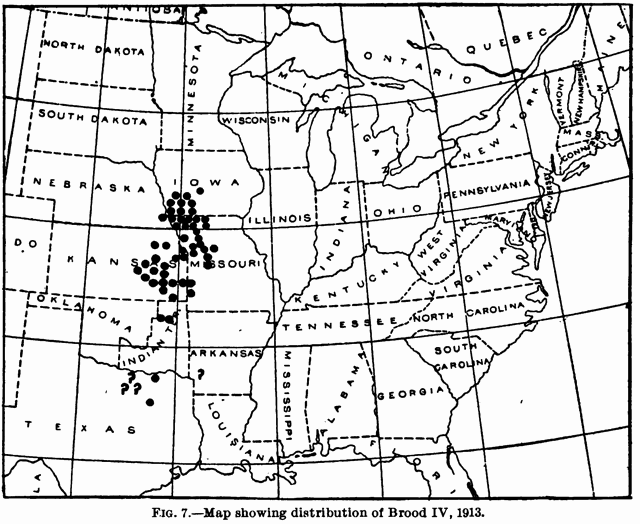
Based on the descriptive criteria given on your website, I feel reasonably certain that we have Magicicada cassini here. (“Here” defined as Longitude: -96.60300 Latitude: 36.24596) The population exploded within the past week or so, the cicadas are black-bodied with no ventral markings, the wings have bright orange borders, and the eyes are a reddish orange. The song is a constant whine, with no pitch variation.
I have a male in a Ziplock Vegetable Bag (built-in perforations allow airflow) in front of me as I write this — and he is seriously annoyed at having his lifecycle interrupted to suit my needs.
They quite unambiguously match the Magicicada photos on your site and elsewhere.
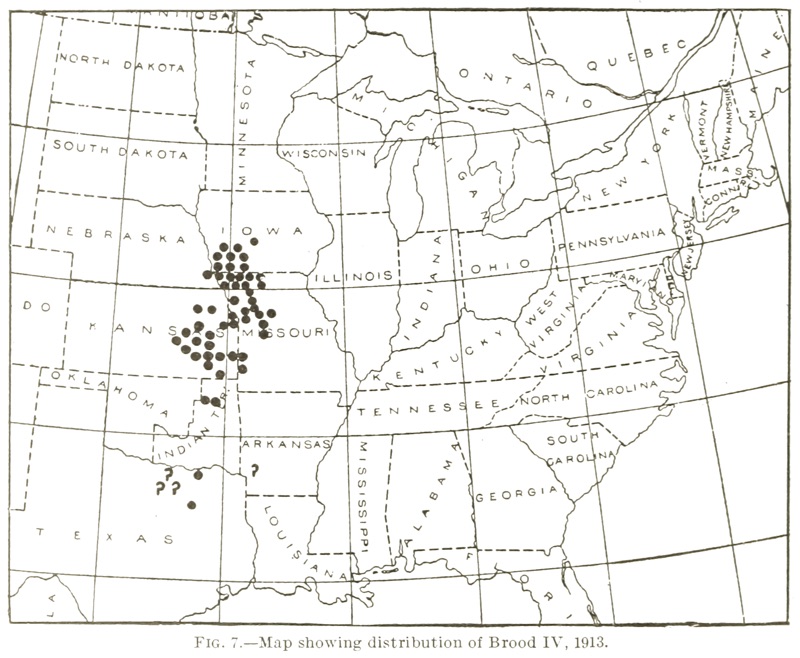
The umich.edu site shows maps for the broods — some are shown as significantly west of the Miss. We are located on the southwestern-most edge of the brood IV map. [Ed: Yeah, My Mistake!]
I mention all of this by way of noting that your “cicada-o-matic” identification page makes the implicit assumption that cicadas found west of the Miss. river are not Magicicada Perhaps the Magicicada are moving westward as the southwest is reforested. The area we live in was treeless grassland 100 years ago — it is mostly forest today. They certainly seem to be happy here.[Ed: Obviously Magicicada do appear west of the Mississippi, but east of the Rockies, my mistake.]
— Kirk or Diane (6/10)
Chilly Cicadas
You say the cicadas are usually gone in two weeks. Well, there have been a few days of cool/cold weather for summer. Will that cause them to stay longer so they can get their business done? [Ed: Maybe they’ll stick around for a few more days, but nothing substantial.]
— Smilee (6/10)
Jeep Thing Checks In
I’m going to put a link to your site on my site if you don’t mind, as most of us backwoods explorers have seen and experienced masses of the little beady eyed bugs here in the Midwest as of recent.
Personally, I love cicada. The things make great temporary companions. They talk back, they love to be petted, they will crawl all over you, and they don’t bite! I think these little bugs are smarter than anyone thinks, and I can’t understand why most people are afraid, bothered, etc. by them. They aren’t particularly good for your trees, but a couple of bagworms can do more damage than a flock of cicada would ever do.
A few points to note about cicada……
If one lands on your ear, coax it to crawl or fly off. They have the grip of a baby human with fingernails. Picking one off your ear could be painful.
They make an exciting SPLAT on your windshield. (I’ve probably hit a couple hundred of them at 65 miles an hour) Wow, guts everywhere. NOTE!!!! Wash them off quick, or their guts will be like dried tree sap soon. It won’t wash off easy when it dries. See those little white capsule things on your windshield??? Those are the eggs…. you just killed an expecting parent!
The discarded larval shell is used in Chinese medicine to cure rashes and sore throats.
Although cicada are found all over the world, the periodical cicada only occurs in North America. Differing broods of cicada vary in size from 1/4 inch to 4 inches in size.
When the cicada emerges from its shell, it is completely white, except the eyes, which are pink…. Colors set in under an hour.
While everyone is busy [cuss omitted] about the arrival of our little friends…… I will enjoy their arrival, and cherish it while it lasts, because I believe they are truly the most amazing treasures of the insect world. I welcome them anytime. [Ed:All Righty Then!]
— Jeep Thing (6/10)
Can’t Sleep
When walking in the woods just west of St. Louis this week, I was amazed by the cicada song. The only cicadas I saw were the Magicicadas with those reddish eyes. I’ve been all over the web, looking for a .wav that sounds like what I heard and the song of the Tibicen chloromera matches perfectly, particularly with the rising & falling chi-chi-chi sound. Help! How could I have seen one type and been deafened by another? I won’t be able to sleep until I get to the bottom of this mystery. [Ed: I’m clueless.]
— Shana (6/10)
Why Not Every Year?
One of your correspondents wondered why there weren’t coincident emergences every year. ( Note if that that were the cases the periodicity of periodical cicadas might never have been noticed!). I suspect the answer is that the vast majority of broods have already gone extinct, so that the coincident emergences even rarer. Several more have gone extinct in the last two hundred years. One of the reasons given for the evolution of periodicity in the first place is that it allows the cicadas to get out of synch with predators. (S. J. Gould has an article somewhere back arguing this also explains why the period is a prime number). But for periodicity to be selected in this fashion it seems that extinction of some broods to occur, for any advantage at all to accrue to the ones that survive. There is evidence of “cheaters” – members of a 17-year brood that emerge early- at 13 years- or vice versa – so that new broods can appear from time to time.
— John Rogers (6/5)
Fish Bait!
Over the Memorial day Holiday I was at the lake of the ozarks trying to enjoy the sun but how can I enjoy anything with all of those Cicada flying into directly into me. They are so bad that I had to go indoors to escape the caos, Although I didn’t enjoy them my boyfriend sure did find a treasure in using them for fish bait. Caught tons of Fish!!!!
— Rchahs (6/5)
More Canines and Cicadas (I need to set up a page just for this topic):
Many vets don’t know of the danger of cicadas and in fact, I have worked at a vet clinic for almost 9 years now and have never heard of it myself. I never thought anything of Emma eating locust but I sat in on the autopsy and I can tell you there were no abnormalities other than the locust in her intestines. In fact the entire small intestine looked normal until you got to the area where the locust were found and from that point back the intestines were in obvious signs of toxic deterioration. She actually died of toxic shock. Her only symptoms were severe vomiting. Even after the autopsy, I still didn’t think that the cicadas were the problem, but when my sister told me she saw it on the St. Louis News I was shocked…all the pieces fell into place. The news story she saw was that many dogs had become ill with severe vomiting and that locust were the problem. Today we had a otherwise healthy dog come into our clinic with severe vomiting. When we obtained a fecal sample we found bits and pieces of some sort of insect….my guess…locust, but there is no way to be sure. I have a theory on the matter but it is just a guess at this point. Emma had a history of constipation and we had to keep her on a very high fat food just to keep her regulated and keep weight on her. I think that cicadas can pass through the dogs system with little or no problems but if the cicada is allowed to digest in the system it becomes toxic to the dog. Just a theory but when I have some more time later this week I plan to call the St. Louis clinics to try to get more information. Thanks for your input on the subject and I’m glad your dog hasn’t become sick. I don’t expect you will have any problems with it but beware if your dog begins vomiting.
— Kim T
Mini-Texas Cicadas
I grew up in CO and so am used to the “dog-day” cicadas. Also have watched them coming out of their “bug suits” in NM–that is where I really learned to love them (I’ve always enjoyed their songs).
However–now I am in Laredo, TX. For the past couple of evenings, I have encountered a cicada look-alike but it is REALLY small! About 1/2 inch total! (well–maybe 3/4 inch) Otherwise, it *looks* exactly like the cicadas I am familiar with. Is it a cicada? (At a truck stop on the way between Houston and San Antonio, I bought a HUGE plastic/rubber cicada–it is about 6 inches long! My younger sister and I always exchange cicada gifts whenever we find them. I figure the truck stop cicada is definitely TX-sized!) [Ed: As usual, if any of you scientists out there have a clue what kind of cicada we have here please email Cicada Mania.]
— Renee L. (6/3)
Chet’s Excretions
My beagle-mix, Chet, loves cicadas, too. The vet said they wouldn’t hurt him but I heard elsewhere that they could be hard on the gastrointestinal tract. I’m putting him on a tie-out to limit his access to them. Otherwise, he roams the yard for more than an hour at a time consuming every cicada in sight. I think my poem artfully describes one of the negative aspects of dogs and cicadas.
Cicadas, my dog, Chet, is eating,
You can see ’em in what he’s excreting!
— D. Smith, Columbia, MO (6/3)
Cicadaphobia
The cicadas here in Decatur, IL are extremely bad!! Today, I went to lay out and they were flying around me everywhere! One landed on me which completely freaked me out. I decided to go inside to avoid them. But later, I was forced to go outside. I was screaming because I didn’t want them to land on me, but my scream seemed to attract them to me! Is it possible that they mistake it for their mating call or something? Well anyway…I was screaming and crying because I am really scared of them. I know they won’t hurt me, but they’re so nasty and big! I don’t want them to land on me. I know it sounds really pitiful to be scared just to go outside, but there are thousands of them and they gross me out! How much longer will they be here?
— Smilee (6/3)
Cicada Pops
I like your cicada site, pretty cool. I live in Columbia, MO where there is a ton all over our trees. It’s kind of interesting to watch them mate, they look at each other…then they come closer…and the rest is history…hehe What’s really cool is you can freeze them quickly, and then UN-freeze them and they’d come back to life! It’s awesome! (I know, it’s kinda cruel to do that, but oh well) I can’t believe the Cicadas are dying out already…Well, bye
— Andrew (6/3)
Dogs and Cicadas
Letter of the week:
Our chow mix dog loves to eat cicadas (in fact we have saved quite a lot on dog food these last few weeks). I called our vet to ask about this habit and found out that cicadas are not toxic, nor do they carry any diseases, so while our dog may get indigestion from consuming too many of these crunchy critters, they won’t kill her.
— M. Gallas (6/2)
13 X 17 = 221
Please elaborate on the unusual emergence this year. The UM site says the concurrent emergence of 17-year and 13-year broods last happened in 1946 and will happen again 2024. Yet posts on your site say this is a 221-year event. [Ed: A particular set of 17 and a 13 year broods will only converge every 221 years. The next time broods XIX and IV converge will be 2219. Because there are other broods which emerge in different years concurrent emergences occur more frequently.]
— Sheri V. (6/2)
Cross Breeding
Do the cicadas have to mate with a compatible mate, such as a [17]yr mates with only a [17]yr or can they cross breed with a 13 yr cicada? [Ed: 17yr and 13 yr species are supposed to be able to interbreed, but since they only coincide once every 221 years, it’s difficult to study the phenomenon.]
— John (6/2)
Kansas
I’m located in South Central Ks. I get on the net to look for info on cicadas and look what I find! All I see here is the 17 year locust. I don’t see any of the 13 year, though I’m told they are emerging as well. Do they prefer different kinds of trees? My property is covered with hackberry, hedge, and some walnut, but they are flying across the road and invading my neighbor, who has a ash that is literally covered with them. They seem to be emerging from my property and flying to my neighbor’s to mate. My walnut trees have them but my hedge and hackberry trees are devoid of all but the hulls. To the lady asking about her sick dog – my big, stupid, black lab has been munching them down for 3 days now with no ill effect [Ed: There are no 13 year broods in South Central KS. Labs love cicadas.]
— FWIW (6/2)
They’re just dying to stay at the Holiday Inn
I was in Decatur, Illinois this weekend and the Cicada were everywhere. The trees were full of them, they were dying on the parking lot and they covered the Holiday Inn. I didn’t know what they were until I got back to work and started asking around. Then I found your website. I’m just hoping they stay away from the Champaign-Urbana area.
— Vicki (6/2)
Terror in the Skies!
I caught part of a news story off satellite (it was a network tv news station originating from Nashville, TN) that said an airplane was refused a divert request to land or return or something when the pilots said the plane was covered in cicadas. I missed the majority of the story and would like to know the details if anyone knows about this one. The event occurred the last full week of May. [Ed. Awesome. If anyone knows anymore about this story please let me know.]
— K D (6/2)
Disclaimer: The information on this page is present for entertainment purposes only. Don’t let your pets or children eat cicadas…
A very sad letter…
Today I am mourning the loss of my daughter’s dog. The irony of it all is that my daughter had just come home from the hospital. She had a pretty major surgery and when we got home we noticed that ‘Emma’ didn’t come to greet us. We went to look for her and found that she had dug a hole near the pond and was almost dead. We rushed her to the vet and she died that night. A necropsy (autopsy) showed she died of toxemia although the source wasn’t known. We did however find several cicadas in her intestines. My vet is unsure of the effects that cicada have on dogs but while telling my sister of Emma’s death she said that she say on a St. Louis TV station about many dogs becoming ill from eating locust. One Email you displayed says, ‘[Ed: There are probably too many Cicadas for the birds to deal with. Try a large, stupid dog. They love to eat cicadas.] –Elaine F (5/28)’ Guess what? It’s not funny! Not to me and definitely not to my 10 year old daughter who just spend 5 hours on the operating room table and came home to find her dog sick. The fact that Emma chased anything that crawled, flew, jumped, buzzed, swam, chirped or slithered was part of the joy of owning her. She would stand half emerged in the pond and dare a turtle to pop his head up….the minute she saw one she’d splash her way to him…always too late of course but she’d be right back at it. At times it seemed the turtles loved it as much as she did. Please let me know if anyone has any source as to the toxicity of cicadas on dogs. My email is [removed] [Ed: My most sincere condolences. If anyone can help this woman, please do.]
— Kim G (6/1)
Response to Elaine
Our Guineas love them. They spot one, take off, and don’t give until they have that little sucker for dinner. Of course, they have really done little for the Cicada population in general. But I am marking my calendar for 13 years to make sure I have a herd of Guineas to greet the next invasion. (Poplar Bluff, MO)
— Trudy (6/1)
Stinky
Glad to know that someone else agrees it’s rotting cicadas that’s raising that stink. It’s what I’ve been saying but everyone else says nah it’s probably your missing cat. [Ed: The cat came back, but it’s missing an eye (seriously).]
— Anne T (6/1)
More Missouri Madness…
The 17 year cycle is in full bloom in eastern Jackson county Missouri. Last weekend (5-23-98) the nymphs were just starting to come up, but by 5-30-98, the cicadas were certainly making themselves known. A walk through the woods would bring you a deafening roar accompanied by a flying frenzy reminding me of Hitchcock’s “The Birds”. Enough already.[Ed: The worst is yet to come. One word: Larvae]
— Steve H. (6/1)
Missouri, hot spot for Cicadas…
wow, the cicada’s are in full song here in mid Missouri. i was sitting around bored today listening to them, as if i could avoid it, and i decided to find out more by looking on the web for info. came across this site and low and behold found the info i was looking for. Actually I think the comments and other info on here are quite funny. Interesting that the majority of the letters I read on here are from people in Missouri. Is mo. a hot spot of cicadas? [Ed. This year, yes. An emergence like this only happens every 221 years.] The noise can be deafening. Went fishing [Ed: They make good bait.] And every single shoreline we pulled up to was awash in The “song” of The cicada. I think The t shirt Is a great idea that if planned for and marketed correctly probably would make a lot of money right now. Seeing tons of The orange winged ones, Magicicada? [Ed: Yes] anyway, thanks for The site, I enjoyed it. Looking forward for The madness to stop and for peace and quiet to return.
— Ubkwts (6/1)
So what do they eat…
Could you tell me what The cicadas eat because there are hundreds of them in my front yard? I live in south St. Louis County? [Ed: For The most part adult Magicicada don’t eat, although they are equipped to suck tree fluids. They live off their body mass, mate and die. Larvae drink The fluid of tree limbs. Nymphs suck sap from roots.]
— S (6/1)
No Cicadas
We are having a blast reading your site. The cicadas have not hit us here at Crossville, TN yet… Don’t know why….We are on The Cumberland Plateau about 35 miles east of Cookeville, TN. In Cookeville on Thurs. we heard them and some trees are swathed in cheesecloth. Last year we could hear The cicadas after dark . But it seems like it was later in The summer. Could it be our elevation means a later hatch?? Guess they are really humming in Lebanon, TN about 25 miles E. of Nashville. [Ed: Unfortunately broods die out from time to time in some areas. New construction, tree removal and pesticides can take their toll….or there just aren’t and Magicicada in your town. That’s a distinct possibility. The cicadas that emerge later in The year are a different Genus of cicada.]
— Eleanor M. (6/1)
Hilarious Entertainment
Now I’ve seen it all…a website for The cicada! WOW! Columbia, Missouri. Is under The same attack as The rest of you. My two year old daughter loves to pull them off The trees and house and hold them by their wings and delights in their buzzing sounds. While I wouldn’t dream of letting her “torture” any other living creature, this I find to be hilarious entertainment! [Ed: We at Cicada Mania wholeheartedly agree.]
— Sarah (6/1)
Fishing Bait!
Here a good use for those annoying bugs. FISHING BAIT! My brother caught a alb. 21 inch bass on a cicada. He Is now getting it mounted. [Ed: Yep, they make excellent bait, but don’t feed them to your pet fish.]
— Gina (6/1)
Abandon all hope…
We live in mid-Mo. We have had Cicadas for several weeks, but today they are without a doubt taking over our trees, deck and yard. We live on a one acre lot near Truman Lake, in The Ozarks, and have an Ash tree in The middle of my deck. The Ash tree Is covered with Cicadas and The other trees in our yard are likewise infested. We are unable to utilize our deck because of The Cicadas. When will this stop? Is there anything we can spray on our deck and/or trees to at least chase them back into The wooded area behind our property? I don’t necessarily want to kill them, but I can not even go outside to take care of my flower garden. When my husband comes inside after working his vegetable garden we have to inspect him and his clothing. We have killed 4 of them inside The house. Is there anything we can do to chase them away? [Ed: There’s really nothing you can do. They’ll be gone in a week or so, but beware of The larvae that follows.]
— Claudean H (6/1)
Awesome
We’ll The little Cicadas have finally decided to surface. `At least 20 kinds of cicadas live in Missouri. Six are periodical cicadas, which have The longest life cycle of any cicada, and occur only in eastern North America. Approx.[ED: Exactly] every 221 years The emergence of a pair coincides. Which enabling The two groups ;to interbreed. This year represents The first year since 1777 that two large broods of 17-and 13-year cicadas have emerged together in Missouri. The last time periodical cicadas emerged in large numbers here was in 1985, when 13-year cicadas emerged. The “chorus” of periodical cicadas can produce sound levels that are painful to human ears, they can even drown out lawn mowers. I found all this information in our MISSOURI. CONSERVATIONIST magazine. I seems like there are millions of them, but they’ll be all gone in about five weeks or so.
— Stacy K. (6/1)






Cicada Mail from June 1998
Tuscon Cicadas
What a beautiful page !!! Can’t wait until 7 and 13 yr old sons get home from yr-round school so they can see this. In the last week they have beome cicada-maniacs. I must admit that I’ve always the chills at the thought of touching a live cicada, but there’s nothing like a seven yr old carrying them around the house to make you see the light. He brought in one with a cactus thorn in it’s leg and now I feel like the mouse pulling the thorn from the lion’s paw. I’m sure they won’t hurt me now because I was able to overcome my fear and be a good samaritan. I realize now, how lovely the song is that they sing. Thanks for all the information.
— Lynn 😉 Tucson
P.S. The cicadas are also keeping Patches (our dalmation who defends the yard from all local creatures) busy so the horned lizards and tarantulas can have some peace. (6/16)
The Love Vac
I was cleaning up the cars yesterday (6/13) here in St. Louis, MO and the cicadas fell in love with my Shop Vac. Must be the noise is similar to their mating call. They are very much on the wane now after one heck of a population explosion (you can actually carry on a conversation in the back yard now), but >they came out of hiding to check out that Hunk of a vac.
— Lee (6/15)
Happy Cicadas
Based on the descriptive criteria given on your website, I feel reasonably certain that we have Magicicada cassini here. (“Here” defined as Longitude: -96.60300 Latitude: 36.24596) The population exploded within the past week or so, the cicadas are black-bodied with no ventral markings, the wings have bright orange borders, and the eyes are a reddish orange. The song is a constant whine, with no pitch variation.
I have a male in a Ziplock Vegetable Bag (built-in perforations allow airflow) in front of me as I write this — and he is seriously annoyed at having his lifecycle interrupted to suit my needs.
They quite unambiguously match the Magicicada photos on your site and elsewhere.
The umich.edu site shows maps for the broods — some are shown as significantly west of the Miss. We are located on the southwestern-most edge of the brood IV map. [Ed: Yeah, My Mistake!]
I mention all of this by way of noting that your “cicada-o-matic” identification page makes the implicit assumption that cicadas found west of the Miss. river are not Magicicada Perhaps the Magicicada are moving westward as the southwest is reforested. The area we live in was treeless grassland 100 years ago — it is mostly forest today. They certainly seem to be happy here.[Ed: Obviously Magicicada do appear west of the Mississippi, but east of the Rockies, my mistake.]
— Kirk or Diane (6/10)
Chilly Cicadas
You say the cicadas are usually gone in two weeks. Well, there have been a few days of cool/cold weather for summer. Will that cause them to stay longer so they can get their business done? [Ed: Maybe they’ll stick around for a few more days, but nothing substantial.]
— Smilee (6/10)
Jeep Thing Checks In
I’m going to put a link to your site on my site if you don’t mind, as most of us backwoods explorers have seen and experienced masses of the little beady eyed bugs here in the Midwest as of recent.
Personally, I love cicada. The things make great temporary companions. They talk back, they love to be petted, they will crawl all over you, and they don’t bite! I think these little bugs are smarter than anyone thinks, and I can’t understand why most people are afraid, bothered, etc. by them. They aren’t particularly good for your trees, but a couple of bagworms can do more damage than a flock of cicada would ever do.
A few points to note about cicada……
If one lands on your ear, coax it to crawl or fly off. They have the grip of a baby human with fingernails. Picking one off your ear could be painful.
They make an exciting SPLAT on your windshield. (I’ve probably hit a couple hundred of them at 65 miles an hour) Wow, guts everywhere. NOTE!!!! Wash them off quick, or their guts will be like dried tree sap soon. It won’t wash off easy when it dries. See those little white capsule things on your windshield??? Those are the eggs…. you just killed an expecting parent!
The discarded larval shell is used in Chinese medicine to cure rashes and sore throats.
Although cicada are found all over the world, the periodical cicada only occurs in North America. Differing broods of cicada vary in size from 1/4 inch to 4 inches in size.
When the cicada emerges from its shell, it is completely white, except the eyes, which are pink…. Colors set in under an hour.
While everyone is busy [cuss omitted] about the arrival of our little friends…… I will enjoy their arrival, and cherish it while it lasts, because I believe they are truly the most amazing treasures of the insect world. I welcome them anytime. [Ed:All Righty Then!]
— Jeep Thing (6/10)
Can’t Sleep
When walking in the woods just west of St. Louis this week, I was amazed by the cicada song. The only cicadas I saw were the Magicicadas with those reddish eyes. I’ve been all over the web, looking for a .wav that sounds like what I heard and the song of the Tibicen chloromera matches perfectly, particularly with the rising & falling chi-chi-chi sound. Help! How could I have seen one type and been deafened by another? I won’t be able to sleep until I get to the bottom of this mystery. [Ed: I’m clueless.]
— Shana (6/10)
Why Not Every Year?
One of your correspondents wondered why there weren’t coincident emergences every year. ( Note if that that were the cases the periodicity of periodical cicadas might never have been noticed!). I suspect the answer is that the vast majority of broods have already gone extinct, so that the coincident emergences even rarer. Several more have gone extinct in the last two hundred years. One of the reasons given for the evolution of periodicity in the first place is that it allows the cicadas to get out of synch with predators. (S. J. Gould has an article somewhere back arguing this also explains why the period is a prime number). But for periodicity to be selected in this fashion it seems that extinction of some broods to occur, for any advantage at all to accrue to the ones that survive. There is evidence of “cheaters” – members of a 17-year brood that emerge early- at 13 years- or vice versa – so that new broods can appear from time to time.
— John Rogers (6/5)
Fish Bait!
Over the Memorial day Holiday I was at the lake of the ozarks trying to enjoy the sun but how can I enjoy anything with all of those Cicada flying into directly into me. They are so bad that I had to go indoors to escape the caos, Although I didn’t enjoy them my boyfriend sure did find a treasure in using them for fish bait. Caught tons of Fish!!!!
— Rchahs (6/5)
More Canines and Cicadas (I need to set up a page just for this topic):
Many vets don’t know of the danger of cicadas and in fact, I have worked at a vet clinic for almost 9 years now and have never heard of it myself. I never thought anything of Emma eating locust but I sat in on the autopsy and I can tell you there were no abnormalities other than the locust in her intestines. In fact the entire small intestine looked normal until you got to the area where the locust were found and from that point back the intestines were in obvious signs of toxic deterioration. She actually died of toxic shock. Her only symptoms were severe vomiting. Even after the autopsy, I still didn’t think that the cicadas were the problem, but when my sister told me she saw it on the St. Louis News I was shocked…all the pieces fell into place. The news story she saw was that many dogs had become ill with severe vomiting and that locust were the problem. Today we had a otherwise healthy dog come into our clinic with severe vomiting. When we obtained a fecal sample we found bits and pieces of some sort of insect….my guess…locust, but there is no way to be sure. I have a theory on the matter but it is just a guess at this point. Emma had a history of constipation and we had to keep her on a very high fat food just to keep her regulated and keep weight on her. I think that cicadas can pass through the dogs system with little or no problems but if the cicada is allowed to digest in the system it becomes toxic to the dog. Just a theory but when I have some more time later this week I plan to call the St. Louis clinics to try to get more information. Thanks for your input on the subject and I’m glad your dog hasn’t become sick. I don’t expect you will have any problems with it but beware if your dog begins vomiting.
— Kim T
Mini-Texas Cicadas
I grew up in CO and so am used to the “dog-day” cicadas. Also have watched them coming out of their “bug suits” in NM–that is where I really learned to love them (I’ve always enjoyed their songs).
However–now I am in Laredo, TX. For the past couple of evenings, I have encountered a cicada look-alike but it is REALLY small! About 1/2 inch total! (well–maybe 3/4 inch) Otherwise, it *looks* exactly like the cicadas I am familiar with. Is it a cicada? (At a truck stop on the way between Houston and San Antonio, I bought a HUGE plastic/rubber cicada–it is about 6 inches long! My younger sister and I always exchange cicada gifts whenever we find them. I figure the truck stop cicada is definitely TX-sized!) [Ed: As usual, if any of you scientists out there have a clue what kind of cicada we have here please email Cicada Mania.]
— Renee L. (6/3)
Chet’s Excretions
My beagle-mix, Chet, loves cicadas, too. The vet said they wouldn’t hurt him but I heard elsewhere that they could be hard on the gastrointestinal tract. I’m putting him on a tie-out to limit his access to them. Otherwise, he roams the yard for more than an hour at a time consuming every cicada in sight. I think my poem artfully describes one of the negative aspects of dogs and cicadas.
Cicadas, my dog, Chet, is eating,
You can see ’em in what he’s excreting!
— D. Smith, Columbia, MO (6/3)
Cicadaphobia
The cicadas here in Decatur, IL are extremely bad!! Today, I went to lay out and they were flying around me everywhere! One landed on me which completely freaked me out. I decided to go inside to avoid them. But later, I was forced to go outside. I was screaming because I didn’t want them to land on me, but my scream seemed to attract them to me! Is it possible that they mistake it for their mating call or something? Well anyway…I was screaming and crying because I am really scared of them. I know they won’t hurt me, but they’re so nasty and big! I don’t want them to land on me. I know it sounds really pitiful to be scared just to go outside, but there are thousands of them and they gross me out! How much longer will they be here?
— Smilee (6/3)
Cicada Pops
I like your cicada site, pretty cool. I live in Columbia, MO where there is a ton all over our trees. It’s kind of interesting to watch them mate, they look at each other…then they come closer…and the rest is history…hehe What’s really cool is you can freeze them quickly, and then UN-freeze them and they’d come back to life! It’s awesome! (I know, it’s kinda cruel to do that, but oh well) I can’t believe the Cicadas are dying out already…Well, bye
— Andrew (6/3)
Dogs and Cicadas
Letter of the week:
Our chow mix dog loves to eat cicadas (in fact we have saved quite a lot on dog food these last few weeks). I called our vet to ask about this habit and found out that cicadas are not toxic, nor do they carry any diseases, so while our dog may get indigestion from consuming too many of these crunchy critters, they won’t kill her.
— M. Gallas (6/2)
13 X 17 = 221
Please elaborate on the unusual emergence this year. The UM site says the concurrent emergence of 17-year and 13-year broods last happened in 1946 and will happen again 2024. Yet posts on your site say this is a 221-year event. [Ed: A particular set of 17 and a 13 year broods will only converge every 221 years. The next time broods XIX and IV converge will be 2219. Because there are other broods which emerge in different years concurrent emergences occur more frequently.]
— Sheri V. (6/2)
Cross Breeding
Do the cicadas have to mate with a compatible mate, such as a [17]yr mates with only a [17]yr or can they cross breed with a 13 yr cicada? [Ed: 17yr and 13 yr species are supposed to be able to interbreed, but since they only coincide once every 221 years, it’s difficult to study the phenomenon.]
— John (6/2)
Kansas
I’m located in South Central Ks. I get on the net to look for info on cicadas and look what I find! All I see here is the 17 year locust. I don’t see any of the 13 year, though I’m told they are emerging as well. Do they prefer different kinds of trees? My property is covered with hackberry, hedge, and some walnut, but they are flying across the road and invading my neighbor, who has a ash that is literally covered with them. They seem to be emerging from my property and flying to my neighbor’s to mate. My walnut trees have them but my hedge and hackberry trees are devoid of all but the hulls. To the lady asking about her sick dog – my big, stupid, black lab has been munching them down for 3 days now with no ill effect [Ed: There are no 13 year broods in South Central KS. Labs love cicadas.]
— FWIW (6/2)
They’re just dying to stay at the Holiday Inn
I was in Decatur, Illinois this weekend and the Cicada were everywhere. The trees were full of them, they were dying on the parking lot and they covered the Holiday Inn. I didn’t know what they were until I got back to work and started asking around. Then I found your website. I’m just hoping they stay away from the Champaign-Urbana area.
— Vicki (6/2)
Terror in the Skies!
I caught part of a news story off satellite (it was a network tv news station originating from Nashville, TN) that said an airplane was refused a divert request to land or return or something when the pilots said the plane was covered in cicadas. I missed the majority of the story and would like to know the details if anyone knows about this one. The event occurred the last full week of May. [Ed. Awesome. If anyone knows anymore about this story please let me know.]
— K D (6/2)
Disclaimer: The information on this page is present for entertainment purposes only. Don’t let your pets or children eat cicadas…
A very sad letter…
Today I am mourning the loss of my daughter’s dog. The irony of it all is that my daughter had just come home from the hospital. She had a pretty major surgery and when we got home we noticed that ‘Emma’ didn’t come to greet us. We went to look for her and found that she had dug a hole near the pond and was almost dead. We rushed her to the vet and she died that night. A necropsy (autopsy) showed she died of toxemia although the source wasn’t known. We did however find several cicadas in her intestines. My vet is unsure of the effects that cicada have on dogs but while telling my sister of Emma’s death she said that she say on a St. Louis TV station about many dogs becoming ill from eating locust. One Email you displayed says, ‘[Ed: There are probably too many Cicadas for the birds to deal with. Try a large, stupid dog. They love to eat cicadas.] –Elaine F (5/28)’ Guess what? It’s not funny! Not to me and definitely not to my 10 year old daughter who just spend 5 hours on the operating room table and came home to find her dog sick. The fact that Emma chased anything that crawled, flew, jumped, buzzed, swam, chirped or slithered was part of the joy of owning her. She would stand half emerged in the pond and dare a turtle to pop his head up….the minute she saw one she’d splash her way to him…always too late of course but she’d be right back at it. At times it seemed the turtles loved it as much as she did. Please let me know if anyone has any source as to the toxicity of cicadas on dogs. My email is [removed] [Ed: My most sincere condolences. If anyone can help this woman, please do.]
— Kim G (6/1)
Response to Elaine
Our Guineas love them. They spot one, take off, and don’t give until they have that little sucker for dinner. Of course, they have really done little for the Cicada population in general. But I am marking my calendar for 13 years to make sure I have a herd of Guineas to greet the next invasion. (Poplar Bluff, MO)
— Trudy (6/1)
Stinky
Glad to know that someone else agrees it’s rotting cicadas that’s raising that stink. It’s what I’ve been saying but everyone else says nah it’s probably your missing cat. [Ed: The cat came back, but it’s missing an eye (seriously).]
— Anne T (6/1)
More Missouri Madness…
The 17 year cycle is in full bloom in eastern Jackson county Missouri. Last weekend (5-23-98) the nymphs were just starting to come up, but by 5-30-98, the cicadas were certainly making themselves known. A walk through the woods would bring you a deafening roar accompanied by a flying frenzy reminding me of Hitchcock’s “The Birds”. Enough already.[Ed: The worst is yet to come. One word: Larvae]
— Steve H. (6/1)
Missouri, hot spot for Cicadas…
wow, the cicada’s are in full song here in mid Missouri. i was sitting around bored today listening to them, as if i could avoid it, and i decided to find out more by looking on the web for info. came across this site and low and behold found the info i was looking for. Actually I think the comments and other info on here are quite funny. Interesting that the majority of the letters I read on here are from people in Missouri. Is mo. a hot spot of cicadas? [Ed. This year, yes. An emergence like this only happens every 221 years.] The noise can be deafening. Went fishing [Ed: They make good bait.] And every single shoreline we pulled up to was awash in The “song” of The cicada. I think The t shirt Is a great idea that if planned for and marketed correctly probably would make a lot of money right now. Seeing tons of The orange winged ones, Magicicada? [Ed: Yes] anyway, thanks for The site, I enjoyed it. Looking forward for The madness to stop and for peace and quiet to return.
— Ubkwts (6/1)
So what do they eat…
Could you tell me what The cicadas eat because there are hundreds of them in my front yard? I live in south St. Louis County? [Ed: For The most part adult Magicicada don’t eat, although they are equipped to suck tree fluids. They live off their body mass, mate and die. Larvae drink The fluid of tree limbs. Nymphs suck sap from roots.]
— S (6/1)
No Cicadas
We are having a blast reading your site. The cicadas have not hit us here at Crossville, TN yet… Don’t know why….We are on The Cumberland Plateau about 35 miles east of Cookeville, TN. In Cookeville on Thurs. we heard them and some trees are swathed in cheesecloth. Last year we could hear The cicadas after dark . But it seems like it was later in The summer. Could it be our elevation means a later hatch?? Guess they are really humming in Lebanon, TN about 25 miles E. of Nashville. [Ed: Unfortunately broods die out from time to time in some areas. New construction, tree removal and pesticides can take their toll….or there just aren’t and Magicicada in your town. That’s a distinct possibility. The cicadas that emerge later in The year are a different Genus of cicada.]
— Eleanor M. (6/1)
Hilarious Entertainment
Now I’ve seen it all…a website for The cicada! WOW! Columbia, Missouri. Is under The same attack as The rest of you. My two year old daughter loves to pull them off The trees and house and hold them by their wings and delights in their buzzing sounds. While I wouldn’t dream of letting her “torture” any other living creature, this I find to be hilarious entertainment! [Ed: We at Cicada Mania wholeheartedly agree.]
— Sarah (6/1)
Fishing Bait!
Here a good use for those annoying bugs. FISHING BAIT! My brother caught a alb. 21 inch bass on a cicada. He Is now getting it mounted. [Ed: Yep, they make excellent bait, but don’t feed them to your pet fish.]
— Gina (6/1)
Abandon all hope…
We live in mid-Mo. We have had Cicadas for several weeks, but today they are without a doubt taking over our trees, deck and yard. We live on a one acre lot near Truman Lake, in The Ozarks, and have an Ash tree in The middle of my deck. The Ash tree Is covered with Cicadas and The other trees in our yard are likewise infested. We are unable to utilize our deck because of The Cicadas. When will this stop? Is there anything we can spray on our deck and/or trees to at least chase them back into The wooded area behind our property? I don’t necessarily want to kill them, but I can not even go outside to take care of my flower garden. When my husband comes inside after working his vegetable garden we have to inspect him and his clothing. We have killed 4 of them inside The house. Is there anything we can do to chase them away? [Ed: There’s really nothing you can do. They’ll be gone in a week or so, but beware of The larvae that follows.]
— Claudean H (6/1)
Awesome
We’ll The little Cicadas have finally decided to surface. `At least 20 kinds of cicadas live in Missouri. Six are periodical cicadas, which have The longest life cycle of any cicada, and occur only in eastern North America. Approx.[ED: Exactly] every 221 years The emergence of a pair coincides. Which enabling The two groups ;to interbreed. This year represents The first year since 1777 that two large broods of 17-and 13-year cicadas have emerged together in Missouri. The last time periodical cicadas emerged in large numbers here was in 1985, when 13-year cicadas emerged. The “chorus” of periodical cicadas can produce sound levels that are painful to human ears, they can even drown out lawn mowers. I found all this information in our MISSOURI. CONSERVATIONIST magazine. I seems like there are millions of them, but they’ll be all gone in about five weeks or so.
— Stacy K. (6/1)