Ricky B sent us this sound file of a cicada that he recorded in August of 2010 in Chicago:
Can you guess which species it is?
Hint: try sites like Insect Singers and Songs of Insects sites for ideas.
Ricky B sent us this sound file of a cicada that he recorded in August of 2010 in Chicago:
Can you guess which species it is?
Hint: try sites like Insect Singers and Songs of Insects sites for ideas.
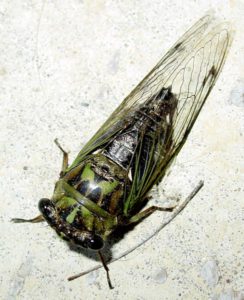
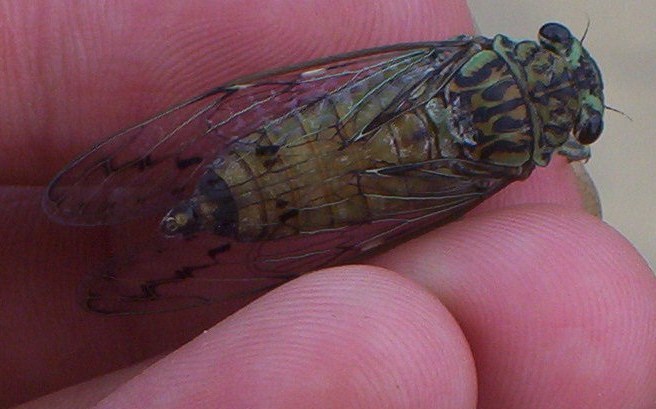
H is for Hieroglyphic Cicada. The Neocicada hieroglyphica a.k.a. Hieroglyphic Cicada is found in the south-eastern United States. It’s active in the late spring and early summer. There are multiple subspecies of the Hieroglyphic Cicada including the Neocicada hieroglyphica hieroglyphica and Neocicada hieroglyphica johannis, according to InsectSingers.com.

Photo by Matt Berger.
Listen to a Hieroglyphic Cicada:
Neocicada hieroglyphica singing by Joe Green from Cicada Mania on Vimeo.
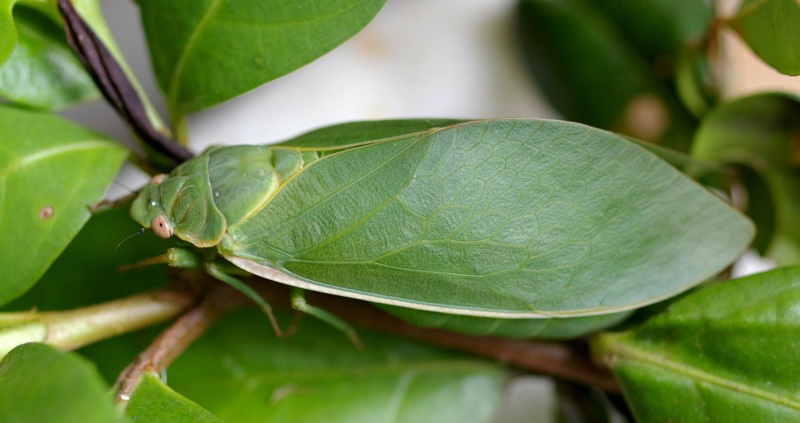
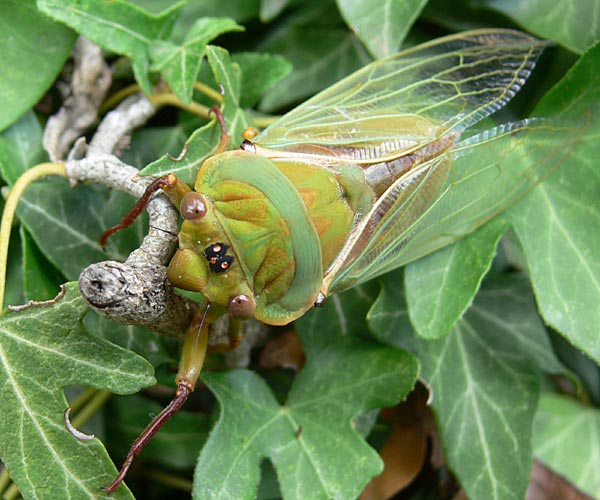
(Photo by Huechys sanguinea by =spurdog=, on Flickr). G is for Greengrocer. The Greengrocer is the green morph of the Australian cicada Cyclochila australasiae. These cicadas can be found in south-eastern Australia. They have a large pronotal collar, and if you use your imagination, it looks like they’re wearing a tiny Pith helmet above their eyes.
Here’s a close of up of a Greengrocer (from Bron):

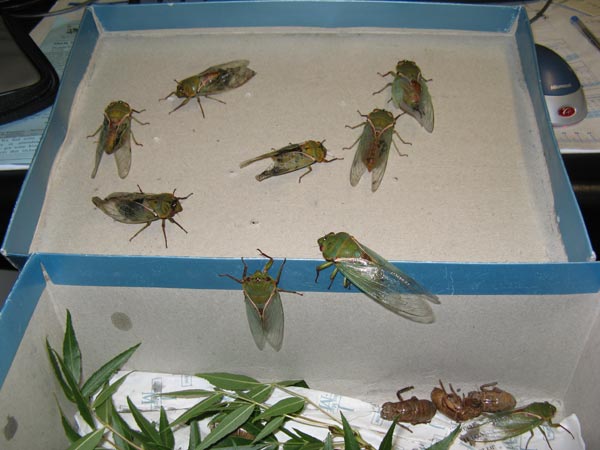
Here’s a box of Greengrocers (from Kevin Lee):

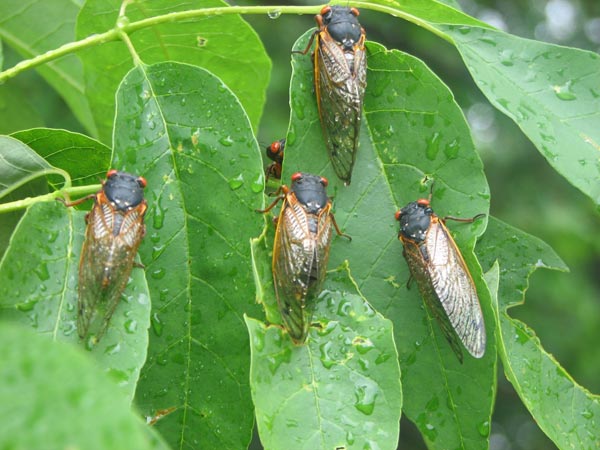
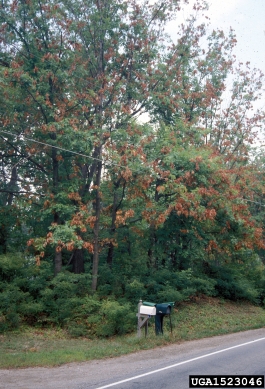
F is for flagging. Flagging is the term for when leaves of a tree die as a result of oviposition (when the cicada lays eggs in the branches of trees).

Photo credit: Daniel Herms, The Ohio State University, Bugwood.org (Forestry Images).
The Floury Baker, aka Aleeta curvicosta, is an Australian cicada. It has excellent camouflage, as you can see from the photo:

Photo credit: Michelle Thompson.
Fidicina is a Genus of cicadae. Here is a photo of a Fidicina mannifera from Brazil:

Photo by Leonardo Milhomem.
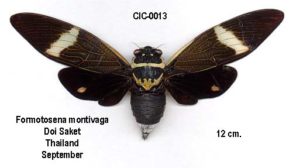
Formotosena is a Genus of cicada. Here is a photo of a Formotosena montivaga from Thailand:

Photo by Michel Chantraine.
Hey,
If you’re interested in North American cicada species, and you’re looking for sound files of those cicada’s songs, check out Insect Singers, a new website from cicada researchers David Marshall and Kathy Hill. It has dozens of audio samples. Awesome!
Thanks for Suzanne M for the scan of the Archie McPhee catalog featuring the amazing cicada keychain.

I actually finally found one of these thanks to a family member.
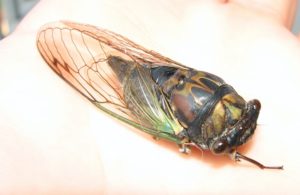
D is for Dog-Day Cicada. The Tibicen canicularis, aka Dog-Day Cicada, is thought to be known as the Dog-Day Cicada because they are most active during the “dog days of summer”, which are the days when the star Sirius is visible in the Northern Hemishphere (July 3-August 11)1. Canicularis is derived from the Latin word canis, which means dog. Tibicen davisi is known as the Southern Dog-Day Cicada. Folks use the term “Dog-Day Cicada” for other species of Tibicen as well, but the T. canicularis the true Dog-Day Cicada.
Image of a N. canicularis (on the left) and N. davisi by Paul Krombholz:

Diceroprocta is a genus of cicadas that exist in North America.
Diemeniana euronotiana is a pretty black, orange and red cicada that exists in south-eastern coastal area of Australia2. See a photo of a Diemeniana euronotiana.
The Double Drummer aka Thopha saccata is an Australian cicada. It exists on the east coast of Australia and prefers eucalyptus trees2. The Double Drummer is a large cicada, as you can see from this photo.
Dundubia is a genus of cicada that exists in Asia. See a photo of a disected Dundbia on Cicada Mania.
We’ve discussed, in previous posts, issues with the naming of Tibicen cicadas; first there were gender agreement issues and then the naming of Tibicen tibicen cicadas (which most people still refer to as Tibicen chloromera).
The gender issue deals with agreement of the Genus and species name. Tibicen superba, for instance, should be called Tibicen superbus since the “en” in Tibicen is male, and the ending of suberbus needs to match that with “us”.
Quoting from Bug Guide1:
“All the —a endings in the species of Tibicen need to be —us, e.g. bifida should be bifidus”, per Allen Sanborn (Barry University, Florida), pers. comm., 2008. (Note, many taxonomists working on larger groups, e.g. leps, have abandoned gender agreement, but apparently this isn’t the case with Cicadas. MQ)
The story for Tibicen chloromera is a bit different. First, chloromera needed to be changed to chloromerus because of the gender agreement issue. Then that had to be changed to Tibicen tibicen because historically this particular cicada was referred to as Tibicen tibicen before Tibicen chloromera. This could be changed, if someone found a precedent of the insect being called a Tibicen chloromera, but then still we’d have to call it a Tibicen chloromerus because of the gender agreement issue.
Quoting from Bug Guide again2:
The long-standing name for this common species, Tibicen chlormera, has apparently been changed to Tibicen tibicen based on priority. See Synonyms and references. –Cotinis 17 October 2008.
That being said, most folks on the web call the Tibicen tibicen “Tibicen chloromera” to this day. Whether this is an act of rebellion, force of habit, loyalty to other researchers who don’t agree with the name change, I’m not sure.
Taxonomic name changes discussed, lets move to common Tibicen names.
Our last post featured Elias Bonaros photo of a Tibicen auletes, which I labeled a Scissor-grinder, a common name for the insect — or so I thought. Elias was quick to point out that other resources call another cicada, the Tibicen pruinosus, a Scissor-grinder. Elias is no slouch when it comes to cicada information, and he has correctly corrected me in the past in mistakes I’ve made, but I needed to figure out where i got my possibly erroneous information from.
Bug Guide calles the T. auletes a Scissor-grinder3 as well as Northern Dusk-singing cicada, as does another IOWA State website4.
University of Florida scientists/researchers, on the other hand, call the Tibicen pruinosus5 a Scissor-grinder as does the Song of Insects6 website. The University of Florida document doesn’t provide a common name for T. auletes, but the Song of Insects site refers to them as Northern Dusk-singing Cicadas.
So… any tie breakers out there? It could be that in the South the T. pruinosus is the Scissor-grinder and in the Mid-west it’s the T. auletes.
Here’s my list of references:
New Tibicen auletes photos from Elias Bonaros.
The Tibicen auletes aka Northern Dusk-singing Cicada is the largest of the Tibicen cicadas in the U.S.A.