Found on Flickr.

Red, orange, blue and green!
 Cicada Mania
Found on Flickr.
Red, orange, blue and green!
N is for nymph. Cicadas spend most of their life in their nymph form, burrowing underground, drinking the fluids of plant roots, growing larger… waiting for the day they emerge and transform into adult cicadas. Here is a photo of a tiny 1st instar nymph, and this is a video of full-grown nymphs that have emerged from the ground:
Magicicada cicada nymph mania from Cicada Mania on Vimeo.
Neocicada hieroglyphica, which was covered in Cicada Alphabet H.
M is for Magicicada. Magicicada is a genus of North American cicadas best known for their 17 or 13 year life cycles, and for the overwhelming numbers in which they emerge. Magicicadas are organized into broods, which emerge in specific years, in specific locations in 17 or 13 year cycles. There are seven species of Magicicada, the 17 year varieties: septendecim, cassini, septendecula, and the 13 year varieties: neotredecim, tredecim, tredecassini and tredecula. Each species is slightly different in coloring, song or other attributes. Magicicada are also know as periodical cicadas and “locusts”.
Magicicada on my finger by Dan from Cicada Mania on Vimeo.
Macrosemia is a genus of cicadas that exists in Asia. See a photo of a Macrosemia chantrainei and Macrosemia tonkiniana from Thailand.
C.L. Marlatt is best know for his study and documentation of periodical cicadas. Marlatt was an assistant entomologist working for the U.S. Dept. of Agriculture, Division of Entomology in the late 19th century when he produced the bulletin “The periodical cicada: an account of Cicada septendecim, its natural enemies and the means of preventing its injury : together with a summary of the distribution of the different broods”. You can read this document on the USDA website.
David Marshall is a cicada researcher well known for his research of cicadas of North America, Australia and New Zealand. Visit Insect Singers, David’s website; it’s packed with cicada photos and sound files, critical for identifying cicadas.
The Masked Devil is an orange and black color variation of the Cyclochila australasiae cicada found in Australia. See a picture of a Masked Devil. The green variety of this cicada is called the Green Grocer.
Massospora cicadina is a fungus that afflicts Magicicadas. The fungus is sexually transmitted, and destroys the abdomen of the afflicted cicada.
The Oncotympana maculaticollis a.k.a. Minmin-zemi is a Japanese cicada with a distinctive call, which sounds like its name: “min min minnnnnnnn”. If you’ve watched enough Japanese films or cartoons, you’ll recognize this cicada’s call. Visit the Cicadae in Japan site for photos and images.
Thomas E. Moore is a cicada researcher and curator of the University of Michigan Museum of Zoology. Visit Singing Insects of North America for cicada information collected by Moore.
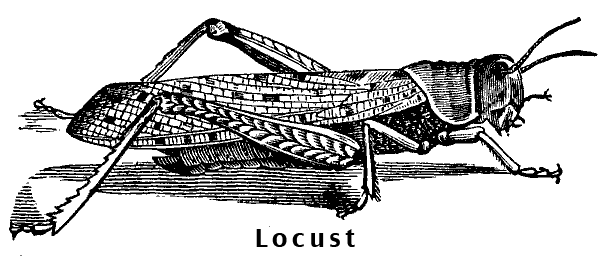
L is for locusts. Locusts are not cicadas. True locusts are grasshoppers (Wikipedia page for Locust).
Locust:
17-year cicada:
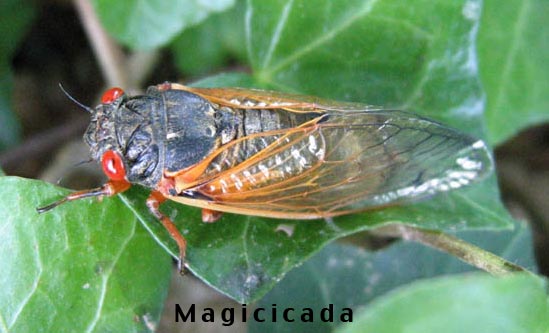
People call Periodical Magicicadas locusts because they emerge in massive numbers, but they are not true locusts.
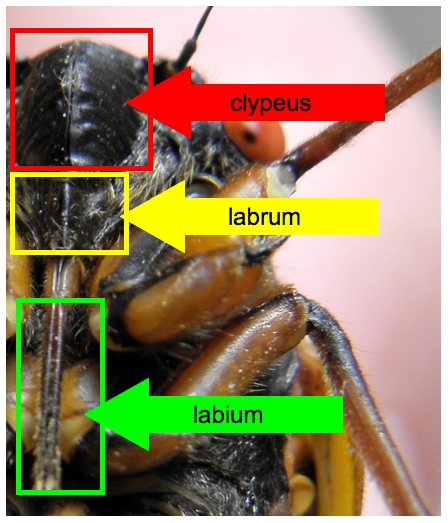
Labrum. The labrum is the structure that connects a cicada’s clypeus to their stylus. The labrum is also know as the anteclypeus.
Labium. The labium form the outside of the beak of the cicada; inside the labium is the stylet which is comprised of the mandibles and maxillae, which the cicada uses to pierce plants and drink their sap. The Latin root of both Labi and Labr is “a lip”, which makes sense when think about it.
Larvae. Cicadas larvae do not look like a grubs or maggots as you might expect; instead they look like tiny termites or ants, with 6 legs and antennae. View a video of a cicada larva.
Lembeja paradoxa, a.k.a. Bagpipe Cicada, is a cicada native to Northern Queensland Australia known for it’s massive abdomen. Here is a photo of a Lembeja paradoxa:
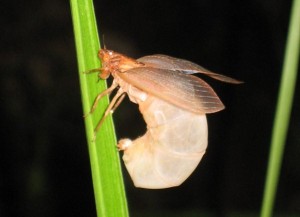
Photo by Timothy Emery.
Linne’s cicada, a.k.a. Tibicen linnei, is a cicada native to most mid-western and eastern states. View a photo of Linnie’s cicada:
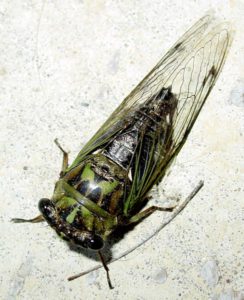
Photo by Tom Lehmkuhl.
The Lyric cicada, a.k.a. Tibicen lyricen, is a cicada native to most mid-western and eastern states (similar to the Linne’s cicada). View some photos of a the Lyric cicada:
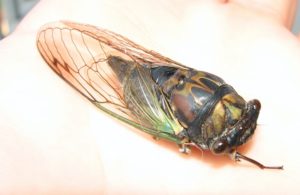
The Insect Singers website has audio files of the songs of both Linne’s cicada and the Lyric cicada.
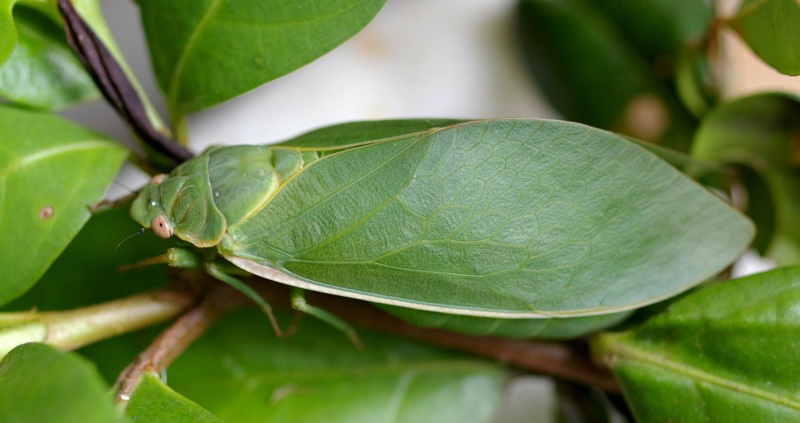
Thanks to David Emery for letting us know that the Bladder cicadas (Cystosoma saundersii) are out in Sydney Australia, and for providing this photo.
Badder cicadas are emerging down the Aussie east coast starting around the Queensland -NSW border on Sept 3 (FlickR) and we heard them for the first time on Sept 10 in Sydney. A photo of one captured on Sept 12 is attached to refresh Cicadamania devotees.
K is for Dr. Kritsky, specifically Dr. Gene Kritsky of the College of Mount St. Joseph in Cincinnati, Ohio.
Dr. Kritsky is one of the premier Magicicada experts and advocates; if you’re a cicada fan you must attend one of his lectures and buy one of his books. A few years ago Gene provided Cicada Mania with an interview.
Kikihia, one of the two major Genus of cicadas in New Zealand. David Marshall says: “The name Kikihia is derived from the Maori word for cicada, as is the name of the town Kihikihi, in New Zealand. You’ll love their public cicada statue. See this web page: http://en.wikipedia.org/wiki/Kihikihi“.
The Kobonga is a Genus of cicadae that exists in eastern Australia. Thanks to David Marshall and Kathy Hill of InsectSingers.com for these wonderful photos of a Kobonga species currently nicknamed the Xmas Clanger (species name pending).
J is for Jar Fly. Jar Fly is a colloquial name for Tibicen cicadas.
I don’t know the origin of the term, but I’m guessing it has to do with the fact that kids keep insects in jars.
I is for instar. An instar is a developmental phase in the life of an insect. Each instar marks a change in the abilities and characteristics of the insect. Most cicadas go through five instars; the final instar of a cicada’s life is the adult or imago phase.
An imago is an adult, sexually mature insect. Here’s a photo of Magicicada imagoes:
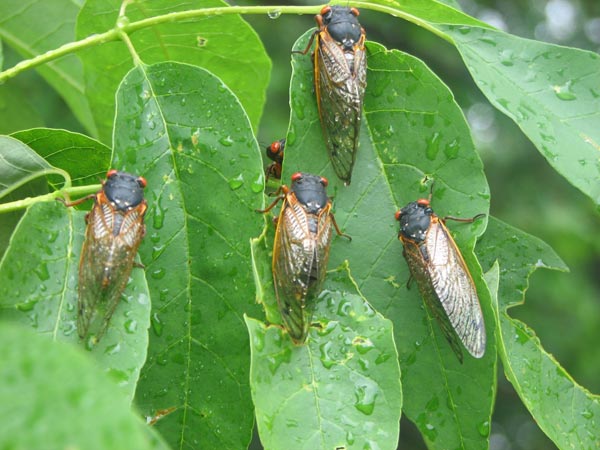
Insectoverdin is the pigment that that makes insects like cicadas green.
Ricky B sent us this sound file of a cicada that he recorded in August of 2010 in Chicago:
Can you guess which species it is?
Hint: try sites like Insect Singers and Songs of Insects sites for ideas.
H is for Hieroglyphic Cicada. The Neocicada hieroglyphica a.k.a. Hieroglyphic Cicada is found in the south-eastern United States. It’s active in the late spring and early summer. There are multiple subspecies of the Hieroglyphic Cicada including the Neocicada hieroglyphica hieroglyphica and Neocicada hieroglyphica johannis, according to InsectSingers.com.
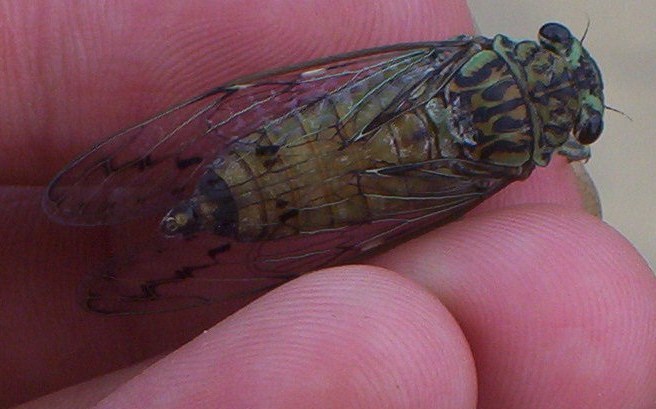
Photo by Matt Berger.
Listen to a Hieroglyphic Cicada:
Neocicada hieroglyphica singing by Joe Green from Cicada Mania on Vimeo.
 (Photo by Huechys sanguinea by =spurdog=, on Flickr).