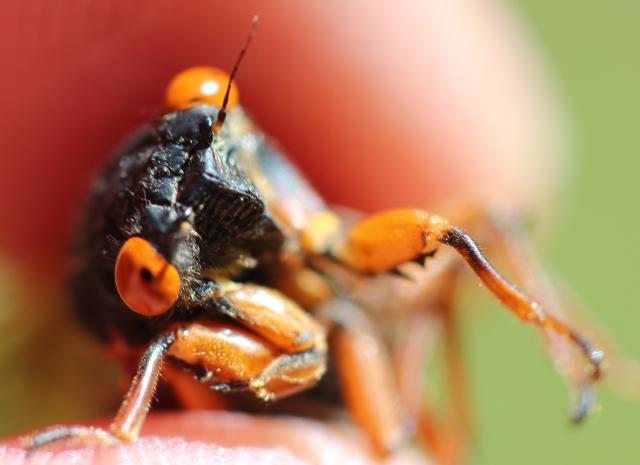
Depending on where you live, it might be warm enough for periodical cicadas to start moving around underground, or start digging tunnels to the surface and building cicada “chimneys” above their holes.
What to look for:
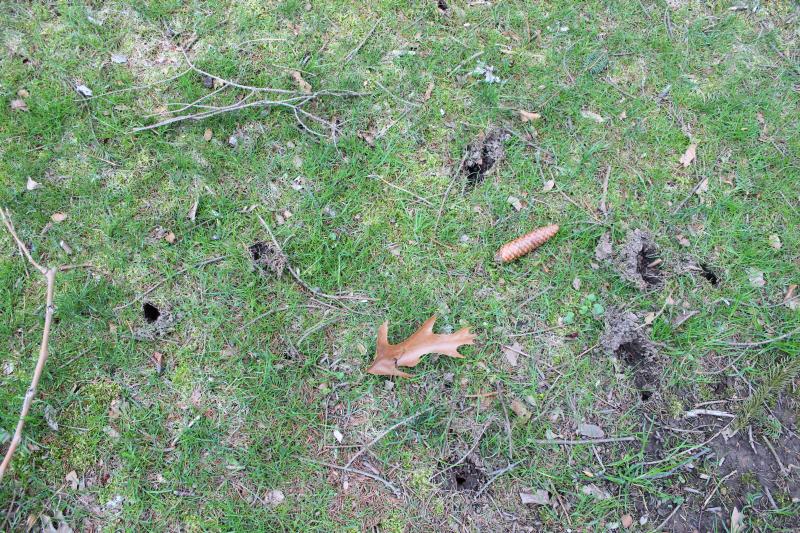
1) Animals can hear the cicadas stirring underground, and will try to dig them up and eat them. Look for holes (about the size of a walnut or larger) made by animals digging for cicadas.
2) Look for cicadas under stones and slates. Some cicadas will burrow their way to the surface, but they hit a large stone or slate and can go no further.
If you find them in this situation, gently put the stone or slate back. They will usually find their way around the obstruction once the time is right.
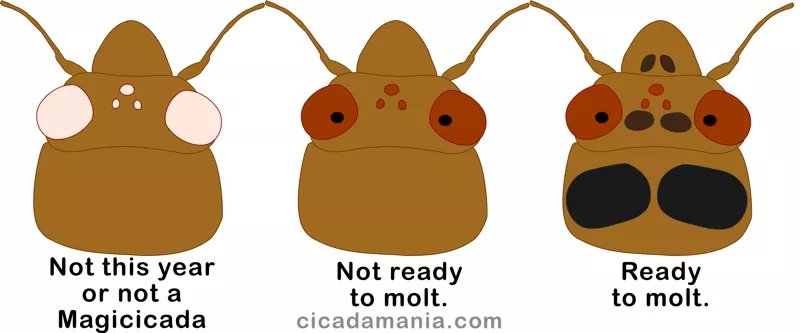
One clue that a Magicicada nymph is not ready to emerge is its eyes are still white. Their eyes turn red/orange before emerging (a few retain a white/blue color).
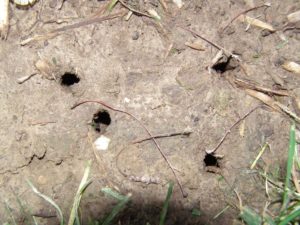
3) Cicada holes are about the size of a dime. Cicadas preemptively dig holes to the surface and wait until the weather is nice enough for them to emerge. Sometimes you can see them down in the holes.
Magicicada holes
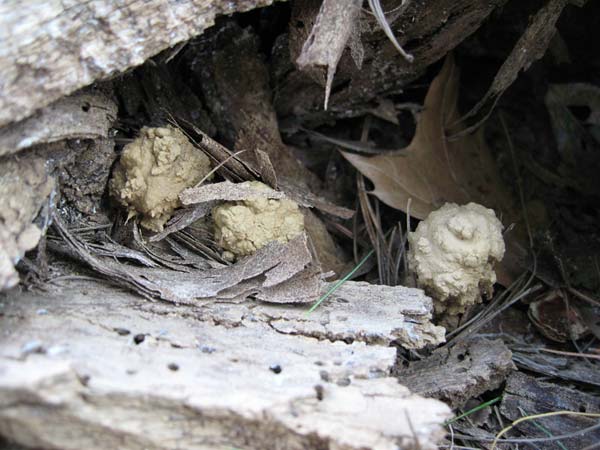
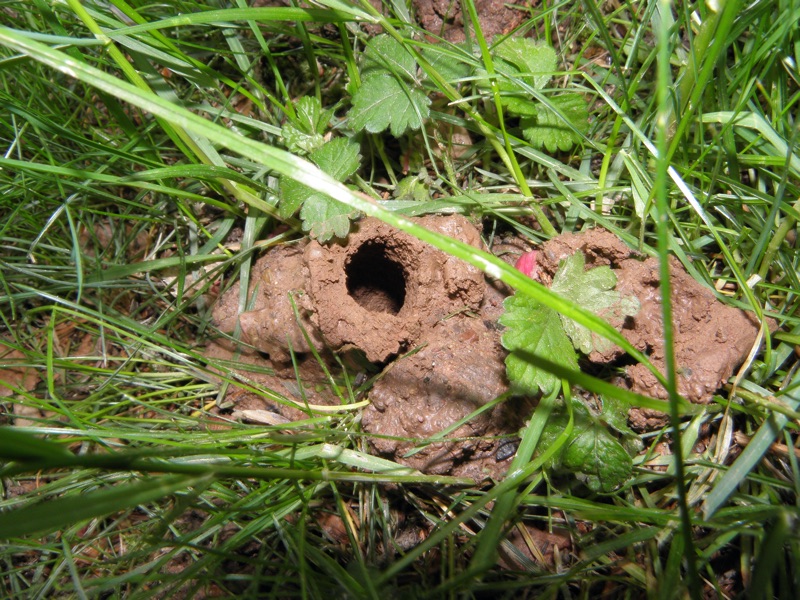
4) Cicadas form chimneys above their holes when the soil is moist or muddy. These chimneys might look like a simple golf ball-sized dome or a structure over six inches tall.
Photo by Roy Troutman.
Periodical cicadas typically won’t emerge until their body temperature reaches approximately 65 degrees Fahrenheit (17-19.5 Celsius1). Their bodies are warmed by surrounding soil or warm water from rain. A good rule of thumb is, if the soil 8 inches(20 cm) deep is 65°F, the conditions are good that they might emerge.
This brood of 13 year Magicicada will emerge in Louisiana, Mississippi, Arkansas, Tennessee, Missouri, Kentucky, Illinois, and Indiana. Brood XXIII features all four 13 year Magicicada species M. tredecim, M. neotredecim, M. tredecassini and M. tredecula.
When they’ll emerge depends on the weather. A cool spring will mean the emergences will start later in the spring. Regardless of the weather, the emergences will begin in the Southern-most states, sometime in late April or early to mid May.
Brood XXIII should, depending on the weather, start emerging in less than two months; some time in late April in Louisiana.
This brood of 17 year Magicicada will emerge in Texas, Oklahoma, Missouri, Kansas, Nebraska, and Iowa. Brood VI features all three 17 year Magicicada species M. septendecim, M. cassini, and M. septendecula.
Brood IV should start emerging in early May.
Brood IV and XXIII won’t emerge in the same year again until the year 2236. The only state that features both Brood XXIII & IV is Missouri, but the areas where they emerge do not overlap.
Stragglers:
The best bet for Stragglers will be Brood VIII (17 year cicadas emerging 4 years early) & XIX (13 year cicadas emerging 4 years late). There is also a chance for III (17yr/1 year late), V (17yr/1 year early), and XXII (13yr/1 year late). Visit our brood page, to see the states where these stragglers might emerge.
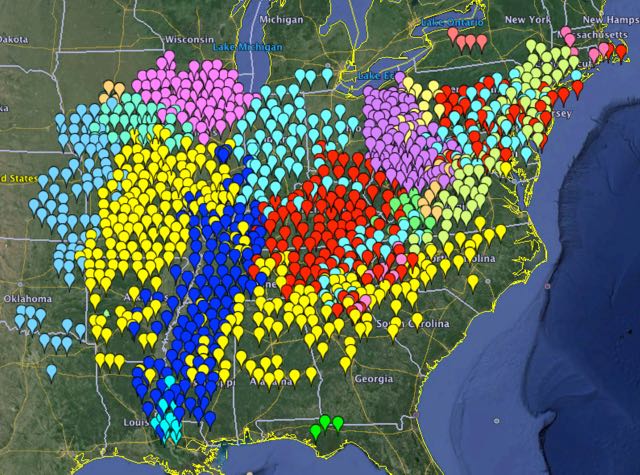
Isn’t this a lovely picture (updated with colors sorted)?
This image represents the combined range of all Magicicada periodical cicada broods, including the extinct Broods XI (last recorded in Connecticut) and XXI (last recorded in Florida).
To produce this image, I visited John Cooley’s Cicadas @ UCONN Cicada Geospacial Data Clearinghouse and downloaded the Shapefile of Magicicada broods. Then I used the computer program QGIS to change the Shapefile to a KML file, and then I opened the file in Google Earth. Credit goes to John for pulling the data together into the Shapefile.
I manually edited the KML file to try to give each Brood a different color.
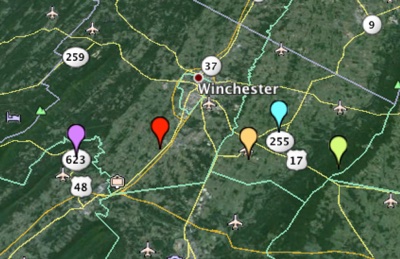
An interesting area is Fredrick County, where 5 different broods seem to exist (or have existed) at once.
Peach = Brood I
Green = Brood II
Purple = Brood V
Cyan = Brood X
Red = Brood XIV
It’s also interesting that four of the broods are separated by four years: X, XIV, I, V.
Here is a video of a rare white eyed magicicada. This is from a gene mutation that strepps the color from the cicadas eyes & also wings to some extent.
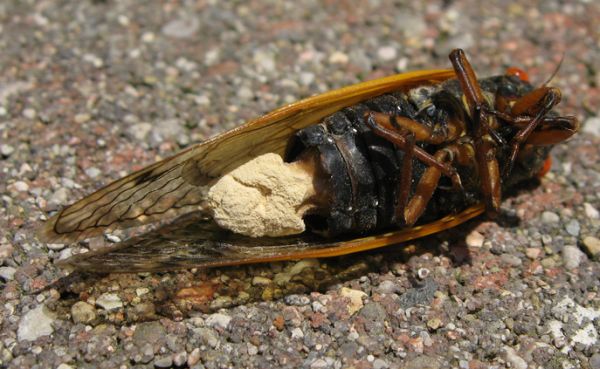
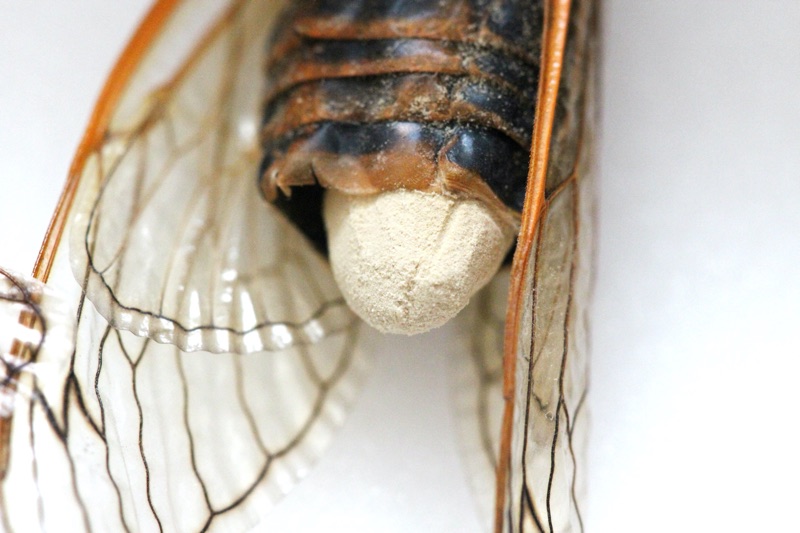
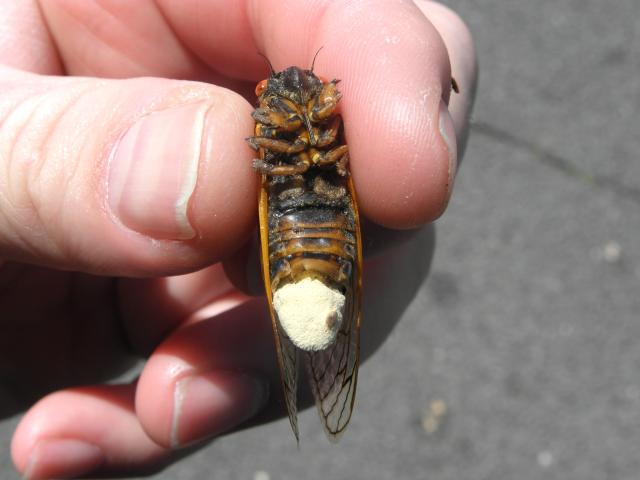
The fungus Massospora cicadina preys on Magicicadas cicadas. This is particularly interesting because the fungus is able to prey upon them in spite of their long 17 year life cycle (apparently fungi are not phased by prime numbers).
When the fungus destroys the abdomen of male cicadas, they will behave like female cicadas and flick their wings in response to the songs of male cicadas, and attempt to mate with other males.
During the Brood II emergence in 2013, Elias Bonaros, Roy Troutman and I spent some time experimenting with coercing male Magicicada to call in response to finger snaps, which mimic the snap of a female cicada’s wings. This trick works fairly well with Magicicada, and can quickly be mastered once you work out the timing. Fingers, wall switches, and the zoom button on my Sony video camera do a good job at mimicking the snap of a females wings.
I also recorded their calls in terms of decibels to see just how loud they could get. They can get very loud, but not as loud as a rock concert (see this db chart).
Update: After emailing with Dave Marshall and John Cooley today (July, 17th), I learned that the ‘decim cicadas in this brood are Magicicada tredecim (not neotredecim), based on their lower-pitched sound and very-orange abdomens! This means that this brood is not related to Brood XIV or X at all, that these cicadas are truly 13-year cicadas, they might be related to Brood XXII and perhaps were once part of the same larger brood thousands of years ago.
Read on:
Back in 2013 Roy Troutman and his wife Michelle visited me in New Jersey to experience the Brood II cicada emergence. At that time, Roy extended an invitation to visit Ohio in 2014 to experience & map a mysterious brood that emerges every thirteen years near his family campsite. A year later, I took him up on his offer.
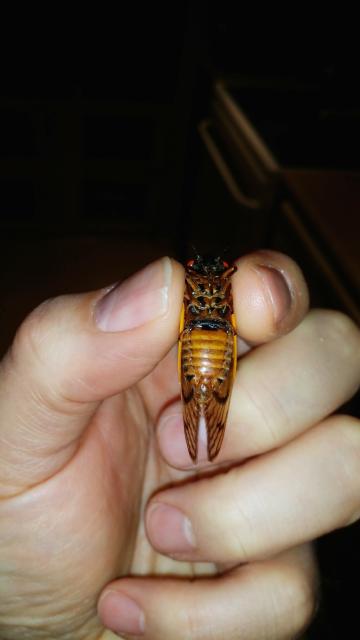
A very orange M. tredecim found by Roy in Ohio.
On June 1st I made the long drive from the Jersey Shore to south-west Ohio. The trip went smoothly, thanks to a well maintained car, a flash drive filled with 37 Gig of music, Red Bull, Monster Energy Drinks, some M&M candies and a tank and a half of gas. Sunday night I met Roy at his family home. After a quick dinner, we immediately went looking for cicadas in Point Pleasant, Ohio. Most of the cicadas had emerged from the ground a week or two ago, but we were able to find a few newly emerged specimens:
The following morning we visited the Crooked Run-Robert J. Paul Memorial Sanctuary in Chilo, Ohio, which is primarily a hardwood forrest along the Ohio River. The nature sanctuary was loaded with Magicicada tredecassini, healthy pockets of M. tredecula and a few M. tredecim. The cicadas were chorusing, feisty and already ovipositing (laying eggs).
So, why spend a week researching cicadas? Why ride in a car for dozens of hours tracking the locations of cicadas? Well, this mysterious Ohio & Kentucky brood is unique, and this would be the first time it was thoroughly mapped.
Why is this Ohio Kentucky brood unique?
These cicadas have a 13-year life cycle. No other brood of periodical cicadas in Ohio has a 13-year life cycle. Note that two 13-year broods (XIX & XXIII) exist in Kentucky, but they are geographically isolated from the OH/KY brood.
The OH/KY brood is also geographically isolated from Brood XXII, a brood of 13-year cicadas that emerged in Louisiana and Mississippi this year (2014). The OH/KY brood might be grouped with Brood XXII just by virtue of the fact that they emerge in the same cycle of years, but the two broods seem to be too far apart, geographically and probably genetically, to be related.
They occupy a relatively small area of south-western Ohio, and north-central Kentucky.
They are in relatively the same area as two 17-year broods, Brood XIV and Brood X. Brood XIV more so than Brood X.
The mystery is: why does this small, isolated brood of 13-year cicadas exist?
Roy Troutman and John Cooley have collected specimens, and the insects genetics will be studied to try to find an answer. Along with the results of genetic testing, the results of mapping will be considered, along with the past work of researchers like Lloyd and White, and local legend Gene Kritsky.
Mapping cicadas:
Mapping cicadas requires that you drive hundreds to thousands of miles, listening for cicadas, and recording the species and location. The hard parts are 1) picking out the individual species (particularly hearing individual deculas in the midst of loud chorus of cassini), and 2) driving slow enough to hear the individual species, without enraging local drivers. Discerning the songs of individual species is easy enough when you’re moving slowly or standing still, but at 55mph, you can hear the roar of a cassini chorus, but a more subtle ‘decim chorus, set deeper in the woods, will go unheard.
Thanks to John Cooley’s Map O Matic — a combination of a tiny laptop, Ubuntu Linux, a numeric keypad, a GPS puck, and some clever programming — marking the locations of Magicicada species is now a simple task. Drive around, and when you hear a heavy ‘decim chorus, you hit the 9 key, and the location is recorded. Hear a ‘cassini individual; hit a 4, and the location is recorded. Genius. I suppose the next best thing would be an app version.
The Cicada Map O Matic
Each day Roy planned the route and we started mapping. Roy driving; me pressing buttons. We traveled highways, and single-laned roads; through heavily populated suburbia with convenience stores selling Pork cracklings and fireworks, as well as, farm and forrest roads. Straight and fast. Winding and bumpy. Each day was amazing road trip for the sake of cicada research.
Mapping can be frustrating. Time limitations are frustrating. The cicadas only sing for a few weeks, so there is only so much time to hear and map them.
Google Maps, often used to visualize cicada mapping data, is frustrating as well. Google maps omits unincorporated towns and villages from their maps. Want to find Utopia, Ohio on Google Maps? According to Google Maps, it doesn’t exist.
Also, if you use an old map, beware; a road that existed 10 years ago, might now be a rocky field. One time we headed down a dusty road that looked like it connected to a major county road. Instead, Roy ended up breaking some part of his car on some bowling ball sized rocks, which I had to get out and move so we could backtrack to civilization. One positive: while rolling boulders, I heard an individual Magicicada tredecim, which are rare in this brood. Hit the 7 on the cicada Map O Matic.
The data from all this cicada mapping will be used by cicada researchers like Gene Kritsky and John Cooley to decode the mystery of this brood. If you’re curious, you can see the map here, or take a look at this short video, which crudely demonstrates the geographic proximity of Brood XIV, the OH/KY Brood and Brood X:
My trip to Ohio and Kentucky, was fantastic. I got to spend dozens of hours helping to map an important brood, hang out with a good friend, and even meet cicada research legend Gene Kritsky for breakfast. For a cicada fanatic, it doesn’t get much better.
A Magicicada tredecassini found in Kincaid Park, Kentucky.
I had such a good time, I headed home via Kentucky (which is not the way to go, if you’re going back to New Jersey). I stopped by Kincaid Park so I could hear all three species in one location. I even drove down the shoe road, and visited the Jim Beam distillery (which has little to do with cicadas, but why not).
After spending a week mapping cicadas, my respect for cicada researchers like Gene, John, Roy, Chris Simon, David Marshall and Jin Yoshimura has grown measurably. Mapping is not easy. It takes concentration, patience, a lot of expensive gasoline, and energy drinks. It’s worth it though. Hopefully I’ll get to do it again next year as well.