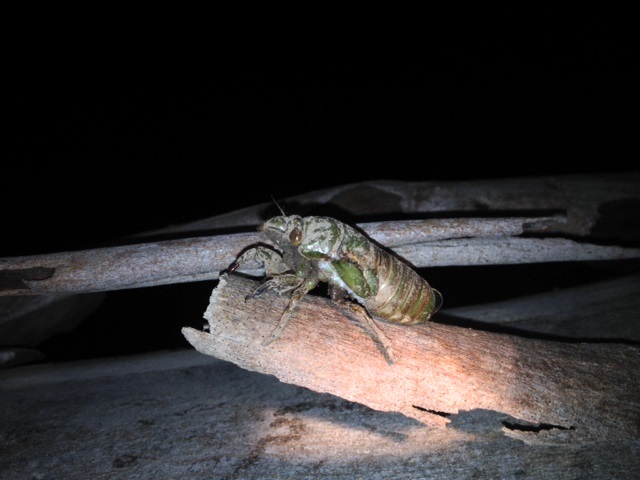
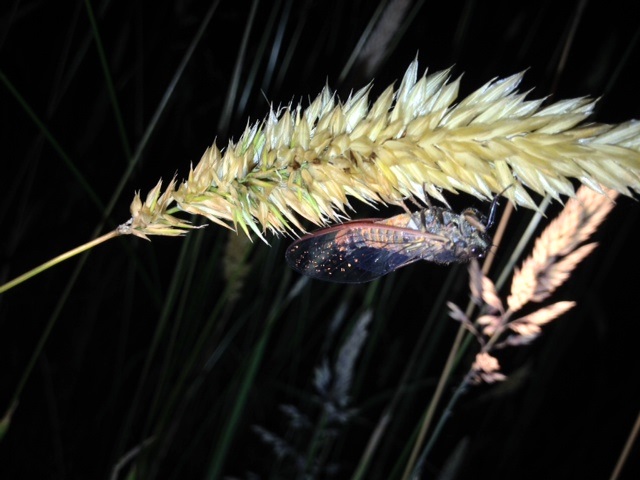
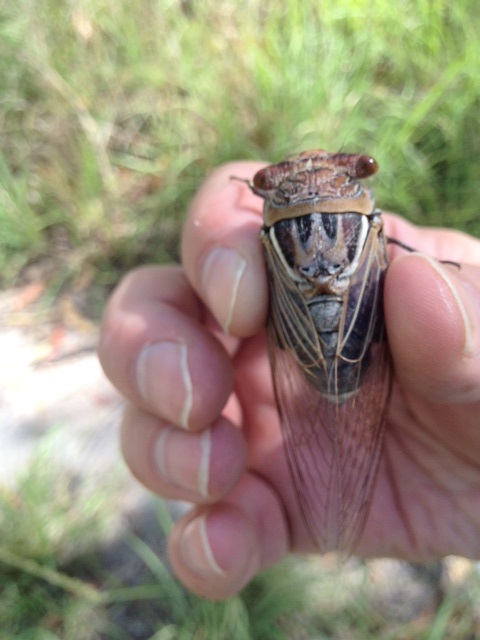
A new species of Tibicen cicada, Tibicen neomexicensis, has been described by Brian J. Stucky.
Thanks to David Marshall for the tip.
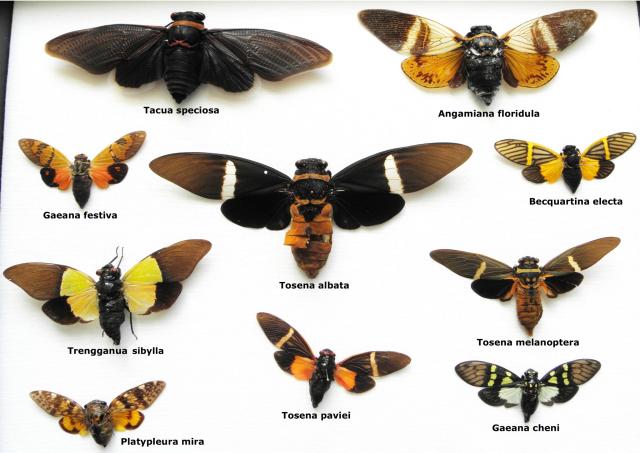
Genera of cicadas.
A new species of Tibicen cicada, Tibicen neomexicensis, has been described by Brian J. Stucky.
Thanks to David Marshall for the tip.
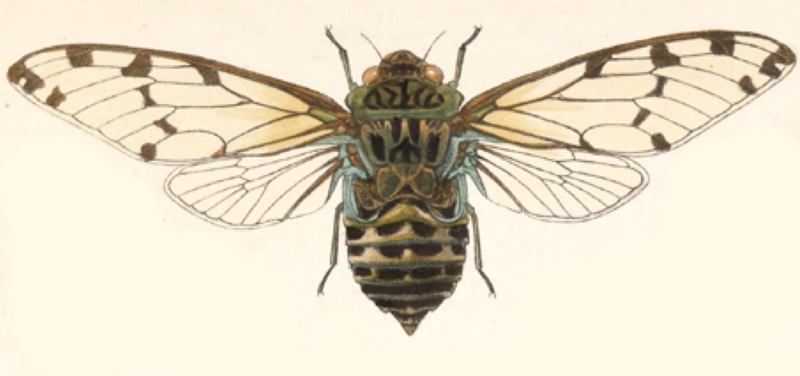
Just in time for Halloween… the Zammara a genus of cicadas with a collar like Dracula!
Andreas Kay has been posting photos of the insects of Ecuador on Flickr for around a year now. He’s posted many excellent cicada photos, particularly, photos of Zammara. They are among the most visually interesting cicadas.
Emerald Cicada, Zammara smaragdina:
Here’s an illustration from Insecta. Rhynchota. Hemiptera-Homoptera. Vol. I by W. L. Distant and The Rev Canon W. W. Fowler, F.L.S:

Here the Scientific classification:
Family: Cicadidae
Subfamily: Cicadinae
Tribe: Zammarini
Genus: Zammara
Species: Zammara smaragdina Walker, 1850
Here’s an article about Collared cicadas of Mexico, Central & South America.
Cicadas are well known for the songs male cicadas make with their their tymbals, which are drum-like organs found in their abdomens.
Some female cicadas will also flick their wings to get the males attention. Watch this video where a male Magicicada is convinced that the snapping of fingers is a wing flick. Note: Magicicada males will also flick their wings once they become infected with the Massospora cicadina fungus (which removes their sex organs).
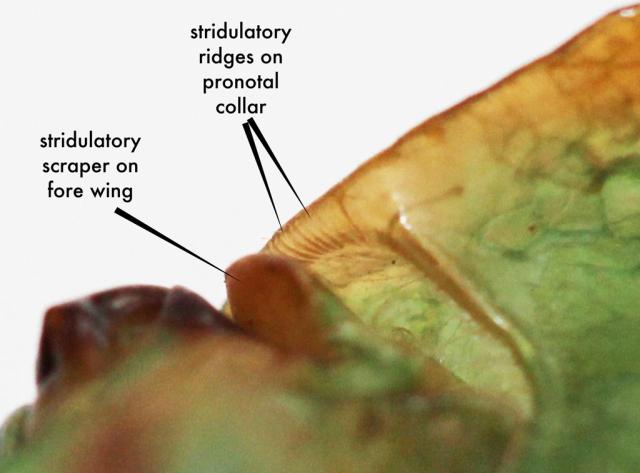
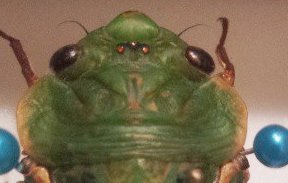
There is a third way some cicadas can make sounds. This method of creating a sound is unique to the Australian species Cyclochila australasiae (aka the Green Grocer and Masked Devil). These cicadas have stridulatory ridges on their pronotal collars (the collar shaped structure at the back of their head), and a stridulatory scraper on their fore wing.
From M. S. MOULDS, 2012, A review of the genera of Australian cicadas (Hemiptera: Cicadoidea). Magnolia Press Auckland, New Zealand. p84:
Cyclochila is unique among the Cicadoidea in possessing a stridulatory file on the underside of the lateral angles of the pronotal collar that interacts with a scraper on the fore wing base (Fig. 132). Rubbed together these produce low audible sound in hand-held specimens (K. Hill, pers. comm.), the purpose of which is for sexual com- munication at close quarters (J. Kentwell and B. Fryz, pers. comm.)
Here is a photo of these structures:
The location of these structures is right about where the blue pin is in this photo:
Update:
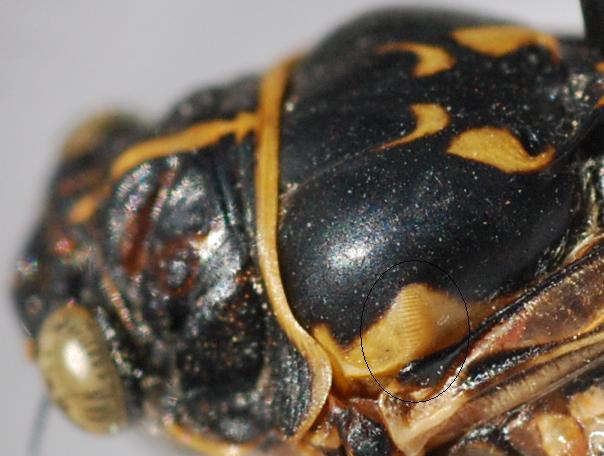
Tim McNary of the Bibliography of the Cicadoidea website, let us know that Clidophleps cicadas are also able to create should using a stridulatory structure. Clidophleps is a genus of cicada that can be found in California, Nevada, Arizona, and I assume adjacent parts of Mexico. Clidophleps differs from Cyclochila in that the stridulatory structure is on its mesonotum, and not its pronotal collar.
Photo courtesy of Tim McNary:
2013 has been an awesome year for cicadas. Here’s a look back at my favorite Brood II moments.


I’m looking forward to the Brood III and XXII emergences next year, but I don’t know if they’ll be as fun as Brood II 2013.

Lozang Y. posted this image of a Masked Devil aka Cyclochila australasiae on our Facebook page. The photo was taken in the Blue Mountains, NSW, Australia.

These cicadas are currently out and singing in the New South Wales area.
The green form of this cicada is called a Green Grocer, the yellow form is called a Yellow Monday, and the Blue Form is called the Blue Moon. The Cyclochila australasiae might have more color variations than even the Gaeana festiva of Southeast Asia.
More info about Cyclochila australasiae from L.W. Popple’s website.
David Emery wrote to let us know that cicada season has begun in parts of Australia:
After some 50mm of rain on 16-17 Sept and the warmest winter on record on the east coast, the “masked devil” morphs of Cyclochila australasiae were in good voice in the mountains west and south of Sydney, Australia on 22nd Sept. The bladder cicadas (Cystosoma saundersii) are also rattling in Metro Sydney. These are about 2 weeks early this year as are several of the smaller grass cicadas and Pauropsalta species. Roll on summer!
Cheers, David.
Masked Devil cicada (Cyclochila australasiae):

More information about Cyclochila australasiae.
Bladder cicadas (Cystosoma saundersii):

More information about Cystosoma saundersii.
Bottle Cicada (Chlorocysta sp.):

More information about Bottle cicadas.
Now is a great time to look and listen for Tibicen cicadas in North America. Tibicen are the medium to large sized annual cicadas. Typically they are well camouflaged – with colors like black, white, green & brown.
During the day you can listen for them, of course, and spot them that way. Try Insect Singers for cicada songs. You can also look for their exuvia (skins), and if you’re lucky you can catch on on a low branch.
Last night I started looking around 10pm and found three Swamp Cicadas (T. tibicen tibicen) shedding their skins on trees around the yard. I also collected about 30 exuvia (skins). All in a quarter acre yard. Take a look at this video:
Swamp Cicada shedding its nymphal skin from Cicada Mania on Vimeo.


Last night I went on an exploration of Manchester, NJ looking for Megatibicen auletes (Germar, 1834) with Elias Bonaros and his friend Annette.
M. auletes, are known as the Northern Dusk Singing Cicada. As their name suggests, M. auletes calls at dusk, around sunset. Their call is amazing – visit Insect Singers to hear their call.
Luckily I found a (deceased) female and an exuvia (nymph skin). Elias and Annette found many exuvia and a live nymph. We were able to watch the nymph undergo ecdysis (leave its exuvia, and expand its adult body).
Here are some images of the cicadas we found last night (click the first two images to get to larger versions):


Some (blurry) video:
Dan and Elias netting a M. auletes exuvia. Photo by Annette DeGiovine-Oliveira:

* Note as of 2023 the name of this cicada has changed to Megatibicen grossus. You can also call it a Northern Dusk-Signing Cicada.
It has been about a month since the last time I saw a Brood II periodical cicada. The Brood II emergence is over, aside from flagging and nymph hatches. That doesn’t mean the cicada fun has to end. Annual species of cicadas are out in the Northern hemisphere. Depending on where you live, you should be able to hear, and if you’re lucky, see annual cicadas.
Tibicen, particularly Tibicen tibicen, the Swamp Cicada, are out in the eastern U.S.
Here’s a cell phone photo of a Tibicen exvuvia (from Middletown, NJ) and a male Tibicen tibicen (found by my sister in Edison, NJ):


Other species are out as well…
If you’re on Twitter, follow @Zi_kade for photos of cicadas from Japan. That is the twitter feed by the guy behind the best website for info about the cicadas of Japan: Cicadae in Japan.
You can also follow @cicadamania, which is the feed for this site.
Raghu Ananth sent us these photos of cicadas from India. If you can identify them, let use know.
UPDATE: David Emery provided use with these ID’s, in Order from Top to Bottom:
Macrosemia umbrata. Platypleura capitata, Platypleura sp and Pomponia linearis.

Click the images for a larger version:
Cicada Found Near Mysore, India: Platypleura capitata

Cicada Found in Kukke Subramanya: Platypleura sp
Cicada Found in Bhagamandala, Coorg, India: Pomponia linearis