Categories
Kathy Hill Megatibicen Neotibicen Tibicen U.S.A.

Megatibicen grossus (formerly Tibicen auletes) is the largest cicada in the United States

Cicada researcher Kathy Hill took this amazing photo of 18 different USA Neotibicen & Megatibicen specimens, plus a Quesada gigas (upper right) for comparison.

Kathy Hill. Auletes is the biggest Tibicen

Click/tap the image for a much larger version. Contact Insect Singers for more information about the image.

I just took a photo of all the “eastern USA” Tibicens except
latifasciata, which we haven’t got yet (I didn’t include the “little
western” Tibicens like T. texana that are more centrally located
either). But I did also add T. duryi from the west coast and Q.
gigas, just for comparison.

I just wanted to prove that auletes IS the biggest USA cicada 🙂

Note that the these cicadas were reorganized into two new genera: Megatibicen (larger USA Tibicen) and Neotibicen (smaller USA Tibicen) since this original announcement in 2006.

* Note as of 2023 the name of this cicada has changed to Megatibicen grossus. You can also call it a Northern Dusk-Signing Cicada. Cicada names change a lot.
Categories
Neotibicen Tibicen

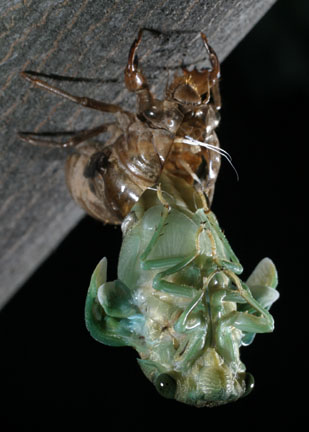
A Neotibicen shedding its skin

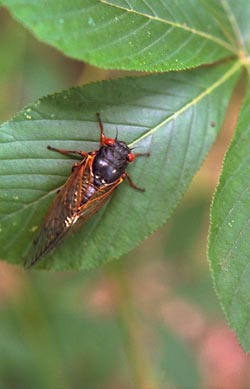
Here’s a great photo of a Neotibicen shedding its skin from Chris Millette.

Thought you might like to share my photo of a dog day cicada that I
made in Hummelstown, Pennsylvania last week.

Tibicen

Categories
Diceroprocta

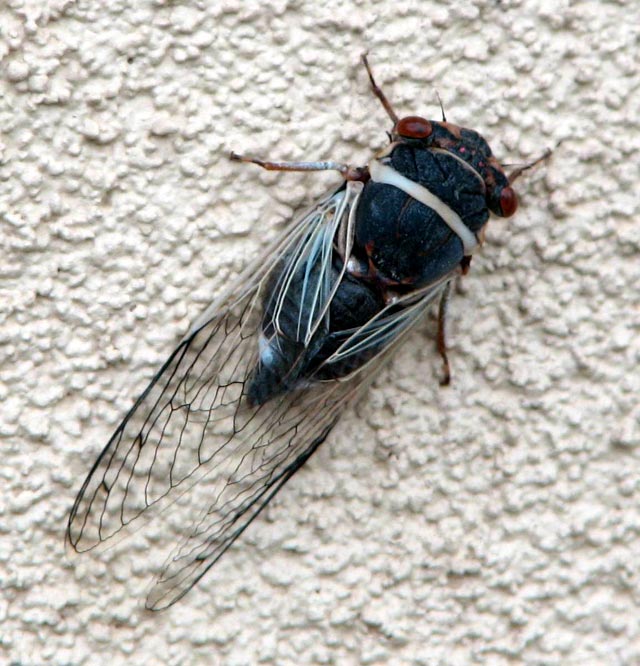
It’s an Apache, not a Magicicada… or mabe an semicinta

Update: Gerry from Massachusetts Cicadas site said that this is a Diceroprocta semicinta, not an apache.

Kathy Hill had this to say

It could be apache or it might be semicincta, depending on where he got it from. But from the pics/specimens we have I think it does look more like apache. We’ve never noticed one with red eyes either but then Dave and I have only collected apache and semicincta once in 2003, so we haven’t seen very many. I don’t know of any other Diceroproctas that it could be. Apache/semicincta are very common in parts of Arizona. I think they are parapatric.

Bill Sheridan has contributed this excellent photo of an Apache cicada, often confused with Magicicadas because of the red eyes and black body.

Apache

Categories
Mike Quinn Quesada

Giant Cicada returns to central Texas

The giant cicada, Quesada gigas, has returned to Texas after 50 years!

Here’s a link:

Giant Cicada / Chicharra Grande

Thanks to Roy Troutman and Mike Quinn.

Bonus:

A large photo of the Giant Cicada (Quesada gigas).

Categories
Magicicada Periodical Stragglers

Magicicada Straggler Watch 2006

In a few weeks you might see some Magicicada stragglers in areas that saw the Brood X emergence back in 2004. If you see any, let us know.

Update: some exciting news in the comments (before I accidentally deleted the original article):

Our 2006 straggler hunt has been very successful— much more successful than our 2005 Brood XI hunt.

Our group found M. septendecim (XIII), M. tredecassini (XIX), M. tredecim, M. neotredecim, M. tredecassini, and M. tredecula (XXIII), and unidentified nymphal skins, as well as a possible M. cassini (X) straggler— all on a 3-day Midwestern trip. Although most sightings consisted of isolated or small numbers of individuals, two emergences— one at Moody Cemetary in Greene-Sullivan State Forest, Indiana (mostly M. neotredecim), and one at the Vectren Energy plant entrance, near Yankeetown (east of Evansville) IN (mostly M. tredecassini) were substantial enough that there were periods of continuous calling. Not bad for an “off” year!

Complete records will be incorporated into the Magicicada database on Cicada Central as soon as some server issues are solved. If you have records that you’d like to put in the database, send the details (species present, approximate numbers of individuals), the complete locality info (including lat. and lon. if you have it), the date, and your complete name to me at the University of Connecticut (email is just firstname.lastname@uconn.edu).

John Cooley

Cicada Central.

Categories
Okanagana Proto-periodical

Okanagana from Carlsbad, CA

Okanagana.

This photo was taken on May 28th, in Carlsbad, CA by Rebecca. Thanks Rebecca!

Originally I had this labeled as O. rimosa, but it is not.

Categories
Magicicada Neotibicen

Four new Roy Troutman Galleries!

Magicicada

We have four new Roy Troutman galleries of restored images from the 1980’s and early 1990’s!

NEW! Roy Troutman’s Cicada Photos. Assorted cicadas photos from the 1980s!

NEW! Roy Troutman’s Cicada Photos. Brood X photos from 1987 and 1988

NEW! Roy Troutman’s Cicada Photos. Brood XIV cicada photos from 1990-91

Categories
Anatomy Eating Cicadas Magicicada

UC Engineering Researchers Find Mercury In Cicadas

I came across this article thanks to Google’s news alerts: UC Engineering Researchers Find Mercury In Cicadas. I’ve never eaten a cicada and I don’t plan on doing so in the future, but a lot of “cicada maniacs” do, so here’s your PSA.

Think twice before you eat one of Cincinnati’s Brood-X cicadas. That’s the warning from researchers at the University of Cincinnati College of Engineering, who have found surprising levels of mercury in these insects.

Categories
Magicicada Pop Culture Samuel Orr

Return of the 17-Year Cicadas

Return of the 17-Year Cicadas Way back in July a man by the name of Samuel Orr mailed me a DVD trailer of a film he had a part in making called Return of the 17-Year Cicadas. At the time my reaction was “I am simply blown away by its excellence. That might be the best cicada video I’ve seen so far”. Somehow I let it slip through the cracks and I forgot to write about it. In the mean time the movie has won first prize in the Non-Interactive Media category of the 2005 Science & Engineering Visualization Challenge. I’m sure once the film reaches a wider audience — perhaps PBS or the Animal Planet channel (hint! hint!) — it will win more awards.

Read all about the new, award winning cicada documentary Return of the 17-Year Cicadas on the excellent EurekAlert! Science Reporting Alert website. Make sure you download and watch the video too. It is incredible.

Thanks to Roy and Dona for reminding me to post something about this film.

Categories
Neotibicen Tibicen

Mystery Cicada 2 is a Neotibicen dorsatus

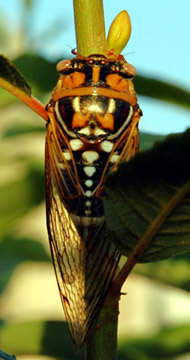
Mystery 2 Bill from Lincoln, Nebraska sent us this awesome photo of a cicada. I’ve never seen a cicada quite like this one. It’s as pretty as a butterfly. My guess is it belongs to the genus Diceroprocta, but I don’t know what species it is. Anyone know? If so, leave your guess in the comments section below.

Tim McNary wrote:

The cicada you pictured is either Tibicen dealbatus or Tibicen dorsatus. It’s kind of hard to tell from a picture. If you found it in trees in town, it is probably T. dealbatus. If you found in grassy sandhills and the pronotum in swollen in profile it is probably T. dorsatus. The characture that Davis uses, the shape of the uncus, is actually unreliable.

David and Gerry said it was a Tibicen dorsatus (formerly T. dorsata).