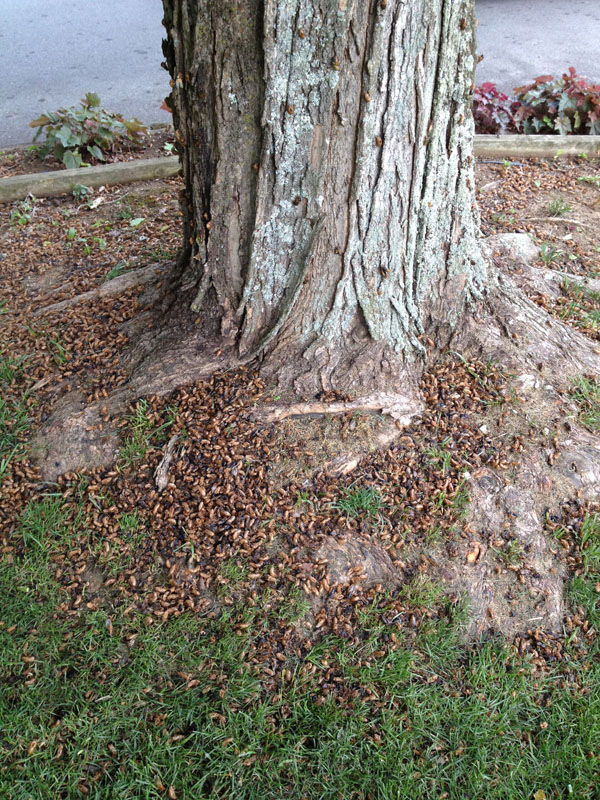
John Cooley of Cicadas @ UCONN (formerly Magicicada.org) (don’t forget to report your sightings) wrote to tell us about the large emergence of periodical cicadas in Tennessee. See the picture below taken by John in Warriors’ Path State Park, TN.
The mystery is defining which brood these cicadas belong to. Are they brood XIV stragglers; are they an undocumented pocket of Brood I cicadas; or are they cicadas that straggled long ago, but finally established a healthy population in synch with Brood I? For now, it’s a puzzle.
Update: A similar emergence occurred in 1995 (17 years ago) in the Warriors’ Path State Park, TN area. This could be an undocumented area of Brood I cicadas.
White or Blue eyed Magicicada are very rare! Typically they have red or orange eyes. There was even an urban legend that scientists were offering a reward for white-eyed Magicicada (well, that was a legend, until Roy Troutman actually offered a reward in 2008). Aside from Blue or White-eyed Magicicada, you can find other colors like yellow eyes, and multicolored eyes.
Try this: Have a contest amongst your friends and family for who can find the most white, yellow and multicolor-eyed cicadas.
Wing Clicks
(Magicicada only)
How do you get a male cicada to sing? Imitate a female cicada. Female cicadas don’t sing, but they do click their wings together to get a male cicada’s attention.
Try this: snap your fingers near cicadas almost immediately (half-second) after a Male stops singing. Male cicadas will hear the snap and think it’s a female clicking her wings, and they may sing in response.
You can also try imitating male cicada calls to get the females to click their wings. Magicicada tredecim and Magicicada neotredecim are probably the easiest to imitate with their “Waaah Ooh”/”WeeOoh” calls. You can find sound files on the Cicadas @ UCONN (formerly Magicicada.org) site so you can practice.
Cicada Free-Styling
(Magicicada only)
One of the best ways to locate cicadas is to simply listen for them. When you’re driving or biking around town, take note of where you hear cicadas. If you hear cicadas in a public place, don’t we afraid to stop and observe them.
Try this: Travel around listening for cicadas, document their location and numbers, and report them to magicicada.org.
Study the maps and other documentation of previous sightings
Network with friends to find out where they are
Drive with your windows open (so you can hear them)
Car pool to save gas (or use you bicycle)
Respect private property
Document the specific location. Some smart phones and GPS devices will give you the latitude and longitude coordinates, but street addresses and mile markers work fine as well.
Document: how many cicadas you saw, and what phase they were in (nymph, white teneral cicadas, live adults, deceased adults).
Document the cicadas: take photos, take video, share your experience on blogs, Twitter, Facebook, YouTube, Vimeo, etc.
Report the your discovery to magicicada.org
Document the Cicada’s Life Cycle
(Works for most cicadas)
You can observe many phases and activities of a cicada’s life while they are above ground.
Try this: Photograph or film as many stages of a cicada’s life as possible, then create a slideshow or movie depicting the life of a cicada. Post your finished slideshow or movie on the web (YouTube?) so other people can enjoy it.
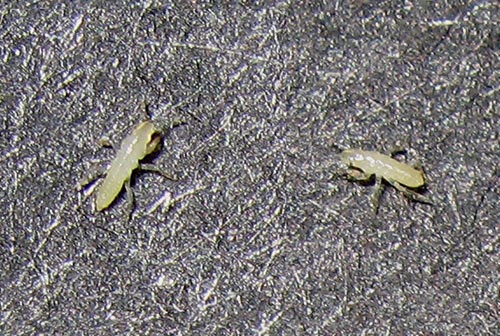
See the tiny cicada nymphs crawl around the branch and fall to the ground
Test Gene Kritsky’s Cicada Emergence Formula
(Magicicada only)
Cicada researcher Gene Kritsky developed a cicada emergence formula to try to predict when the cicadas will emerge based on the mean temperature in April.
Try this: on May 1st, go to our cicada emergence formula page, follow the instructions and find out when the cicadas might emerge in your area. Document when the cicadas emerge in your area, and compare the results. Note whether the cicadas emerge in sunny or shady areas.
People ask: “what’s the best way to keep a cicada in captivity?” The answer depends on how long you plan on keeping the cicada, and how happy you want the cicada to be.
Wooden and plastic bug houses (“Bug Bungalows”, “Critter Cabins”, “Bug Jugs”, etc.) will suffice as temporary homes for cicadas. The classic jar with holes punched in the lid works too. Add a fresh branch for them to crawl on and drink fluids from (or at least try). Remember not to leave it in the sun so the cicadas inside don’t bake!
Butterfly Pavilions are collapsible containers made of netting that you can use to gather cicadas, and provide them with a temporary home. People also use Fish Aquariums to keep cicadas in their homes for extended periods of time — add plenty of vegetation for the cicadas to crawl around on and some water for the cicadas to sip.
Try this: get some flexible netting and wrap it around a branch on a tree, making sure not to leave any openings, then put your cicadas inside. Cicadas in this kind of enclosure will be more likely to sing and interact because life trees are their natural habitat.
You can also try wrapping netting around a small, potted maple tree.
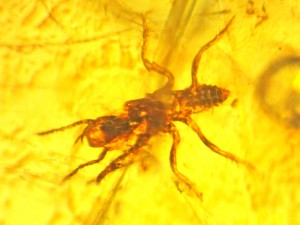
Apparently cicadas serenaded the dinosaurs! Entomologist and Mount St. Joseph professor Gene Kritsky shared the news today that cicadas lived as long as 110 million years ago during the Cretaceous period.
A quote from a press release:
New research has documented that cicadas, those noisy insects that sing during the dog days of summer, have been screaming since the time of the dinosaurs.
A fossil of the oldest definitive cicada to be discovered was described by George Poinar, Jr., Ph.D., professor of zoology at Oregon State University and Gene Kritsky, Ph.D., professor of biology, at the College of Mount St. Joseph in Cincinnati. The cicada, measuring 1.26 mm in length, was named Burmacicada protera.
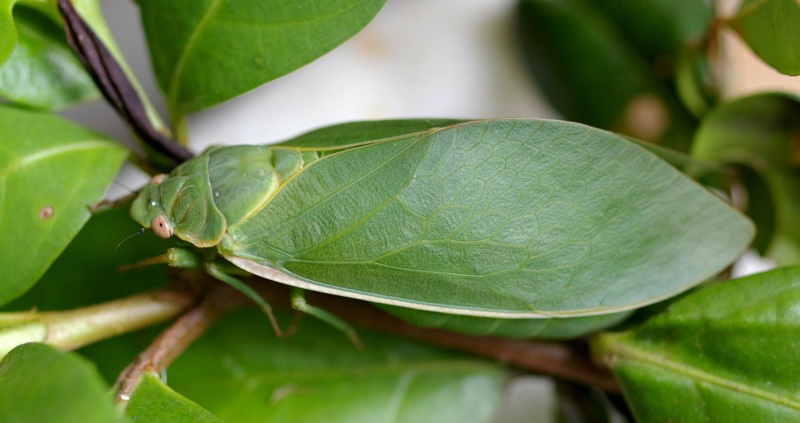
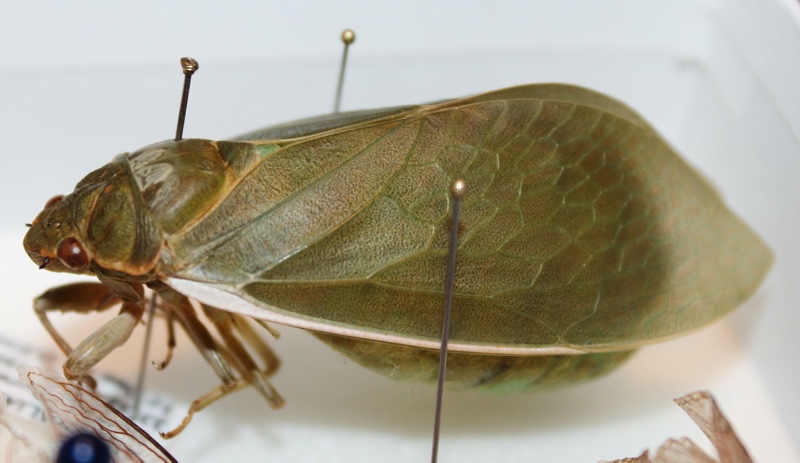
Thanks to David Emery for letting us know that the Bladder cicadas (Cystosoma saundersii) are out in Sydney Australia, and for providing this photo.
Badder cicadas are emerging down the Aussie east coast starting around the Queensland -NSW border on Sept 3 (FlickR) and we heard them for the first time on Sept 10 in Sydney. A photo of one captured on Sept 12 is attached to refresh Cicadamania devotees.
If you’re interested in North American cicada species, and you’re looking for sound files of those cicada’s songs, check out Insect Singers, a new website from cicada researchers David Marshall and Kathy Hill. It has dozens of audio samples. Awesome!
Gene Kritsky wrote us to let us know that Brood III periodical cicadas are emerging in Iowa and Missouri.
Dan,
I wanted to let you know that I have received emails with reports of
emerging periodical cicadas in Iowa and northern Missouri in Brood III
territory. These cicadas would be emerging four years early similar to
the early emergences observed in 2000, 2003, 2004, and 2009.
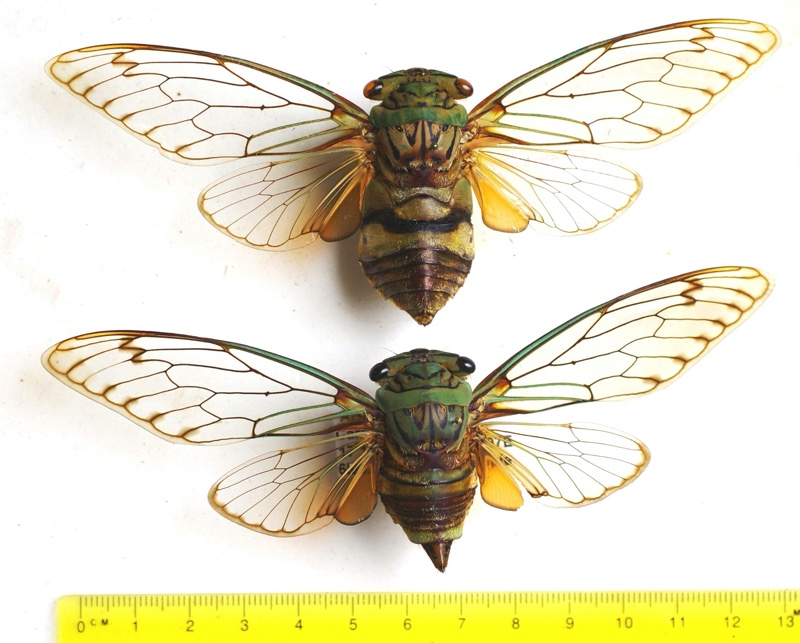
David Emery emailed us this amazing photo of Anapsaltoda pulchra cicadas. Anapsaltoda pulchra are also known as Golden Emperors. These cicadas are from Herberton, Queensland, Australia.
Tribe (Psaltodini) information comes from: MARSHALL, DAVID C. et al.A molecular phylogeny of the cicadas (Hemiptera: Cicadidae) with a review of tribe and subfamily classification.Zootaxa, [S.l.], v. 4424, n. 1, p. 1—64, may 2018. ISSN 1175-5334. Available at: https://www.biotaxa.org/Zootaxa/article/view/zootaxa.4424.1.1
Diceroprocta viridifascia aka the Salt Marsh Cicada can be found in AL, Florida, Georgia, Louisiana, Mississippi, North Carolina, South Carolina, and Virginia.
David Emery send us a photo of a Cystosoma saundersii (bladder cicada) from Australia and we added it to the gallery.
Just to complement the Aussie cicadas, a small colony of these Cystosoma saundersii have been droning and rattling at dusk around Burwoood in Sydney for the past 2 months. This is their southern-most extension down the east coast of Australia.
cheers,
David.
Click the link above or the image below to access large versions of the image.
The Bladder Cicada can be sound in eastern Queensland & NSW, and are most common Nov-Jan. (Moulds, M.S.. Australian Cicadas Kennsignton: New South Wales Press, 1990, p. 193.)