Categories
Eating Cicadas Magicicada Periodical

Are cicadas safe to eat?

Update (July 2018): A company called Meat Maniac sells cicadas in a can. Don’t know which species, but they have a “nutty flavor”.

Also, send me a box of these cicadas from China… um, I mean Chinese City Tells Citizens to Fight Bug Infestation By Eating Them.
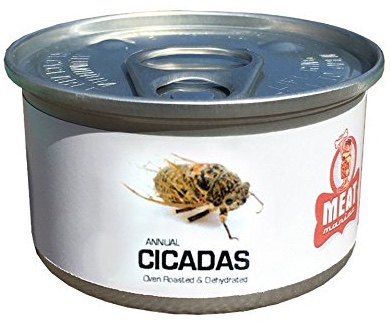
Meat Maniac cicadas in a can

Also, read this amazing story about how Brood VII cicadas helped kept the Onondaga Nation alive during a time of famine.

The original article from 2006:

[WARNING:] Cicadas, 17-year cicadas at least, are well-known bioaccumulators of mercury. If consuming mercury is a concern, you should not eat cicadas.

Dogs, cats, squirrels, fish, and people can’t stop eating cicadas. Are they crazy, or “crazy like a fox”? (Foxes will eat them too.)

Pets and other domesticated animals

This is a cartoon of a dog about to eat a cicada

People want to know: “is it safe for my pets to eat cicadas”. The truth is in most cases your pets will be fine if they eat a few cicadas, however, you still need to be cautious and keep a close eye on your pets. Watch them for odd behavior, and don’t let them gorge themselves. Be cautious: the Humane Society has warned: “Cicadas Dangerous to Pets” [the original link is gone].

Pet-related concerns:

  1. Pets can choke on the rigid wings and other hard body parts of the cicadas.
  2. Pets will gorge themselves on cicadas, and possibly become ill and vomit.
  3. Pets who consume cicadas sprayed with copious amounts of pesticide can and will die.
  4. Pets might have an allergic reaction to the cicadas just as people do.

Bottom line: play it safe, and don’t let your pets eat cicadas if you can help it.

People:

Whether they’re curious, hungry, or doing it for the shock value, people are eating cicadas. Asian peoples have eaten cicadas for centuries, and there are records of Native Americans eating cicadas. People joke that they’re Atkins friendly [also no gluten]. I’ve heard they taste like asparagus, popcorn, minty shrimp, and piney shrimp — YUMMY PINE.

A man in Bloomington Indiana had an allergic reaction to cicadas after eating 30. He was also allergic to seafood — both cicadas and shrimps are arthropods so this makes sense.

[Note to self, “Do it, Dan, don’t be a wimp!”]

People related concerns:

  1. Cicadas are well known bioaccumulators of mercury.
  2. You could choke on their hard body parts.
  3. You could have an allergic reaction. If you’re allergic to seafood, don’t think about eating them.
  4. Do you really want to eat something that’s been marinating in lawn fertilizers,
    pesticides and other chemicals for the past 17 years?
  5. If you get the gout, it makes sense to avoid them.

People related links:

  1. National Geographic: National Geographic News :Low-Fat, High Protein Cicadas: New Health Snack
  2. Stephanie Bailey’s Internet insect cookbook has tips on how to prepare insects for human consumption! [note that the link now goes to an article by Stephanie about eating insects in general.]

Bottom line: You’re not a contestant on Fear Factor [a reality TV show in the 00s]. Why eat cicadas when you can choose from many of the fine menu choices at Applebees [a chain restaurant]?

Fish, turkeys, squirrels and everything else

If a creature has a mouth or some other mechanism to digest cicadas, it likely will try to eat them. Cicadas make great fish bait. Squirrels (yes, they’re nuts for cicadas too), birds, possums, raccoons, foxes, other insects, fungi… they all love cicadas.

Bottom line: let nature do the dirty work and clean your yard one bite at a time.

Tom, Cicada Gormandize:

Tom eats a cicada


Categories
Folklore

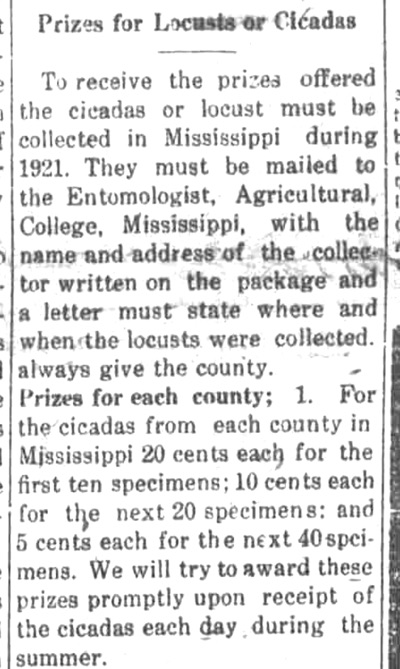
An old news story about Prizes for Locusts or Cicadas

Once again I was grinding through the Library of Congress website, and I came across another Cicada story. This story, from the July 21, 1921 edition of the Okolona (Mississippi) Messenger, is a request from the entomologist of the “Agricultural, College, Mississippi” (Agricultural College in Mississippi) for cicadas. Send cicadas to the college and get a prize. Sounds awesome.

The terms cicadas and locusts seem to be used interchangeably, which is common for these old newspaper articles. If you read “locusts” they mean cicadas, in this article at least.

Note that this is from 1921. Don’t send them cicadas today.

Prizes for Locusts or Cicadas

To receive the prizes offer the cicadas or locust must be collected in Mississippi during 1921. They must be mailed to the Entomologist, Agricultural, College, Mississippi, with the name and address of the collector written on the package and a letter must state where and when the locusts were collected. Always give the county.

Prizes for each county 1. For the cicadas from each country in Mississippi 20 cents each for the first ten specimens; 10 cents each for the next 20 specimens; and 5 cents each for the next 40 specimens. We will try to award these prizes promptly upon receipt of the cicadas each day during the summer.

State Prizes; 2. For the largest number of cicadas send in by any one person during the year 1921 $5.00; for the second largest number $3.00; and for the third largest number $2.00. The locusts or cicada should be mailed in as soon as possible after they are collected. Careful record will be kept of all specimens and these prizes will be awarded next fall.

Special Prizes: 3. For a cicada that proves to be a new species, that is not previously know to entomologist, $5.00 for the first specimen; $3.00 for the second and $1.00 each for the next five specimens.

4. For any species of cicada not previously recorded from Mississippi $3.00 for the first specimen; $2.00 for the second, and $1.00 each for the next five specimens.

5. For specimens of the rare small green cicada Okanagana Niridis, $1.00 each for the first ten specimens. The species will most likely be collected in Bolivar, Sunflower, Washington and other Delta Counties during June and July, but may possibly be collected in the other sections of the state during other months.

Okanagana Niridis is actually Okanagana viridis. The meaning of viridis is the color green. Here is a photo.

6. For specimens of Tibicen Linnei $1.00 each for the first ten specimens. This species will most likely be collected in the northern part of the state.

Tibicen Linnei is now known as Neotibicen linnei.

7. For any Periodical Cicada, or 1-year locust collected in Mississippi during 1921, $1.00 each for the first ten specimens. Brood No. 20 of the Periodical Cicada that occurs during May and June of 1921 had been recorded from Georgia, North Carolina, and Virginia, but has never in the past been reported from Mississippi.

This paragraph is the most interesting. They probably mean 1-year stragglers from Brood XIX. (First, I think they mean 13-year or 17-year cicada, not 1-year locust. A 13-Year cicada collected in 1921 would belong to Brood XX (20), which doesn’t exist, and I don’t think it did at the time (I’ll check, may have gone extinct). A 17-year cicada that emerged in 1921 would belong to Brood XII (12) which also does/did not exist. There aren’t any stragglers (4 year) that line up as well. There are four broods that emerge in GA, NC & VA: II which would have emerged in 1928; X which would have emerged in 1919; XIV which would have emerged in 1923; and XIX which would have emerged in 1920 and definitely is also in Mississippi.)

Here’s a chunk of the article:

Prizes

Categories
Eating Cicadas Folklore

Cicada soap and snacks

I came across an article from 1876 in the Bossier Banner titled Edible Insects (The Bossier Banner., June 22, 1876. (Bellevue, Bossier Parish, La.)). The article covers many types of insects but has at least five paragraphs devoted to cicadas. The article uses the term “locust” interchangeably with “cicada”, and the author does seem to know the difference (see the last paragraph).

The most interesting bit of information is that people might have used cicadas to make soap and cakes.

I believe, in this paragraph, locust may refer to the grasshopper locust, but it could be cicadas as well:

Among the folk-lore of the Khoikhoi you may find this legend: “Faraway in the North-land dwells the great master-conjurer, who, when he wishes to confer a benefit on his people, rolls away a stone from the mouth of a certain deep pit and from it issues a host of winged messengers who soar away to the southward and there surrender themselves as a food to the hungry Africans.” These messengers are the famous locusts of which it is recorded that John the Baptist ate, and which are to-day sold by the cart-load in the cities of Morocco.

The “locust” in this paragraph is very likely cicadas, because of the use of the words “harmless” and “celebrated for its song”:

With how much affection the Romans spoke of the locust! “A little, harmless creature,” says one historian, “celebrated for its song from most ancient times.”

No reference to “locust” was made — definitely cicadas:

The same song was so dear to the Greeks, “because it seemed to give life to the solitude of our shady groves and academic walks, and conveys to our minds the idea of a perfectly happy being,” that they kept the insect in cages, and gave it pet names, as, “The Nightingale of the Nymphs,” “Sweet Prophet of Summer,” “The Love of the Muses.” Then, after all this lavishing of affection, they are it!

Could be either cicadas or grasshopper locusts:

Aristotle, with the smack of the lips, says of the female locusts, caught before the depositing of their eggs, and fried in sweet oil: “Quo tempore gustu suavissimo sunt”— “at which time they are very sweet.”

Sounds like it could be either:

Another naturalist says when the cicadae first leaves the earth they are plump and oily, and used in the making soap. Bread is also made of them, and in Africa a kind of sweet cake. This is probably what Shakespeare refers to when Iago, plotting against the Moor, says, in his wrath: “The food that to him now is as luscious as locusts shall be to him shortly as bitter as coloquintida” — the bitter apple of Crete.

This paragraph makes me think the author knows the difference between cicadas and grasshoppers:

These little, dew-sucking locusts are not to be confused with the strong-jawed grasshoppers, the Heupferde, or “hay-horses,” as Germans call them, and as Martin Luther translated the word from the Hebrew text, for, though used as food, it is the grasshopper that commits such depredations on the foliage.

Read/see the article on the Library of Congress website.

Categories
Folklore

How the Cicadas Brought the Beans

This story, written by John Milton Oskison, was published on January 28, 1914, in the Richmond, Virginia, Times-Dispatch. It’s in the public domain, so I’ll share it here. Oskison was part-Cherokee and was born in the Cherokee nation. We can assume that this story is a retelling of Native American folklore, possibly Cherokee.

New Indian Animal Stories

How the Cicadas Brought the Beans

By John M. Okinson

Long time ago, in midsummer, when Lalu (the cicada) began to sing, the old women among the Indians used to go our to the fields with their baskets to gather green beans. And while they were away in the fields one of the old men would gather the little children and promise to tell them of how the cicada brought the beans to the people if the little ones would only keep quiet until their mothers and their grandmother got back and had put some beans to cook in the pot.

So white the little ones listened, the old man would tell them this story:

It was at the time the animals got so crowded in Galun-lati (the world above the arch of the sky) that they sent the tiny water beetle down to the world below to find some earth. And after the water beetle had gone own to the bottom of the water which covered all the earth at that time and had brought up a bit of mud, and after this bit of mud had grown to be the earth as we know it now, the animals all came down from Galun-lati.

Now, they were in such a hurry to get down to this earth, which they could see by looking over the edge of the world above, that it was hard for the great beaver, who was chief of the animal people, to make them remember to take food with them. Over and over the great beaver had to tell the animals that they had to take seed to plant on the new earth, as well as food to last them until the seed had had time to grow.

It was springtime when the earth got hard enough for the animals to live on; and then they came down, hand over hand, by way of the four cords which had been let down to hold the earth from the four corners of the world above. Every animal had on his back a pack which held food and seed for planting.

Now, the rabbit was the fellow who ought to have brought down the bag of beans for seed. But when he came to the edge of the world above and looked down, he was afraid that if he strapped a pack on his back, he would not be able to stick to the cord and come safely down to the earth. So when no one was looking, he took off the pack and threw it in a pile of brush.

And when the great beaver asked the rabbit for the seed beans to plant, the rabbit looked very sad and said that the strap on his pack had come loose and the pack had fallen before he was half way down. They all began to look for it, but it was not to be found!

And so the animals planted their corn and their tobacco, and their greens and their nut trees and their goobers and their potatoes. But they had no beans! And then they began to build their houses while they were waiting for everything to grow.

The animals did not know it, but they left behind the cicada. He had gone to sleep months before, when the winter was coming on; and it was not until midsummer, long after the others had gone down, that Lalu woke in Galun-lati and found himself alone.

And when the cicada had found that all the others had gone, he went all around the edge of the world above to find out where they had gone. And he came to the pile of brush into which the rabbit had thrown the beans for seed, and he found that the beans had been spilled out of the pack and were growing.

So, the cicada, being very hungry, cooked some of the green beans and sat down and began to eat them, though he knew that everybody had always waited for them to grow ripe and hard. And they were good! As he ate, he heard a noise down below. It was the animals in council, and they were talking about what they would have to eat next winter.

The cicada heard some of the talk and he leaned over and shouted:

“You must try some of these green beans!” And he threw down a handful. The animals tried them, and they were good! Then they told the cicada how to get down.

And now, whenever the cicada begins to sing, after waking from his long sleep, the people know that the green beans are ready to eat.

Some notes:

  1. “Indian” and “Indians” refers to Native Americans / Indigenous peoples in what is now the contiguous United States.
  2. It’s likely true that many species of cicadas start to sing when beans are ready to harvest.
  3. Cicadas don’t eat beans, however some species may drink fluids from bean roots at some point while they’re underground.
  4. Adult cicadas don’t go to sleep in the fall — they die. New-born cicadas do burrow underground in the summer and fall, so that much is true.
  5. Cicadas don’t just sleep underground. They lead productive, albeit relatively boring lives.
  6. Goobers are peanuts.
  7. Assuming this story is based on Cherokee folklore, we could assume the cicada was one of the many species found in Oklahoma.
Categories
Folklore Magicicada Periodical

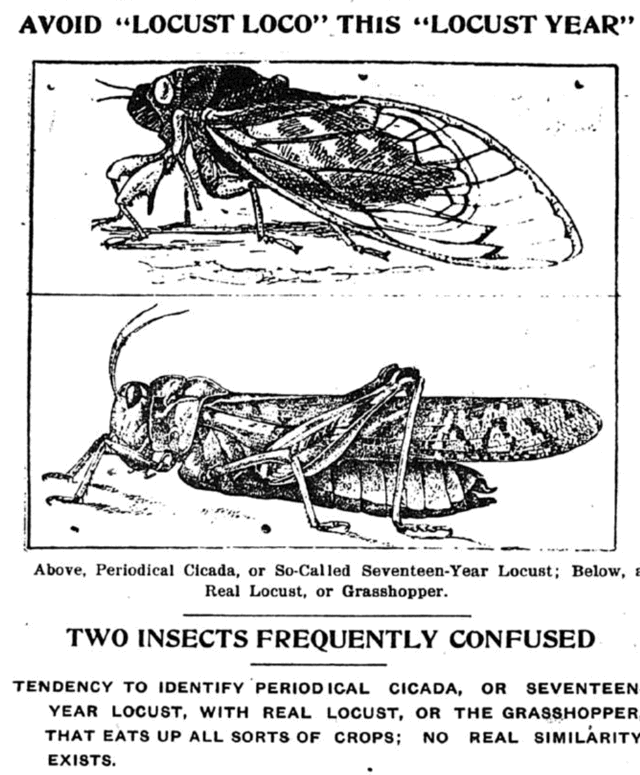
Avoid “Locust Loco”

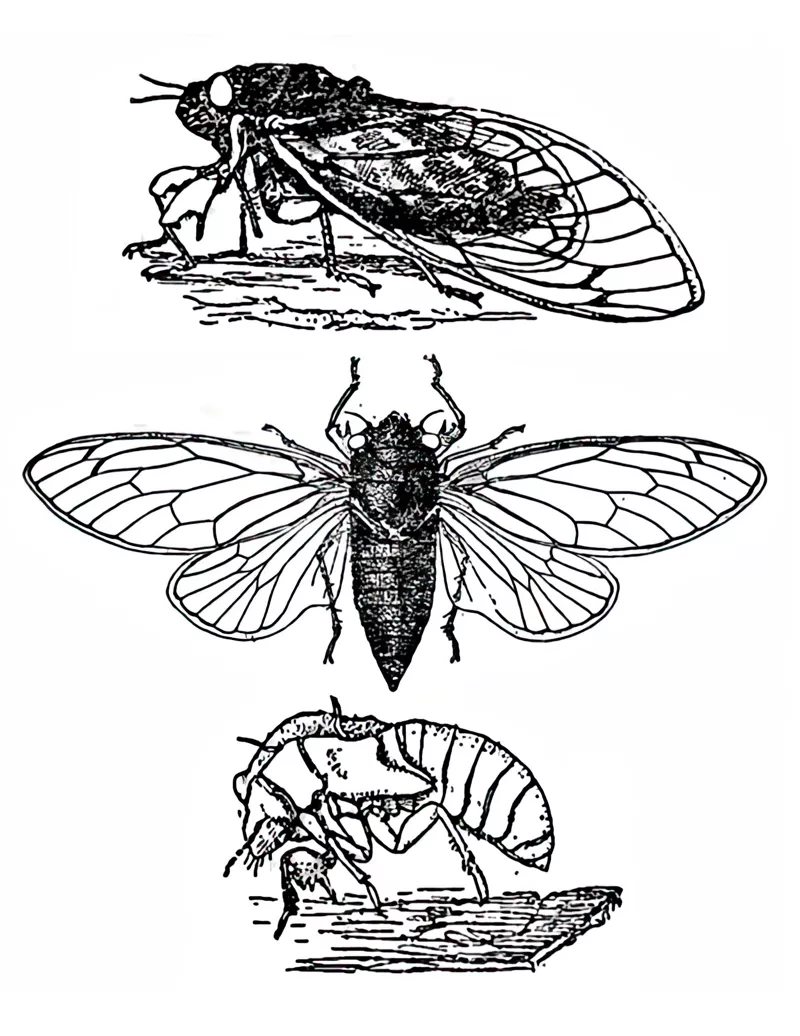
A nice illustration that shows the difference between Magicicada periodical cicadas & Locust grasshoppers from the April 18, 1919 edition of The Washburn Leader, Washburn, North Dakota.

Once you see them up-close, it’s clear that cicadas are not locusts. Nearly 98 years later, people still call cicadas “locusts” though.

1919

Categories
Folklore

Cigars got their name from cicadas?

Cigars got their name from cicadas?

A 1916 article titled “How Men’s Habits Began” (The Press Publishing Co, The New York Evening World) says this:

A cigar deserves a better start, but some of our highbrows claim it got its name from our little friend, the katydid. “Cigarro” was the Spanish name, and the learned ones twist this into coming from “cicada”.

This story seems believable. “Cigarra” is one word Spanish-speaking people use for cicadas. Cicadas do look like cigar butts. Katydids — while not cicadas — are insects that sing like cicadas, and their wings kind of look like tobacco leaves.

Here’s a link to the story.

Categories
3301 Distantalna Pop Culture Tosenini

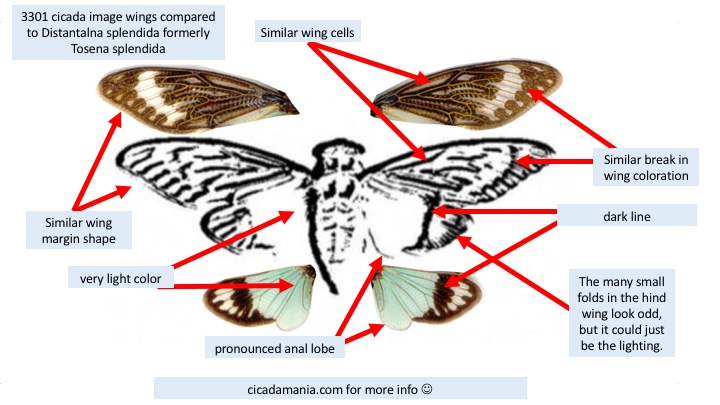
Cicada 3301 cicada compared to Distantalna splendida

Today I took a fresh look at the 3301 Cicada image. In the past I thought it was a composition of multiple cicadas — and it still might be — but I now think it’s primarily a Distantalna splendida formerly Tosena splendida, a cicada found in southern Asia (China, India, Burma, Thailand, Vietnam, etc.). Distortions caused by embossing — or whatever filters they used — make identifying the cicada difficult.

Here’s my comparison of the wings.

cicada 3301

I will probably do a comparison of the body and head at some point.

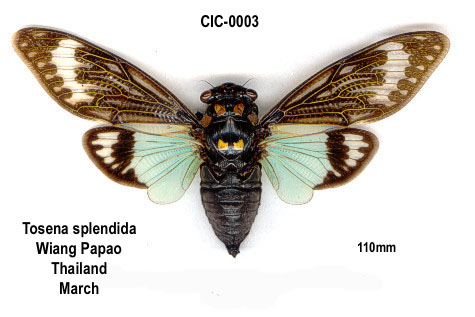
Here’s a photo of this Splendid cicada:
splendida

Specimens vary in appearance (size, wing patterns) from individual to individual — they all look similar, but they’re not exact matches. The process of spreading a specimen’s wings and preserving it can also alter its appearance, and introduce unnatural changes to the insect’s morphology.

Distantalna splendida are easy to find on eBay or taxidermy shops if you’re interested, although they’re often mislabeled using their former name Tosena splendida, or something totally different.

Bonus:

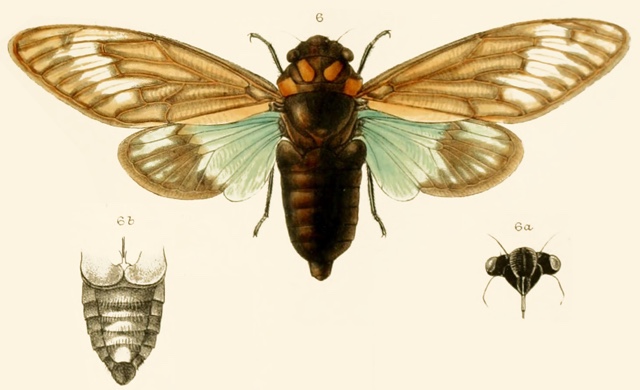
Here’s an illustration from A Monograph of Oriental Cicadas by W. L. Distant. 1889-1892. Read it on the Biodiversity Heritage Library website:

3301 Cicada

More information about 3301: Cicada 3301 – solution.

Categories
Christmas

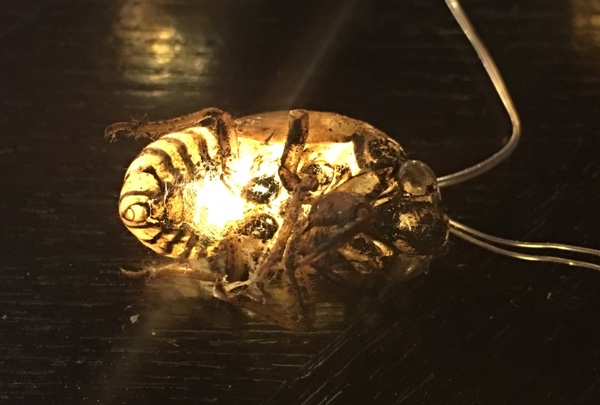
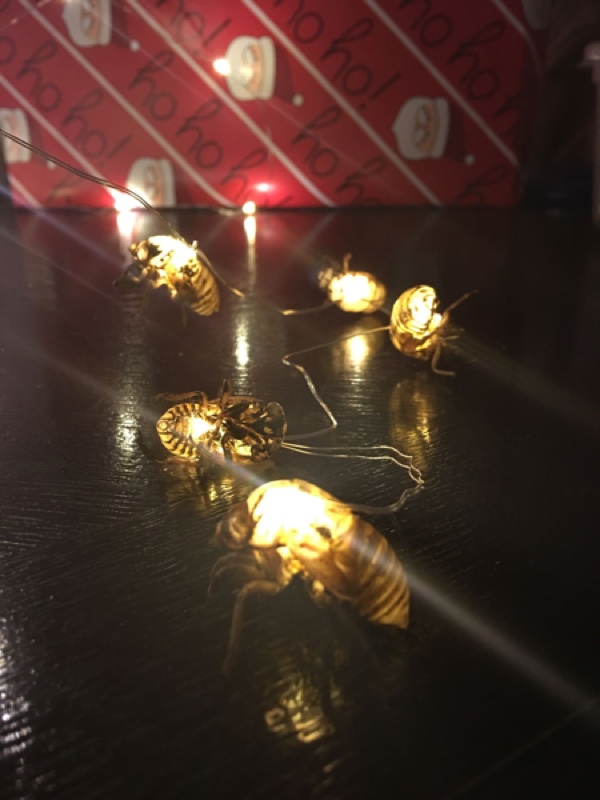
Cicada Christmas Lights 2016

Cicada Lights

String of Cicada Lights

I’ve made Christmas lights, in the past, from plastic cicada whistles from Australia.

This year I tried something new and used real cicada exuvia (skins/shells) and LED “fairie lights”, which seem to run cool enough that they won’t be a hazard to the fragile skins. They look pretty. I’m still in the testing phase, but the results so far look promising.

Categories
Pop Culture

I want a cicada emoji

New emoji are coming soon. A adult butterfly will be added to the list of insect emoji, which include a beetle, ant, caterpillar (aka larval butterfly) and bee. You know what is missing? A cicada.I doubt we’ll get it now that the emoji are decided by a consortium, but you never know.

It could be this one:
cicada emoji

Categories
Music Pop Culture

Some Songs About Cicadas

Everyone knows cicadas love to sing (the males) or be serenaded (the females).

A lot of people like to write songs inspired by cicadas. If you search online music stores or YouTube, you’ll find hundreds of songs about cicadas, in every genre imaginable including rap, country, rock, folk, dance, parody, classical and experimental.

Here are some cicada songs:

The Cicada Song by CincyPolly

Genre: Rock.

Cicada Serenade by The Pheromones

Genre: 1980s Rap.

Cicada By Hannah Gansen

Laura Imbruglia sings her song Cicada on a talk show for teens (YouTube Link):

(You might want to skip ahead 20 seconds to when the music starts.)

Here’s one of my favorite bands, Southern Culture on the Skids peforming their song Cicada Rock (YouTube link):

CICADA Song – SICKA CICADAS by Kathy Ashworth:

Not quite a song, but still very much an audio performance about cicadas: Tessa Farmer and David Rothenberg perform Magicicada in Dublin (YouTube Link):

Do you have a favorite cicada song? Let us know in the comments!

Bonus: Another cicada song send by a reader:

CICADA by Liam Titcomb (YouTube link):

And more:

Seventeen Years (a cicada love song) – Lloyd H. Miller (YouTube Link):

Baby Bug by Samm Bennett:

“Seventeen Years” by Jen Schaffer and the Shiners:

I Ate A Cicada Today:

Periodic Cicadas by Dr. Chordate:

No video for this song, but Dr Chordate wrote a song called Periodic Cicadas.