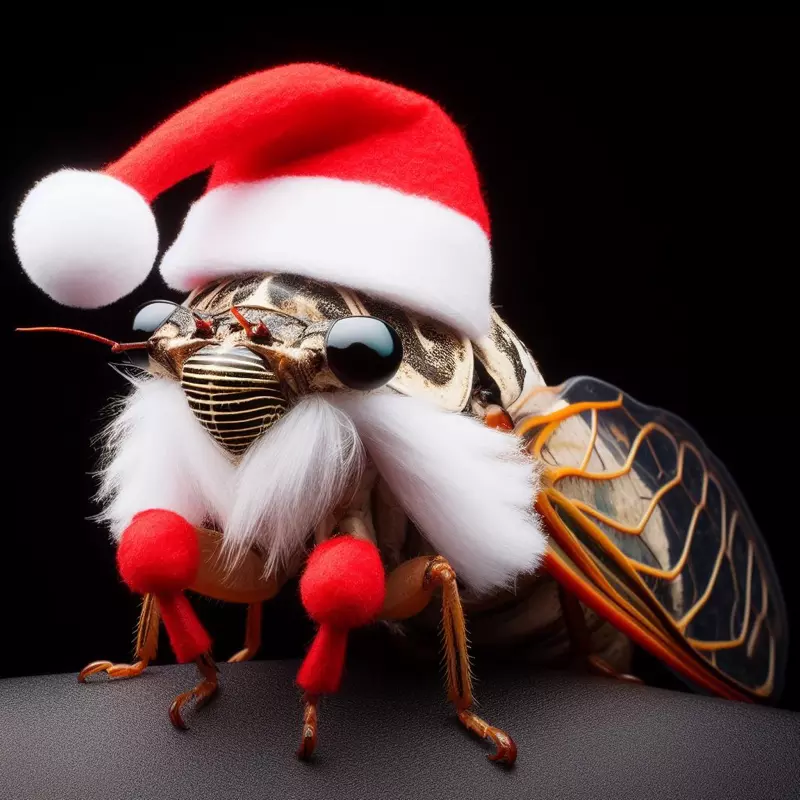
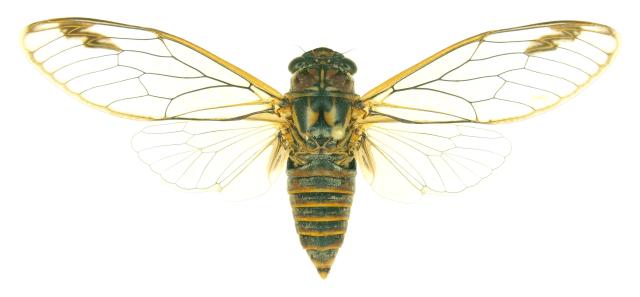
New emoji are coming soon. A adult butterfly will be added to the list of insect emoji, which include a beetle, ant, caterpillar (aka larval butterfly) and bee. You know what is missing? A cicada.I doubt we’ll get it now that the emoji are decided by a consortium, but you never know.
Everyone knows cicadas love to sing (the males) or be serenaded (the females).
A lot of people like to write songs inspired by cicadas. If you search online music stores or YouTube, you’ll find hundreds of songs about cicadas, in every genre imaginable including rap, country, rock, folk, dance, parody, classical and experimental.
Here are some cicada songs:
The Cicada Song by CincyPolly
Genre: Rock.
Cicada Serenade by The Pheromones
Genre: 1980s Rap.
Cicada By Hannah Gansen
Laura Imbruglia sings her song Cicada on a talk show for teens (YouTube Link):
(You might want to skip ahead 20 seconds to when the music starts.)
Here’s one of my favorite bands, Southern Culture on the Skids peforming their song Cicada Rock (YouTube link):
CICADA Song – SICKA CICADAS by Kathy Ashworth:
Not quite a song, but still very much an audio performance about cicadas: Tessa Farmer and David Rothenberg perform Magicicada in Dublin (YouTube Link):
Do you have a favorite cicada song? Let us know in the comments!
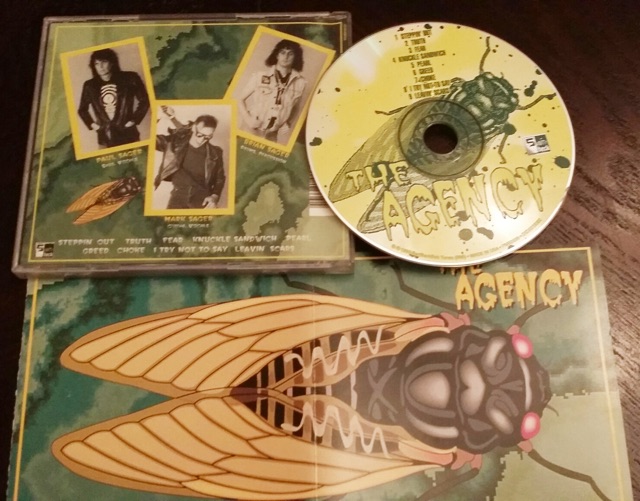
This week I bought The 17-Year Locust Tour by the band The Agency. It was recorded in Leetown, West Virginia, and copyrighted in 1993. Periodical cicadas are known as “17-Year Locusts” in the U.S., which is where this band got the name for the album. My guess is the album title was inspired by the Brood XIV emergence of 1991.
I haven’t yet listened to the album from start to finish but it falls into the hard rock genre.
The artwork is very nice and was done by bassist and singer Paul Sager using Corel Draw. I used Corel Draw to create the first Cicada Mania logo.
You might ask, what do cicadas symbolize? What are cicadas a metaphor for?
Cicadas, for many people, represent personal change, renewal, rebirth, and transformation.
Unlike a butterfly, moth, or other insects that undergo complete metamorphosis, cicadas have no pupal state. They transform from one fully-functioning state (instar) to another — one viable form, in a small amount of time, changing to another. The cicada’s transformation is like that of human beings. If a person wants or needs to make a change in their life, they do not enclose themselves in a pod and emerge next spring (I suppose some might) — more likely they remain in their human form as they change.
People use cicadas to symbolize their own personal transformation, in art, song, poetry, or even a tattoo. The cicada inherently symbolizes what they were — earth-bound, nymphs –and all the glory of what they have become — adults with wings & a song.
Cicadas can also be a symbol for a musician or singer since they sing.
Since cicadas sing mostly during the summer months, they are a symbol of summer and a precursor to the harvest.
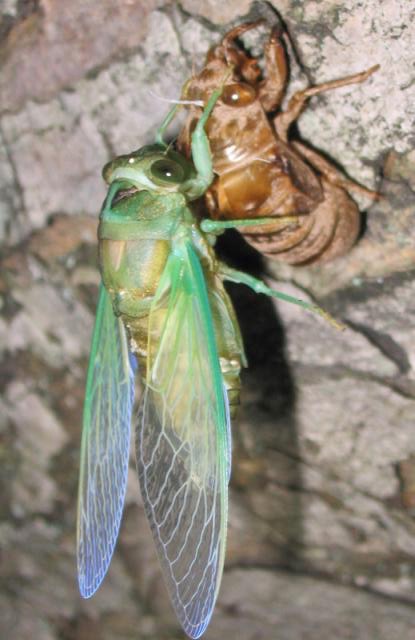
Watch some cicada transformations:
An aside:
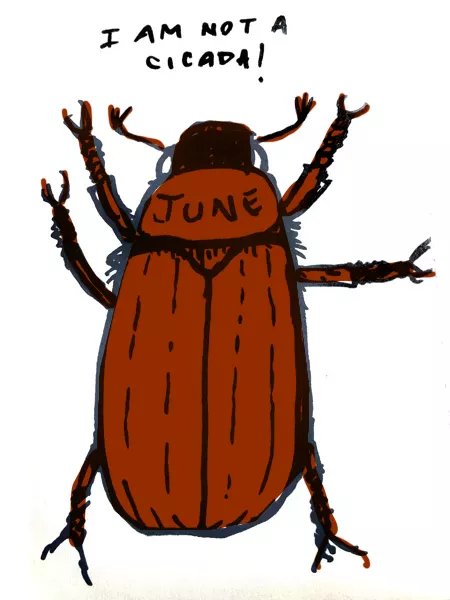
Although cicadas are bugs that are around in June, actual “June Bugs” are not cicadas. They are leaf-eating beetles belonging to the genus Phyllophaga.
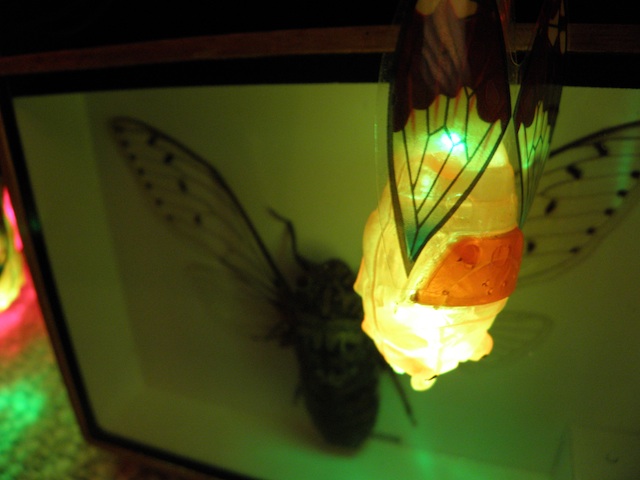
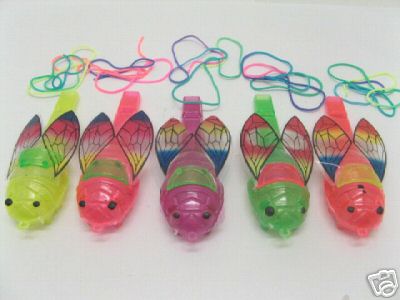
I made cicada Christmas lights using some LED USB Christmas lights, and some plastic cicada whistles from Australia. The song of cicadas heralds the Christmas season in many countries in the southern hemisphere like Australia.
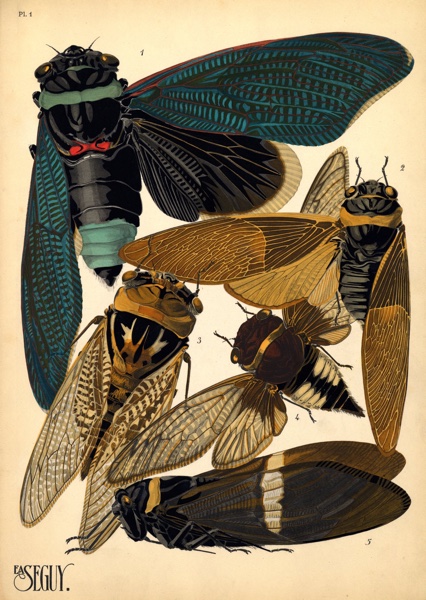
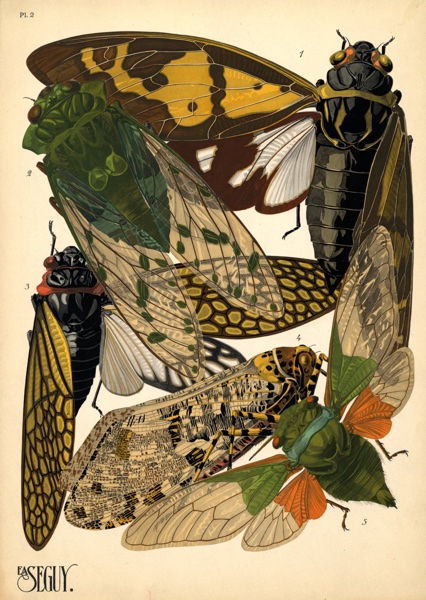
The NCSU Libraries Rare and Unique Digital Collections website recently reminded the us of artist Eugene Alain (E.A.) Seguy’s insect illustrations. Seguy created these illustrations in the 1920’s, and as you might imagine, some of the cicada names cited in the notes for these illustrations have changed. Names typically change when cicadas are reclassified due to discoveries about their biology, or when we realize that someone else had actually named them earlier than the namer currently given credit.
Here are the two illustrations, the accompanying identification, and corrected identifications.
Tacua speciosa. This is correct, although there are two subspecies of T. speciosa, I’m going to guess it is Tacua speciosa speciosa (Illiger, 1800) based on the location.
Polyneura ducalis. This is correct. Polyneura ducalis Westwood, 1840.
Cicada saccata. This is now: Thopha saccata (Fabricius, 1803).
Cicada fascialis. This is now: Cryptotympana facialis facialis (Walker, 1858). Update: David Emery says this might be a Cryptotympana acuta (Signoret, 1849).
Tozena melanoptera. Close enough. Tosena melanoptera melanoptera (White, 1846). There are a few unnamed subspecies.
Goeana festiva is actually Callogaeana festiva festiva (Fabricius, 1803).
Zammara tympanum. This is correct. Zammara tympanum (Fabricius, 1803).
Goeana ochracea is way off. It is a Talainga binghami Distant, 1890.
Phenax variegata is not a cicada, is it a fulgoroid planthopper, but the id is correct.
Hemisciera maculipennis is correct. Hemisciera maculipennis (de Laporte, 1832) aka the “Stop and Go” cicada, because its colors resemble the colors of a stop light.
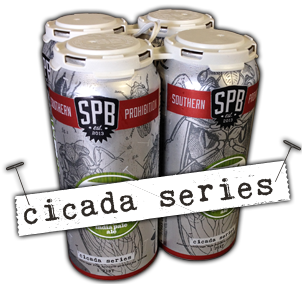
Southern Prohibition Brewing is offering Cicada themed (but not flavored) beer this year. Just in time for Brood XXII.
Their site says cicadas are their favorite “invasive species”, but cicadas are not an invasive species, however it can feel like an invasion when periodical cicadas arrive.
BTW, here’s the first news article about Brood XXII I’ve found. It’s from the LSU AgCenter and features Christopher Carlton, LSU AgCenter entomologist and director of the Louisiana State Arthropod Museum.
No signs of Brood XXII cicadas on social media yet.