Categories
FAQs Life Cycle Magicicada Periodical

Why do Magicicada stay underground for 13 or 17 years?

People ask: why do periodical cicadas stay underground for 17 or 13 years?

There are three parts to this puzzle that people are interested in:

  1. How cicadas count the years as they go by.
  2. Why prime numbers? 13 and 17 are prime.
  3. Why is their life cycle so long? They are one of the longest living insects.

Cicadas likely don’t count like people do (“1,2,3,4…”) and you won’t find scratch marks inside the cell (where they live underground) of a Magicicada, marking off the years as they go by. However, there is a kind of counting going on, and a good paper to read on that topic is How 17-year cicadas keep track of time by Richard Karban, Carrie A. Black, and Steven A. Weinbaum. (Ecology Letters, (2000) Q : 253-256). By altering the seasonal cycles of trees they were able to make Magicicada emerge early, proving that cicadas “count” seasonal cycles, perhaps by monitoring the flow and quality of xylem sap, and not the passage of real time.

Why prime numbers, and why is the life cycle so long? This topic fascinates people. The general consensus is that the long, prime-numbered life-cycle makes it difficult for an above-ground animal predator to evolve to specifically predate them. Read Emergence of Prime Numbers as the Result of Evolutionary Strategy by Paulo R. A. Campos, Viviane M. de Oliveira, Ronaldo Giro, and Douglas S. Galvao (PhysRevLett.93.098107) for more on this topic. An argument against that theory is that a fungus, Massospora cicadina, has evolved to attack periodical cicadas regardless of their life cycle. Of course, a fungus is not an animal. Maths are easy for fungi.

There are also questions about why there are 13 and 17 year life cycles, why a 4 year acceleration of a brood might occur1 and why Magicicada straggle.

1 This is a good place to start: Genetic Evidence For Assortative Mating Between 13-Year Cicadas And Sympatric”17-Year Cicadas With 13-Year Life Cycles” Provides Support For Allochronic Speciation by Chris Simon, et al, Evolution, 54(4), 2000, pp. 1326—1336.
Categories
C.L. Marlatt FAQs Magicicada Periodical

What are Broods?

It is important to note that when we talk about cicada broods, we are talking about the 17 & 13-year periodical Magicicada cicadas. We are not talking about Tibicen or other species.

All Broods

There are 12 groups of Magicicadas with 17-year life cycles and 3 groups of Magicicadas with 13-year life cycles. Each of these groups emerge in a specific series of years, rarely overlapping (17 & 13-year groups co-emerge every 221 years, for example). Each of these groups emerge in the same geographic area their parents emerged. These groups, each assigned a specific Roman numeral, are called broods.

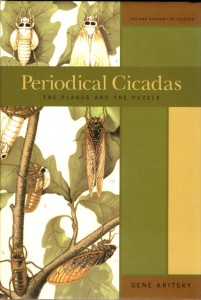
Gene Kritsky’s book, Periodical Cicadas: The Plague and the Puzzle, documents the history of the recognition and naming of the broods. The first person to document that different groups of periodical cicadas emerged in different years was Nathaniel Potter in 1839. Benjamin D. Walsh and Charles V. Riley devised the system for numbering the different broods in 1868, and then C. L. Marlatt sorted the 17 year broods out from the 13-year broods, giving us the system we have today.

Visit our Broods page which features a grid of the Brood names, their lifespan, when & where they’ll emerge next and links to maps.


Categories
Eye Color FAQs Magicicada Roy Troutman

Did Someone Offer a Reward for White or Blue-eyed Cicadas?

Is it true that someone has offered a reward for a white or blue-eyed Magicicada cicadas?

This was false and an urban legend until in 2008 when Roy Troutman began to offer rewards for living blue-eyed cicadas for scientific research. All cicadas were released, unharmed.

Important: Roy is no longer offering the reward as he has obtained the cicadas needed for his research. So, don’t bug him, unless you want to tell him that his photos and video are awesome.

White or Blue-eyed Magicicadas cicadas are extremely rare, so finding them can be difficult. I usually find one per emergence, and that is after looking at thousands of cicadas.

Speaking of Roy and White-eyed cicadas, here is a video Roy took of a White-eyed cicada:

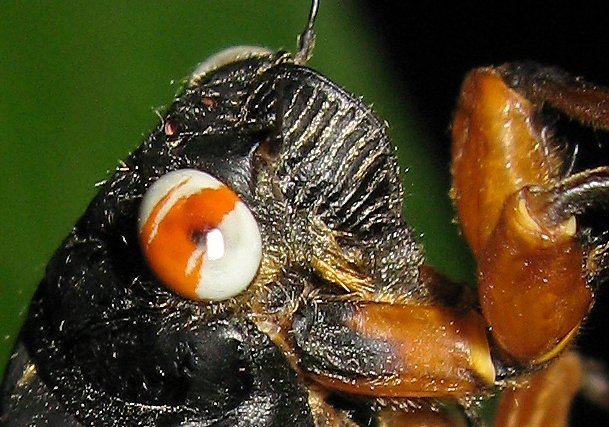
And here’s a white and orange-eyed cicada photo taken by Roy:

Upclose on Marble eyed 17 year cicada

Categories
Behavior FAQs Magicicada

Are cicadas attracted to the sound of lawnmowers and other machinery?

Cicadas on Man Are cicadas attracted to the sound of lawnmowers and other machinery? Yes! Cicadas, particularly Magicicada periodical cicadas, are attracted to lawnmowers, weed-whackers, leaf blowers, hedge trimmers, power drills, etc. If it is loud and vibrates, cicadas will be attracted to it. Why? Most likely because they think your tool is a particularly impressive periodical cicada chorusing center, so males want to join in with the chorus and females want to mate with the particularly impressive males.
So, next time you’ve got the old angle grinder out, don’t be surprised if a cicada lands on your shoulder.


Categories
FAQs Magicicada

When is a locust not a locust? When the locust is a cicada.

Are Cicadas Locusts? The short answer is NO. However, in the U.S.A. we’ve been calling cicadas “locusts” for hundreds of years.

People have seen referring to cicadas, particularly Periodical cicadas, as both flies and “locusts” since the 1600’s, when colonists first documented them.

Gene Kritsky's The Plague and the Puzzle

Gene Kritsky’s book Periodical Cicadas: The Plague and the Puzzle provides a chronology and historical texts of people referring to cicadas as “locusts”. Consider this quote from Pehr Kalm from 1756:

By the Englishmen here they are called Locusts and by the Swedes living here, they have gotten the name Grasshoppers. In Latin, they could be called Cicada.

It makes some sense that Englishmen would call cicadas Locusts, and Swedes would call them Grasshoppers because there was only one species of cicada in both England and Sweden. This cicada, Cicadetta montana montana, call is so high-pitched you need electronic assistance to hear it, so most people were not aware of its existence. So, when Englishmen and women encountered cicadas they likely thought “there are a lot of them, they’re big, I’m afraid they’re going to eat my carrots — these must be LOCUSTS”!

Cicadas are indeed not Locusts, Grasshoppers or Flies.


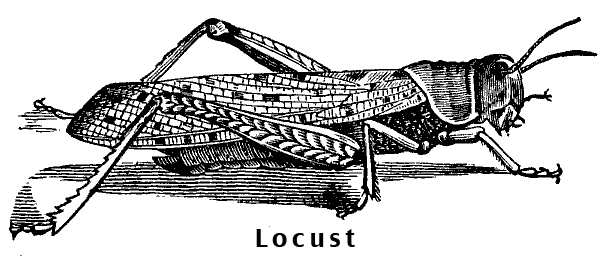
Take a look that the illustration of a true locust below. You’ll notice the true locusts have HUGE rear legs for hopping, long antennae, and relatively long bodies. True locusts chew the plants they consume, while Magicicadas suck fluids from trees.

Locust:

Locust

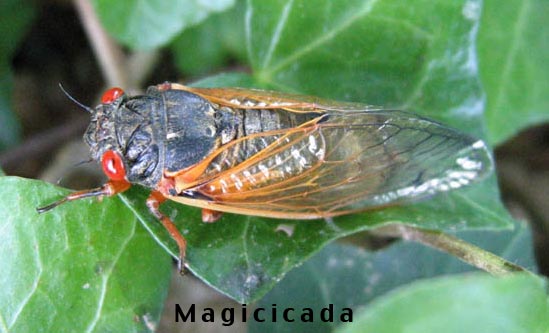
17-year cicada:

17-year cicada

Characteristic Locust Cicada
Order Orthoptera Hemiptera
Hind Legs Giant hind legs for jumping Hind legs about the same size as other legs; great for climbing and perching.
What they eat Everything green they can find to eat Xylem sap
They’re in your town All the plants in your town have been stripped bare Cool UFO movie soundtrack sounds during the day

For more instances of cicadas being confused with other types of insects, read the article These are not cicada insects!

Categories
FAQs Magicicada Periodical

How Long Does a Periodical Cicada Emergence Last?

People often ask: “how long do cicadas last”, “how long will the cicadas be here”, or “how long do cicadas live above ground”?

People probably ask these questions, sadly, because they are tired of listening to the love songs of these cicadas. Like the saying “it is darkest before the dawn”, however, silence is typically a few weeks away.

The length of a local emergence:

The typical periodical cicada emergence will last between 6 to 8 weeks in a single location, with significant chorusing (singing) lasting about 3 to 4. Cool weather or rain can prolong an emergence.

The research paper Emergence of 13-Yr Periodical Cicadas (Cicadidae: Magicicada): Phenology, Mortality, and Predator Satiation by Kathy S. Williams, Kimberly G. Smith, and Frederick M. Stephen1 contains a wonderful study of the arc of a periodical cicada emergence. The entire emergence event takes place within 8 weeks, from the first emerged cicada to the last dead cicada (see Fig 4 in that document 1). The number of live adults reached its peak within two weeks and then began to die off in significant numbers two weeks after that, due mostly to natural causes. After that, the population of cicadas gradually dwindles due to natural deaths and predation.

Length of the chorusing:

Male cicadas will not begin chorusing at the start of an emergence, for a couple of reasons: 1) the first cicadas to emerge, which are primarily males (Fig 3 in 1), are mostly lost to consumption by predators (Fig 6 in 1), 2) Males can’t sing until their adult bodies are fully sclerotized, and 3) they need a significant number of males present before they will chorus. That said, chorusing typically begins within two weeks 2. Males will continue to chorus until enough cicadas die to no longer sustain the chorus, which is why the chorus lasts less than a month.

Length of the emergence of an entire brood:

An emergence spanning multiple states could last between 8 to 10 weeks from when the first cicadas emerge in the South to when the last cicada dies in the North. For example, Brood XXIII began appearing the second to last week of April in Mississippi, and there were likely some left in southern Illinois up until the last week of June.

References:

1 Kathy S. Williams, Kimberly G. Smith, and Frederick M. Stephen, Emergence of 13-Yr Periodical Cicadas (Cicadidae: Magicicada): Phenology, Mortality, and Predator Satiation, (1993), Ecology, Volume 74, Issue 4 (Jun., 1993), 1143-1152
2 Kathy S. Williams and Chris Simon, The Ecology, Behavior, and Evolution of Periodical Cicadas, (1995), Annu.Rev. Entomol. 40:269-95

Categories
Anatomy Chremistica FAQs Magicicada

Do cicadas pee?

More than a few people have asked Cicada Mania: “do cicadas pee”? Absolutely, cicadas do pee. There are a couple of reasons why:

  • They pee to eliminate excess fluids taken in while drinking xylem (1).
  • They pee to eliminate non-essential amino acids (2).
  • Underground, they could use excess fluid to help moisten and remold their tunnels & cells (2).
  • They might, in some cases, even use it to keep ants from attacking… (3)

You may have been under a cicada-filled tree on a sunny day and felt a sprinkle or two. Don’t worry, it is just watery tree sap (xylem) passed through a cicada.

A detailed explanation of the experience courtesy of Les Daniels:

I’ve experienced this several times where I was on the receiving end of this artificial rain. When many cicadas congregate on warm days, they feed on the tree fluids and often urinate ‘piss’ while doing so. This bug urine is called ‘honeydew.’ The little buggers have pelted me several times while I was observing a little ‘too’ close. It isn’t uncommon. Lastly, the ‘honeydew’ does not stain or stink. In fact, it feels like raindrops.

Some cicadas seem to pee more than others, for instance, the Chremistica umbrosa of South-East Asia. If you walk under an umbrosa, you will need an umbrella! (The Latin root of both words, umbr means shade). Here is a video of Chremistica umbrosa:

Sources:

1 Records Of The Cicada, Chremistica Umbrosa (Distant, 1904) In Singapore, With Accounts Of Its Mass Emergence (Homoptera: Cicadidae: Cicadinae), Tzi Ming Leong, Aminurashid and Benjamin P. Y-H. Lee, NATURE IN SINGAPORE 2011 4: 163—175, 15 June 2011

2 The Ecology, Behavior, And Evolution Of Periodical Cicadas, Kathy S. Williams and Chris Simon, Annu.Rev. Entomol. 1995. 40:269-95

3 The documentary The Queen of Trees by Deeble & Stone features a segment about Fig Cicadas, that expel pee, sweet with the phloem sap of the fig tree, which is enjoyed by ants and monkeys, which has the side benefit of keeping those predators and nuisances away.

Categories
FAQs Magicicada Periodical

What is Predator Satiation?

Why are there so many Magicicada periodical cicadas, and what does it have to do with the survival of their species? One of the answers is: Predator Satiation.

A predator is any animal that would eat a periodical cicada, i.e., birds, raccoons, squirrels, dogs, snakes, etc. Satiation, in the case of cicadas, means to supply predators with enough cicadas to eat until they are wary of eating and thus avoid them completely.

Predator satiation works like this:
1) Periodical cicadas emerge in tremendous numbers.
2) Adult cicadas are often timid, even after having sclerotized.
3) The first cicadas that emerge are eagerly consumed by predators.
4) The predators are so overwhelmed by the bounty of easily eaten cicadas, that they fill themselves to the point of disgust and exhaustion.
5) This gives the remaining cicadas a chance to escape the predators.

The first periodical cicadas are literally “fodder”, in the battle between predators and periodical cicadas, to use a war/video game analogy.

Look at this periodical cicada: it is thinking “hopefully this creature will eat me, so my siblings will live on!”

Magicicada on my finger by Dan from Cicada Mania on Vimeo.

The research paper Emergence of 13-Yr Periodical Cicadas (Cicadidae: Magicicada): Phenology, Mortality, and Predator Satiation by Kathy S. Williams, Kimberly G. Smith, and Frederick M. Stephen (Ecology, Volume 74, Issue 4 (Jun., 1993), 1143-1152) is worth reading if you are interested in this topic. They found that predation of cicadas peaks during the first few days of the emergence, and doesn’t resume in significant numbers until three weeks later (see figure 6, if you read the paper).

Unfortunately, this strategy could be detrimental to periodical cicadas in areas with dwindling populations, where there isn’t enough of them to satiate the predators completely.

This strategy might also be used by other types of periodical cicadas like the Chremistica ribhoi of India, or cicadas that emerge in large numbers like Callogaeana festiva of south-east Asia.

Categories
Brood V Brood VIII Magicicada Matt Berger Periodical Periodical Stragglers

Look and listen for Magicicada stragglers in 2015

Another straggler sighting, this time in Cleveland which should make it a Brood V one year straggler:

Matt Berger Brood V Stragger 2
A Brood V straggler found by Matt Berger in West Virginia. See more photos of this cicada.

The emergence of Brood XXIII is well underway in the states along the Mississippi, and Brood IV should kick off in the west as soon as it stops raining every day. These aren’t the only Magicicada periodical cicadas emerging in the U.S. this year — some stragglers will emerge as well.

A straggler is a periodical cicada that emerges before or after the rest of its brood. Typically a straggler belonging to a 17 year brood will emerge 4 years early, but they might also emerge a year early, or a year late, or even 4 years late. This probability chart, details the probability of a straggler emergence.

In 2015 you might find the following stragglers:

Tyla MacAllister found a Brood XIX Magicicada straggler (emerged 4 years late) in Alabama!

Categories
Brood IV Magicicada Periodical

Brood IV, the Kansan brood, will emerge in 2015

Brood IV will next emerge in the year 2032.

This page was last updated in 2015.

The most popular question is “how long will the cicadas last“. They’ll last as long as it takes for them to mate and run our of energy. They translates to about 4 weeks of singing. Good weather — dry, calm, and in the 80s — helps them finish their business quicker.

Here is a video that will show you how to identify the various species:

2015 Brood IV

Brood IV, the Kansan brood, will emerge in Texas, Oklahoma, Missouri, Kansas, Nebraska, and Iowa, in the spring of 2015.

The cicada species that will emerge are Magicicada cassinii (Fisher, 1852), Magicicada septendecim (Linnaeus, 1758), and Magicicada septendecula Alexander and Moore, 1962. These periodical cicadas have a 17-year life cycle. The last time they emerged was 1998.

Counties:

Here is a list of the Counties where Brood IV periodical cicadas have appeared in the past. The data came from the Cicada Central Magicicada Database(RIP). The bolded counties are the ones Cicada Central has specimens for, indicating that they’re more of a sure thing.

Iowa: Adair, Adams, Cass, Dallas, Fremont, Johnson, Mills, Montgomery, Page, Pottawattamie, Ringgold, and Taylor

Kansas: Allen, Anderson, Atchison, Bourbon, Butler, Chase, Cherokee, Coffey, Crawford, Doniphan, Douglas, Geary, Greenwood, Johnson, Labette, Linn, Lyon, Marion, Montgomery, Neosho, Osage, Pottawatomie, Riley, Saline, Sumner, Wilson, Woodson, and Wyandotte

Missouri: Atchison, Barton, Buchanan, Caldwell, Clay, Clinton, Daviess, Dekalb, Gentry, Grundy, Harrison, Holt, Jackson, Johnson, Lafayette, Livingston, Mercer, Nodaway, Pettis, Ray, Saline, Vern, and Worth

Nebraska: Cass, Douglas, Johnson, Nemaha, and Sarpy

Oklahoma: Bryan, Carter, Choctaw, Comanche, Cotton, Craig, Garvin, Grady, Lawton, Mayes, McCurtain, Muskogee, Noble, Osage, Ottawa, Pawnee, Rogers, Stephens, Tulsa, and Washington

Texas: Cooke, Denton, Fannin, Grayson, Kaufman, Lamar, Montague, Wise

Learn more about Brood IV:


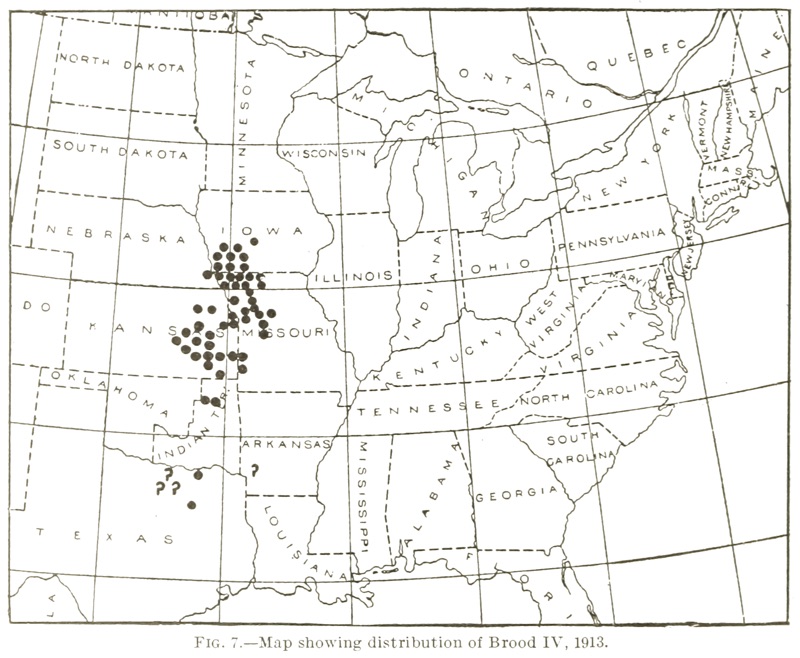
1907 Map from Marlatt, C.L.. 1907. The periodical cicada. Washington, D.C. : U.S. Dept. of Agriculture, Bureau of Entomology.

Marlatt 1907 04 Brood IV