Categories
Brood X Gene Kritsky Magicicada Periodical Stragglers

Brood X Stragglers Emerge in Ohio

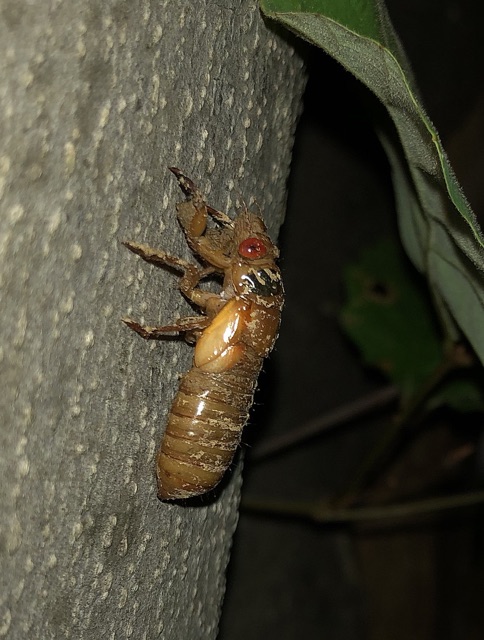
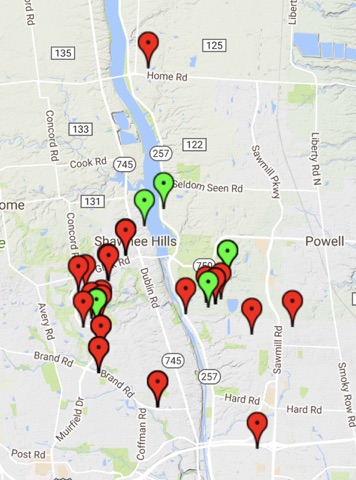
Gene Kritsky, author of Periodical Cicadas. The Plague and the Puzzle, let us know that many of what are likely Brood X cicada stragglers have emerged around the Mount St. Joseph University campus, in Cincinnati, Ohio. It’s likely that cicadas are emerging elsewhere in the Cincinnati area.

This is significant because Brood X cicadas should not emerge until 2021.

This is a photo of a Magicicada periodical cicada emerging on the MSJ campus, courtesy of Gene:
2018 MSJ nymph

Quick facts:

  • Gene Kritsky is a periodical cicada expert and Dean of the School of Behavioral and Natural Sciences and Professor and of Biology at Mount St. Joseph University. Read more.
  • Brood X is a massive brood of Magicicada (the genus) periodical (the lifecycle type) cicadas that are set to emerge in 2021 in 15 states.
  • A straggler is a periodical cicada that emerges off-schedule, often a few years before or after the rest of its Brood.
Categories
Brood XXIII Magicicada Periodical Periodical Stragglers

Periodical cicada season starts, with a straggler

Update: in addition, two Brood X stragglers were reported on 5/21 in Bloomington, Indiana (thanks Rhonda and Leah).

Original post:

Cicada researcher John Cooley has received the first cicada sighting of the year — a Brood XXIII straggler in western Tennessee!! 3 years later than expected.

So, what’s a straggler? A straggler is a periodical cicada that emerges sooner or later than it is expected to emerge. In this case, a cicada with a 13-year lifecycle emerged in 16 years — 3 years off.

Categories
Brood XXII Chris Simon Gene Kritsky John Cooley Magicicada Papers and Documents Periodical Roy Troutman

New paper about Brood XXII Magicicadas

There is a new paper out about Brood XXII, titled Evolution and Geographic Extent of a Surprising Northern Disjunct Population of 13-Year Cicada Brood XXII (Hemiptera: Cicadidae, Magicicada). I helped with the field work for this paper, traveling through Ohio and Kentucky with Roy Troutman, recording the locations of periodical cicadas.

Brood XXII, a brood of Magicicada periodical cicadas with a 13-year lifecycle, exists in Louisiana & Mississippi, and Ohio & Kentucky with no geographic connection between them (the two groups are geographically isolated). The paper discusses the similarities and differences between the two groups.

You can read and download the paper for free.

Citation for the paper:
Gene Kritsky, Roy Troutman, Dan Mozgai, Chris Simon, Stephen M Chiswell, Satoshi Kakishima, Teiji Sota, Jin Yoshimura, John R Cooley; Evolution and Geographic Extent of a Surprising Northern Disjunct Population of 13-Year Cicada Brood XXII (Hemiptera: Cicadidae, Magicicada), American Entomologist, Volume 63, Issue 4, 12 December 2017, Pages E15—E20, https://doi.org/10.1093/ae/tmx066

Categories
Chremistica India Periodical Sudhanya Hajong Tacuini (Cryptotympanini)

The World Cup Cicada, Chremistica ribhoi

Update: this cicada has a Leap-Year Brood (2024) as well as a World-Cup Brood (2026)! Both have 4-year year life cycle.

cicada soccer

Chremistica ribhoi Hajong and Yaakop 2013 is a cicada that lives in the Ri-Boi district of India. C. ribhoi is known as the World Cup cicada because it emerges every four years in synch with the World Cup association football (soccer) tournament.

C. ribhoi is known locally as Niangtasar. It only lives in a very small area: Saiden village (25°51’37.1"N 91°51’16.3"E) and Lailad/Nongkhyllem Wildlife Sanctuary (25°55’09.7"N 91°46’25.0"E) situated on the northern part of the state of Meghalaya. The cicada can be identified by the presence of two white spots on either side of the anterior abdominal segment.

Researcher Sudhanya Hajong is gearing up to study these cicadas since this is the year they will emerge. Ri-Boi area locals use these cicadas as a food source and fish bait. These cicadas are threatened by deforestation (cutting down forests for agricultural purposes). Sudhanya plans to educate locals about conserving them and protecting their habitat.

Photos of Chremistica ribhoi.

Most of the facts in the post come from the following document: Hajong, S.R. 2013. Mass emergence of a cicada (Homoptera: Cicadidae) and its capture methods and consumption by villagers in ri-bhoi district of Meghalaya. Department of Zoology, North-Eastern Hill University, Shillong – 793 022, Meghalaya, India.

Thanks to Chris Simon of The Simon Lab at UCONN for providing the information that made this post possible.

Note: the image in this article is not an accurate depiction of C. ribhoi. 🙂


There’s also a brood of C. ribhoi that emerges during Leap-years.

Categories
Fiji Periodical Raiateana Tacuini (Cryptotympanini)

Fiji 8-year periodical Nanai aka Raiateana knowlesi

Fiji $100 note

This cicada will next emerge in 2025.

Update (11/4/2017): from Facebook, it looks like folks are finding them. Here’s an image.

Update (9/13/2017): the Nanai have begun to emerge! This cicada last emerged in 2009 in Nadroga-Navosa and Serua Provinces, and now again emerge in 2017.

Notes from Chris Simon:

Early this morning I got the first Reports of the 8-year periodical Nanai emerging in Navosa, Fiji! Some people in that area had them for dinner.

This confirms earlier reports of the eight-year periodicity. There was some uncertainty because the original specimens were dated (1906) a year later than they would be if on the current 8-year schedule.

Duffels and Ewart (1988, The Cicadas of the Fiji, Samoa, and Tonga Islands, their taxonomy and Biogeograohy) noted that “Until recently the present species is only known from three males collected in “Fijii” in 1906 by C. Knowles.” Duffels was not able to describe them when he first saw the specimens because they were missing the male genitalia. After obtaining, “a series of females and two males” from Dick Watling and Andrew Laurie in 1986, Duffels was able to assign it to the genus Raiateana. There is one other species of Raiateana in Fiji, R. kuruduadua (two subspecies in Fiji and one in Samoa) but it is not periodical as far as we know.

You might be familiar with American periodical cicadas (Magicicada) and the World-cup synchronized Chremistica ribhoi of India, but Fiji has a periodical cicada too: the 8-year periodical Nanai cicada aka Raiateana knowlesi.

It also appears on Fiji’s $100 note.

There’s even a local legend about the cicada.

More information:

Thanks to Chris Simon of the University of Connecticut for this information.

More shots of the Fiji $100 note and the folder it comes in:

Fiji $100 note

Fiji $100 note

Categories
Folklore Magicicada Periodical

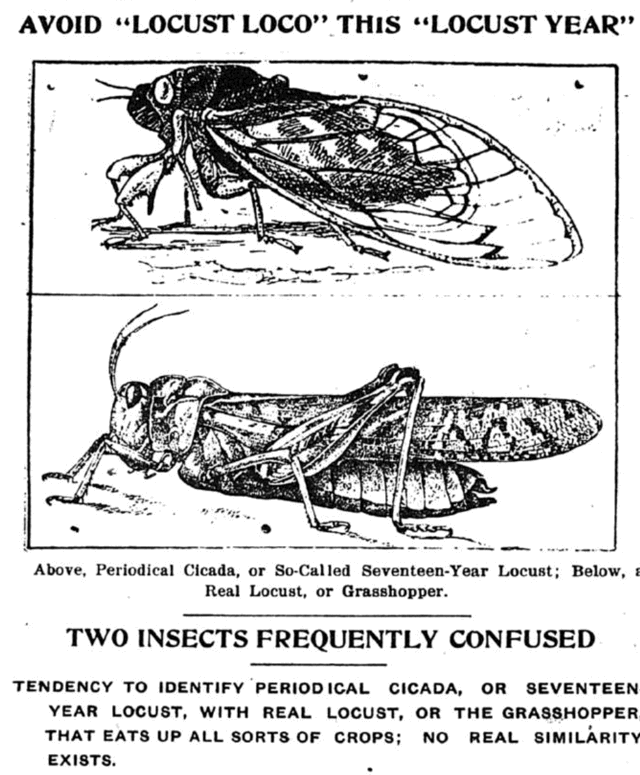
Avoid “Locust Loco”

A nice illustration that shows the difference between Magicicada periodical cicadas & Locust grasshoppers from the April 18, 1919 edition of The Washburn Leader, Washburn, North Dakota.

Once you see them up-close, it’s clear that cicadas are not locusts. Nearly 98 years later, people still call cicadas “locusts” though.

1919

Categories
FAQs Life Cycle

How long do cicadas live? Longest life cycle?

Which cicada has the longest life cycle?

The most famous cicadas — North American periodical cicadas — typically live 17 or 13 years. These cicadas only represent about 0.2% of all cicadas, most of which live shorter lives.
Magicicada septendecim cicadas live 17 years.

Cicada Life Spans:

Cicada life spans (life cycle length) vary from one year to as many as 21, depending on the species. Cicadas like Myopsalta crucifera and Parnkalla muelleri of Australia have one-year life cycles6. Magicicada septendecim, M. cassini and M. septendecula, of the United States, can live as long as 21 years (read What are Stragglers?).

Some life spans for well-known cicadas:

    North America:

  • Magicicada septendecim, M. cassini and, M. septendecula: 13 to 2210, but typically 17.
  • Magicicada tredecim, M. neotredecim, M. tredecassini, and M. tredecula: 9 to 17, but typically 13.
  • Diceroprocta apache: 2-5, but typically 3-4 years1.
  • Neotibicen and Megatibicen genera: 2-7 years2.
  • Okanagana rimosa: 9 years3.
  • Okanagana synodica: possibly 17 to 19 years.5
    Australia:

  • Cyclochila australasiae: 6-7. 6
    India:

  • Chremistica ribhoi: 4. 7
    Japan:

  • Hyalessa maculaticollis: 2-5, but typically 3. 8
    New Zealand:

  • Amphipsalta zealandica: 3-4, but typically 4. 9

Table 3 of the paper Genome Expansion via Lineage Splitting and Genome Reduction in the Cicada Endosymbiont Hodgkinia (Campbell et al, 2015) contains a large table of cicada life cycle lengths.

Annual, Periodical, or Protoperiodical

Most cicadas appear on an annual basis, meaning that every year adults will appear.

It is common for many species to be Protoperiodical as well, meaning that some years will see an abundance of adults, while other years there will be a limited number of that species. Okanagana rimosa, in particular, are Protoperiodical 9.

Some species, like the Magicicada species and Chremistica ribhoi, appear on a periodic basis, meaning that after a specific number of years almost all adults of the species will emerge.

Life Expectancy

Although many cicadas have long life cycles, not many of them make it to adulthood. Nymphal mortality of Magicicada can reach 98% in the first 2 years 4. Imagine if all those cicadas made it to adulthood. 50 times more cicadas! Unfortunately, that isn’t the case.

Magicicada is just one genus of cicadas (representing about 0.2% of all species), but I have to think that most cicadas, regardless of species, will never make it to adulthood.

How long do cicadas live as adults?

Short answer: about a month.

How long a cicada lives as an adult depends on the species, but the answer could be from a matter of seconds, if the cicada dies due to predation or an accident, to more than a month. Cicadas are primarily subterranean plant (mostly tree) parasites and only enter their above-ground, adult form to mate/reproduce.

A particular species of cicada, like Neotibicen tibicen tibicen, might appear to last for two or three months, because their song can be heard for that length of time, but that’s likely because they emerge over a month, not all on the same day, extending the length of time their species is present above ground.

No matter what the species, adult cicadas perish within a season or two, and do not live multiple years in their adult form, like other types of insects. They won’t try to move inside your house once winter approaches to find warmth and shelter.

References

1 Aaron R. Ellingson, Douglas C. Andersen and Boris C. Kondratieff (2002) Observations of the Larval Stages of Diceroprocta apache Davis (Homoptera: Tibicinidae), , Journal of the Kansas Entomological Society, Vol. 75, No. 4, pp. 283-289. Link.
2 Richard Fox, Tibicen spp, (2001) http://lanwebs.lander.edu/faculty/rsfox/invertebrates/tibicen.html
3 Soper RS, Delyzer AJ, & Smith LFR (1976) The genus Massospora entomopathogenic for cicadas. Part II. Biology of Massospora levispora and its host Okanagana rimosa, with notes on Massospora cicadina and the periodical cicadas. Ann. Entomol. Soc. Am. 69(1):89-95.
4 Karban R. 1984. Opposite density effects of nymphal and adult mortality for periodical cicadas. Ecology 65: 1656-61.
5 Campbell et al. 10.1073/pnas.1421386112.
6 Moulds MS (1990) Australian Cicadas (New South Wales University Press, Kensington, NSW, Australia).
7 Hajong SR & Yaakop S (2013) Chremistica ribhoi sp. n. (Hemiptera: Cicadidae) from North-East India and its mass emergence. Zootaxa 3702(5):493.
8 Logan DP, Rowe CA, & Maher BJ (2014) Life history of chorus cicada, an endemic pest of kiwifruit (Cicadidae: Homoptera). New Zealand Entomologist:1-11.
9 Kathy Williams & Chris Simon, The Ecology, Behavior, and Evolution of Periodical Cicadas, (1995), Annu.Rev. Entomol. 40:269-95.
10 David C. Marshall, John R. Cooley, and Kathy Hill, Developmental Plasticity of Life-Cycle Length in Thirteen-Year Periodical Cicadas (Hemiptera: Cicadidae), Ann. Entomol. Soc. Am. 104(3): 443Ð450 (2011)

Categories
Brood VI Brood X Life Cycle Magicicada

My 2017 Brood X and VI Experiences

I’ll cut to the chase, in terms of Brood VI, I only experienced the emergence via my web browser. I planned on visiting North Carolina but rain and car troubles stood in my way. I did travel to Wisconsin to try to find legendary populations said to exist there, but I found no cicadas. I drove routes 90, 14, 12, 23, and roads in between, but I had no luck finding them. My investigation was by no means comprehensive, but I covered as much ground as I could in the two days I was there and found no periodical cicadas.

Brood X stragglers are a different story. I missed seeing the massive Virginia/Maryland area populations, but I was able to see cicadas in Princeton, and the significant emergence in the Dublin area of Ohio.

Princeton, NJ

On May 20th I visited Princeton and found exuvia (shed skins/”shells”) on a pole next to where I parked my car, which was very encouraging. I headed for the Princeton Battle Monument park, a place where I saw massive numbers of cicadas in 2004. There, in 2017, I found exuvia but no adults — from 5 to as many as 200 per tree (I counted what I could see). The park was overflowing with squirrels and birds that would love to eat cicadas — I have no doubt why no stragglers survived. Blackbirds paced the lawn five abreast, like a small army systematically hunting for insect prey. During a normal emergence periodical cicadas emerge in such great numbers that many are able to get past the armies of hungry birds and rodents (this is called predator satiation). After visiting the park, I walked many side streets and found exuvia everywhere I went — not massive piles as we see during a normal, on-schedule emergence — but at least a few on every tree.

I returned on May 27th and actually found adult cicadas in Princeton. I found dozens of Magicicada cassini and a few Magicicada septendecim. There were not enough adults to form viable choruses. I doubt a few mated. I heard a single Magicicada cassini court song, so all least they were trying.

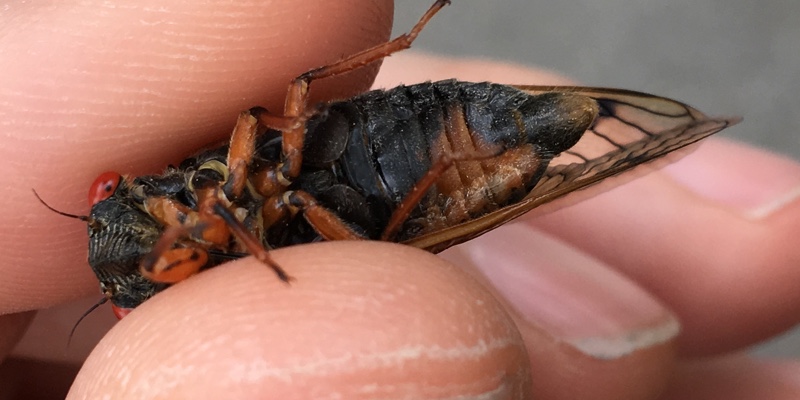
The most interesting cicada I saw was this Magicicada cassini with a mosaic pigment mutation, which caused the unusual orange marking on its abdomen. At first, I thought it was a Magicicada septendecim, but Chris Simon confirmed that it was not.

Magicicada cassini with mosaic pigment mutation in Princeton 2017

I also drove Rt 29 from Trenton to Frenchtown, across Rt 12 to Flemington, and down Rt 31 and heard no cicada populations. I visited Sourland Mountain. I visited many of the markers on Cicadas @ UCONN (formerly Magicicada.org) but found no cicadas, and certainly no viable adult populations (no singing, not enough to perpetuate a population).

North of Dublin, Ohio

On June 10th I made it to the suburbs north of Dublin, Ohio (itself north of Columbus). There I encountered a very active periodical cicada emergence. I mostly found Magicicada cassini, but I could hear Magicicada septendecim from time to time. I have little doubt that many cicadas mated and some of their progeny will survive to appear in another 14 or 17 years.

North of Dublin

Cedar Springs, OH

When I’m mapping cicadas I try to stop at every rest stop and welcome center to look for cicadas. I found periodical cicada exuvia at a rest stop on Rt 70 hear Cedar Springs, Ohio. This was a nice find because I didn’t see any sightings in this area on the Cicadas @ UCONN (formerly Magicicada.org) map.

Indianapolis, IN, near Ft. Harrison State park

I passed through Indianapolis, IN twice on my way to and from Wisconsin. I found some exuvia on the outskirts of Ft. Harrison State Park, but nothing inside the park (weird).

Categories
Annual Megatibicen Neotibicen U.S.A.

The Dusk Singers

The Dusk Singers

Dusk is the time of day between sunset and night. Many species of Megatibicen & Neotibicen (formerly Tibicen) sing at this time. I’m not sure why they sing at this time — perhaps it helps them avoid audio competition with other singing insects, or perhaps it helps them avoid predators by calling at this specific time of the day.

If you find yourself outdoors in the eastern half of the U.S. after sunset and hear a cicada call, it is likely one of the following Megatibicen or Neotibicen species:

Megatibicen

Megatibicen are LARGE and LOUD cicadas.

Megatibicen auletes aka the Northern Dusk Singing Cicada. This cicada can be found in these states: AL, AR, CT, DE, DC, FL, GA, IL, IN, IA, KS, KY, LA, MD, MA, MI, MS, MO, NE, NJ, NY, NC, OH, OK, PA, SC, TN, TX, VA, WV, WI. Season: July to Fall.

M. auletes Call*:

Megatibicen figuratus aka the Fall Southeastern Dusk-singing Cicada. Found in: AL, AR, FL, GA, LA, MS, NC, SC, TN, TX, VA. Season: July to Fall.

M. figuratus Call*:

Megatibicen resh aka Resh Cicada aka Western Dusk Singing Cicada. Found in: AR, KS, LA, MS, NE, OK, SC, TN, TX. Season: July to Fall.

M. resh Call*:

Megatibicen resonans aka Southern Resonant/Great Pine Barrens Cicada aka Southern Dusk Singing Cicada. Found in AL, FL, GA, LA, MS, NC, SC, TN, TX, VA. Season: July to Fall.

M. resonans Call*:

Neotibicen

Medium-sized, green cicadas with calls that sound like the rhythmic grinding of a scissor on a sharpening wheel (not a common tool in the 21st century).

Neotibicen pruinosus pruinosus aka Scissor(s) Grinder. Found in AL, AR, CO, IL, IN, IA, KS, KY, LA, MI, MN, MS, MO, NE, OH, OK, SC, SD, TN, TX, VA, WV, WI. Season: June – September. Neotibicen pruinosus fulvus aka Pale Scissor(s) Grinder Cicada. Found in: KS, OK. Season: June – September.

N. pruinosus Call*:

Neotibicen winnemanna aka Eastern Scissor(s) Grinder. Found in AL, DE, DC, GA, KY, LA, MD, MS, NC, NJ, PA, SC, TN, TX, VA, WV. Season: June – Fall.

N. winnemanna Call*:

*Audio files are Copyright of InsectSingers.com. Season information gathered from BugGuide.net.

Categories
Okanagana Proto-periodical

Okanagana Cicadas

Okanagana cicadas
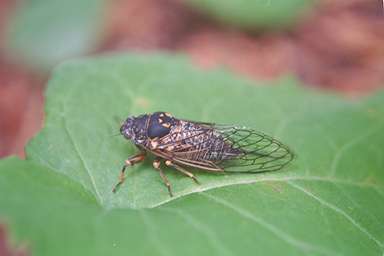
Photo credit: left, O. rimosa by Natasha; right, O. bella by Matt Berger.

Okanagana is a genus of cicadas that share their name with the Okanagan Lake, Valley & County areas of British Columbia, Canada. As you might guess, Okanagana are common in Canada. It is likely that the genus was named in tribute to the Okanagan people.

West of the Mississippi, O. synodica synodica & O. bella are the most common species in terms of the number of states and providences they are found. O. canadensis & O. rimosa are the most common species east of the Mississippi.

Lifespans and Lifecycles:

Okanagana rimosa have a lifespan of 9 years. Okanagana synodica have a lifespan of possibly 17 to 19 years! (see Campbell et al. 10.1073/pnas.1421386112).

Okanagana rimosa also appear to be proto-periodical (source) meaning they are abundant in some years, and scarce, but not absent in others.

“Soper et al (112) showed experimentally that Okanagana rimosa had a life
cycle of 9 years, and that in the field during a 9-year period (1962 to
1970) it was extremely abundant in 4 years and scarce or absent in the
other 5. Heath (32) also studied cicadas of the genus Okanagana and
found several species that appear to be protoperiodical.”

I’m not sure, but I suppose other species of Okanagana have proto-periodical lifecycles as well. This would explain why people see Okanagana in great numbers one year, and very few in previous years.

Okanagana adult photographed by Les Daniels

Identification:

Okanagana are typically around between June and July, depending on the species and latitude.

Okanagana are often black, with white, beige or orange highlights on their wings and body. The black color of their exoskeletons helps them absorb warmth from the sun.

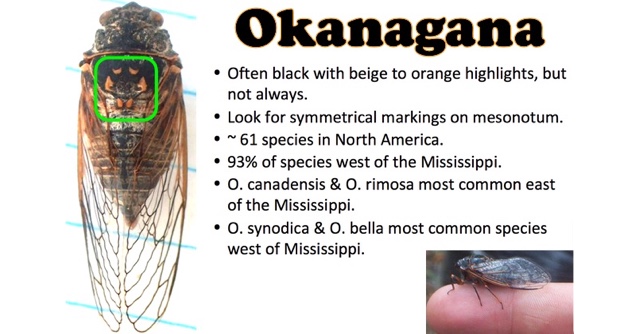
Look for four symmetrical markings on their mesonotum (back). The image at the beginning the the article highlights these markings.

One Okanagana that has atypical coloration is the O. viridis which is green. This outlier is one of the few species found in southern states.