
This is a wonderful macro photo of a Floury Baker (Aleeta curvicosta) from Australia. Thanks to Cameron for posting this photo on our Facebook page.
 Cicada Mania
This is a wonderful macro photo of a Floury Baker (Aleeta curvicosta) from Australia. Thanks to Cameron for posting this photo on our Facebook page.
I picked up a film on 16mm (what they showed to kids in school before VHS tapes were popular) called Cicada – The Insect Methuselah. I would love to see it, but I don’t have a 16mm projector (who does?) The film is presumably about 17/13 Year cicadas. I held the film up to a light, and it indeed features the Magicicada species.
The film was produced by the Moody Institute of Science in 1955, and I assume they still hold the copyright to the film. It is 12 minutes in length.
Update: Roy Troutman contacted us to let us know that this video footage can be found in another video: The Mystery of The Three Clocks, which you can watch here:
The most impressive thing about the video is the anatomical model of the cicada. I wish I had one (but I might have to go back to the 50’s to get one).
This video taken by Samantha Madell in NSW Australia is a time lapse video of of a Redeye Cicada (Psaltoda moerens) molting.
Poor, poor cicada — never had a chance. Here’s a video of bull ants attacking a molting cicada:
Now that is a lot of cicada skins!
This cicada photo was taken by photographer Cameron George about 60km south of Sydney Australia. I believe this is a Green Grocer, but I’m not 100% sure. The cicada is attempting to molt.
A new species of Tibicen cicada, Tibicen neomexicensis, has been described by Brian J. Stucky.
Thanks to David Marshall for the tip.
Just in time for Halloween… the Zammara a genus of cicadas with a collar like Dracula!
Andreas Kay has been posting photos of the insects of Ecuador on Flickr for around a year now. He’s posted many excellent cicada photos, particularly, photos of Zammara. They are among the most visually interesting cicadas.

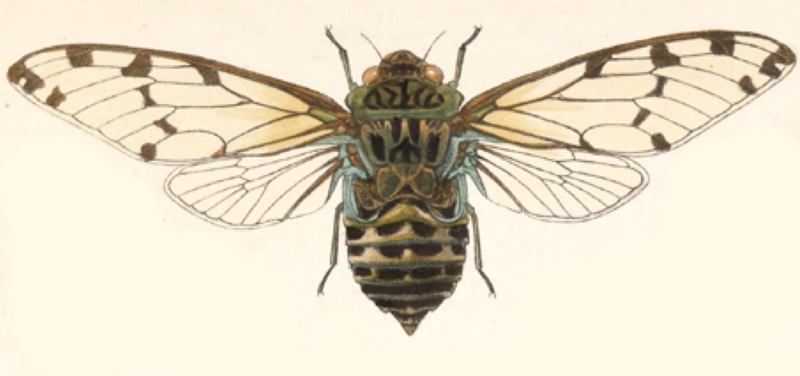
Emerald Cicada, Zammara smaragdina:


Here’s an illustration from Insecta. Rhynchota. Hemiptera-Homoptera. Vol. I by W. L. Distant and The Rev Canon W. W. Fowler, F.L.S:
Here the Scientific classification:
Family: Cicadidae
Subfamily: Cicadinae
Tribe: Zammarini
Genus: Zammara
Species: Zammara smaragdina Walker, 1850
Here’s an article about Collared cicadas of Mexico, Central & South America.
Cicadas are well known for the songs male cicadas make with their their tymbals, which are drum-like organs found in their abdomens.
Some female cicadas will also flick their wings to get the males attention. Watch this video where a male Magicicada is convinced that the snapping of fingers is a wing flick. Note: Magicicada males will also flick their wings once they become infected with the Massospora cicadina fungus (which removes their sex organs).
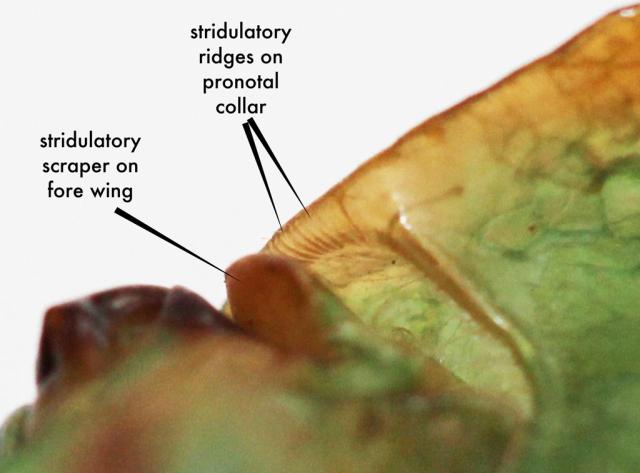
There is a third way some cicadas can make sounds. This method of creating a sound is unique to the Australian species Cyclochila australasiae (aka the Green Grocer and Masked Devil). These cicadas have stridulatory ridges on their pronotal collars (the collar shaped structure at the back of their head), and a stridulatory scraper on their fore wing.
From M. S. MOULDS, 2012, A review of the genera of Australian cicadas (Hemiptera: Cicadoidea). Magnolia Press Auckland, New Zealand. p84:
Cyclochila is unique among the Cicadoidea in possessing a stridulatory file on the underside of the lateral angles of the pronotal collar that interacts with a scraper on the fore wing base (Fig. 132). Rubbed together these produce low audible sound in hand-held specimens (K. Hill, pers. comm.), the purpose of which is for sexual com- munication at close quarters (J. Kentwell and B. Fryz, pers. comm.)
Here is a photo of these structures:
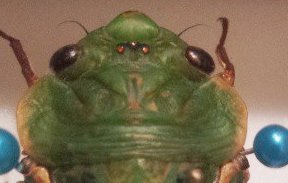
The location of these structures is right about where the blue pin is in this photo:
Update:
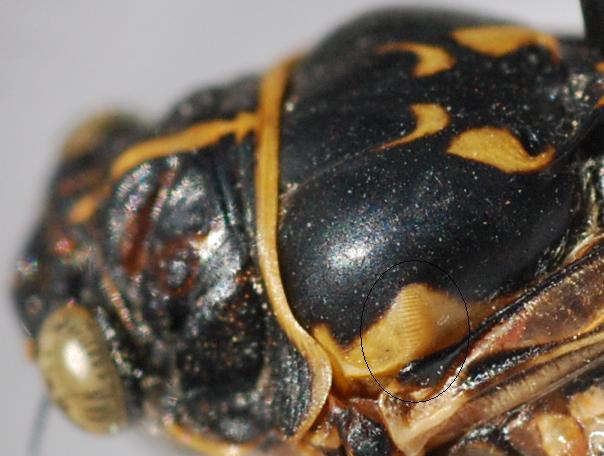
Tim McNary of the Bibliography of the Cicadoidea website, let us know that Clidophleps cicadas are also able to create should using a stridulatory structure. Clidophleps is a genus of cicada that can be found in California, Nevada, Arizona, and I assume adjacent parts of Mexico. Clidophleps differs from Cyclochila in that the stridulatory structure is on its mesonotum, and not its pronotal collar.
Photo courtesy of Tim McNary:
 I am excited about the 17 and 13 year cicada emergences expected in 2014.
Here is what we can look forward to:
I’m looking forward to taking some vacation time and tracking cicadas. Brood XXII is a good excuse to visit New Orleans (even if it isn’t on the cicada map).
Fun fact: Brood III and XXII won’t emerge in the same year again until the year 2235.

