Many of you will remember Samuel Orr from his film Return of the Cicadas.
He has a new Instagram account and website.
Sam is well known for his cicada photography and videography.
Return of the Cicadas from motionkicker on Vimeo.
 Cicada Mania
Many of you will remember Samuel Orr from his film Return of the Cicadas.
He has a new Instagram account and website.
Sam is well known for his cicada photography and videography.
Return of the Cicadas from motionkicker on Vimeo.
People ask, “Can periodical cicada singing damage hearing”? It all depends on how long you expose yourself to their song, and how close your ears are to the insect. Invest in some quality ear plugs if you are concerned. Consult a medical professional, of course.
Periodical cicada choruses are often in the 80–85db range, which the CDC says “You may feel very annoyed” and “Damage to hearing possible after 2 hours of exposure”:

If you spend a long time outside during a chorus, your ears will probably ring for hours after. That is my personal experience.
Placed directly on a microphone, I have observed periodical cicadas get as loud as 111.4db. According to the CDC, that is close enough to cause hearing damage in less than 2 minutes. Do not place male cicadas on your ear! Do not put your head right next to the tree branches where they’re singing.


Check out this video of Magicicada sound levels measured by an EXTECH 407730 Sound Level Meter:
How to avoid hearing them?
I’ve exposed myself to hundreds of hours of cicada songs. I’ve also gone to hundreds of concerts and listened to a lot of rowdy music over the years. My hearing is not great, but it is probably not due to cicadas.
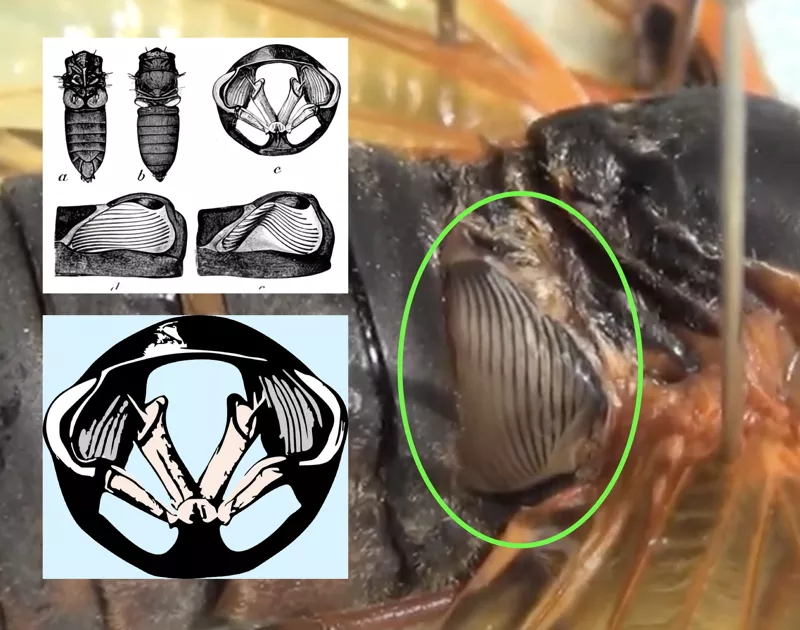
It is worth mentioning that only male cicadas sing. Females make noise by flicking their wings, but they are not as loud as the males. Males have organs called tymbals that vibrate creating their signature sound.
Here are illustrations and a photo of a Magicicada’s tymbals. They have one on each side of their body:
So what is the loudest cicada? According to the University of Florida Insect Book of World Records, “The African cicada, Brevisana brevis (Homoptera: Cicadidae) produces a calling song with a mean sound pressure level of 106.7 decibels at a distance of 50cm.” The loudest cicada in the United States, using the same methodology, is Diceroprocta apache (Davis) at 106.2db at 50cm.
I need to take measurements of Magicicada from 50cm to make a comparison. The measurements I’ve taken are in the midst of a large chorus with cicadas about a meter to 20 meters away, which falls in the 80-85db range; or directly on the mic, which gets into the 109-111db range. Your results may vary.

One phenomenal behavior of Magicicada periodical cicadas is they “straggle”, meaning they emerge earlier or later than the year they are expected. Typically they emerge 1 or 4 years before they’re supposed to emerge.
Brood XXIII is expected to emerge in four years in 2028, but enough are emerging in 2024 for cicada researchers like Chris Simon to take notice! She let us know about the stragglers on May 8th.
Brood XXIII is found in Arkansas, Illinois, Indiana, Kentucky, Louisiana, Mississippi, and Tennessee. This is not a perfect map (it overlaps with Brood XIX), but XXIII cicadas will show up in that area.
Arkansas: Bayou Deview Wildlife Management Area, Poinsett County, Devalls Bluff, Harrisburg, Holland Bottoms, Jacksonville, Jonesboro, Knox Co., Lake Hogue, Lake Poinsett State Park, Little Rock, and Wynne.
Illinois: Anna, Carbondale, Carterville, Chester, Clinton Lake, Marissa and Robinson.
Indiana: Harmonie State Park, Hymera, Leanne, Richland, Sullivan And Posey Counties.
Kentucky: Benton, Calvert City, Gilbertsville, Henry County, Murray, and Paducah.
Louisiana: Bastrop, Choudrant, Grayson and West Monroe.
Mississippi: Alva, Arlington, Booneville, Brandon, Clinton, Corinth, Desoto County, Florence, French Camp, Hernando, Holcomb, Houlka, Jackson, New Albany, Oxford, Potts Camp, Silver Creek, Tishomingo, and Water Valley.
Tennessee: Atoka, Benton, Cordova, Henry County, Huntingdon, Jackson, Lavinia, Leach, Lexington, McNeary County, Memphis, Paris, Savannah, and Speedwell.
Here’s a blue overlay of there Brood XXIII emerges from the UCONN map on the iNaturalist data (as of May 5th):
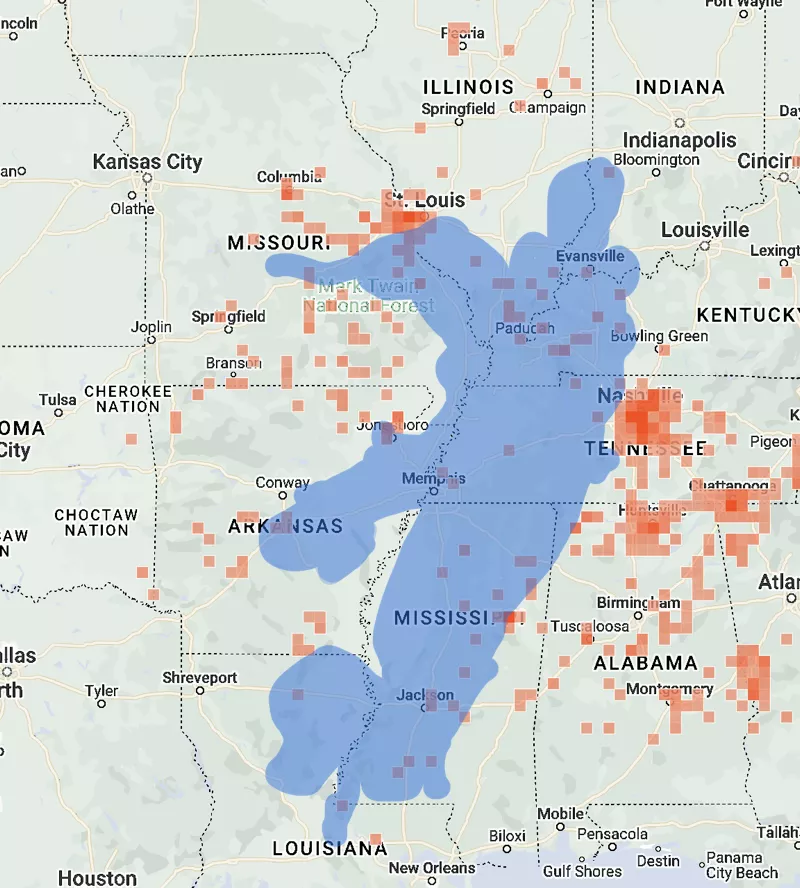
Surrounding the blue area on the west and east is Brood XIX and north will be Brood XIII.
More info:
I created a new iNaturalist project called the Magicicada Flagging Project to track tree flagging damage by Magicicada cicadas.
Upload a tree or branch with flagging to iNaturalist, add it to the Magicicada Flagging Project, and when it asks you if the observation has “Magicicada Flagging” select “yes”.

When Magicicada cicadas lay eggs in the branches of trees (ovipositing) branches may become damaged or die which causes the leaves to turn brown. This is called flagging. Magicicadas, depending on their location, oviposit between late April through to the end of June. Flagging will appear in the weeks following ovipositing. Leaves will remain brown throughout the year.
The project leverages the observation field Magicicada Flagging set to yes.

The project works regardless of whether the organism is identified as a type of tree (oak, chestnut, etc.) or a Magicicada cicada. Most people identify trees with flagging as a “Magicicada” but I would not want to take away the option to allow people to identify a tree (oak, chestnut, etc.) over the type of cicada that did the damage.
There is a similar observation field for cicada presence set to flagging/oviposition scars, but it’s not specific to Magicicada and oviposition scars do not always accompany flagging. I do encourage you to use this observation field as well!


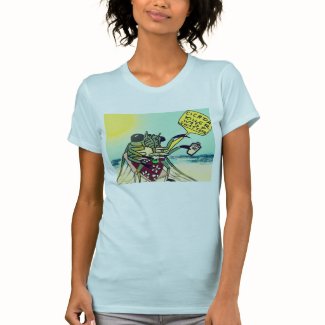
Cicada t-shirt of the day: Cicada Summer.
Periodical cicadas will be dead before summer.
Time to enjoy the summertime cicadas that few people know exist. Do you need a t-shirt that needs at least 15 minutes of explanation? What’s a cicada? What is it drinking? What does it have a wasp swatter (search for Cicada Killer Wasp)? What does MPF stand for (Massospora Protection Factor)? Embrace the weird.

Charles Lester Marlatt is the most well-known Magicicada researcher of all time. He spent the late 19th and early 20th-century researching periodical cicadas and establishing the location of their broods. Marlatt is responsible for the concept of broods and the name Magicicada (he thought the cicadas were Magical).
The illustrations contained in his publications make excellent decorations that you can color and make crafts with.
Download a free PDF of Magicicada illustrations that you can print out and color and festoon around your house or classroom.

Sources:
More cicada activities:
Massospora cicadina is a fungus that infects Magicicada cicadas. They contract it when they are still in the soil, and then spread it during sex as adults. It contains amphetamine and it sends the cicadas into a mating frenzy. It makes males behave like female cicadas. It replaces their butt-ends with a white chalky fungal substance.
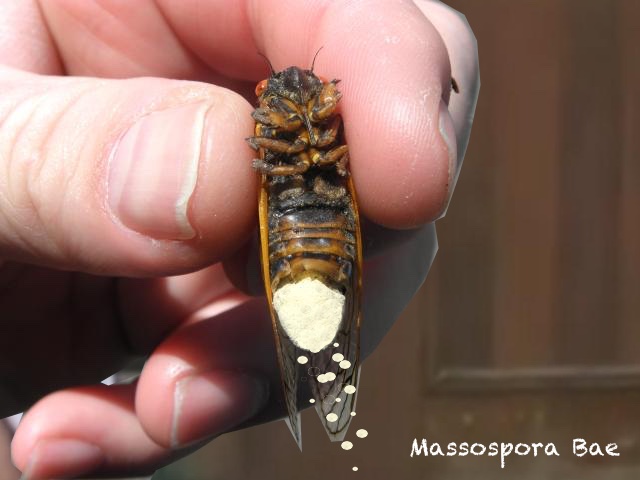
Matt Kasson, PhD, of West Virginia University wants you to share the fungus-infected cicadas with him.
If you post a photo of a Massospora-infected cicada on iNaturalist, tag him @mperfectfunguy.
If you post a photo of the same thing on Twitter, tag him @ImperfectFunGuy.
Got a sack of fungus-infected cicadas? He might want them.
Here’s the text from his post on Twitter/X:
‼️ ATTENTION ‼️ It’s #EarthDay2024 and we need your help finding / collecting Massospora-infected zombie cicadas for research so please share and RT! Illustration????by Molly Sherlock.
If you somehow missed it, trillions of cicadas are beginning their emergence across the Midwest and Southern U.S. This is a rare double emergence of both 13-year and 17-year cicadas, both of which are known hosts of the zombie cicada fungus, Massospora cicadina!
We are hoping to collect many infected cicadas as possible, especially infected 13-year cicadas as we only have three total specimens in our collection and none from Brood XIX.
The best way to help is to upload your observations in either
@inaturalist
or
@CicadaSafari
. You can also tag me in Massospoara cicadina iNat posts (
@imperfectfunguy
). DMs are also open here for inquiries about next steps.Receiving a heads up is as important as receiving actual specimens so no observation is insignificant.
Look for a chalky white fungal plug of M. cicadina emerging from the back of the abdomen on infected adults. Unlike many insect pathogens, Massospora does not kill its host so you will observe infected cicadas among a larger population of healthy cicadas.
He’s worth following on Twitter/X because it posts a lot of wild photos and illustrations like this.
More about Massospora:
Massospora papers:
I created a 2024 North American Proto-Periodical & Annual Cicada Location Project on iNaturalist.
Why?
1) Because the periodical cicadas get all the spotlight… that said do sign up for the 2024 Magicicada: Broods XIII and XIX iNaturalist project.
2) Because the 2023 project was a success.
What is it about?
2024 North American Proto-Periodical and Annual Cicadas
This project will document the location of cicada species that emerge semi-annually and annually* in North America.
2024 is a huge year for Periodical Cicadas (Magicicada Broods XIX and XIII) so it is very useful to track other types of cicadas lest they be lost in the frenzy of attention for the Periodicals.
Cicada genera of North America include: Beameria, Cacama, Cicadettana, Clidophleps, Cornuplura, Diceroprocta, Hadoa, Megatibicen, Neocicada, Neoplatypedia, Neotibicen, Okanagana, Okanagodes, Pacarina, Platypedia (Proto-Periodical), Quesada and Tibicinoides. There are over 200 species of cicada in North America that emerge annually or semi-annually.
Note: *Cicadas that emerge every 13 or 17 years are known as “Periodical cicadas” because they emerge periodically. In North America the genus that emerges periodically is Magicicada. Some species like Platypedia have a prototypical periodicity to their emergences, but it is usually due to influences like weather events or overpopulation underground rather than a predictable number of years.
There is a new cicada book emerging in August or September of 2024 called The Cicadas of North America Book by the author and illustrator Chris Alice Kratzer.
You can order it online.

Another cicada t-shirt that you can buy is Massospora Activated!

What is the meaning of this?! Well, Magicicada periodical cicadas contract a fungus called Massospora cicadina during sexual contact. It turns their rumps into a white chalky mess and sends them into a mating frenzy.
Learn more about Massospora cicadina: