Matt Berger was able to coerce a cicada nymph to enter the adult phase (instar) by raising it indoors (where it is warmer). Congratulations to Matt!
I took a Brood XIV nymph i found under a rock about a week ago, put some soil in a pot, poked a cicada sized hole in the soil and let the cicada burrow in. I wanted to see if I could make them emerge early. I put it in my house where it is warm. It worked! I now have a male (im guessing M. cassini) that just emerged from that hole and shed his skin and is now drying. Probably the first Magicicada to emerge all year! Earliest emergence I have ever heard of (even if it was assisted). Thought it might be interesting for Cicadamania.
Here are some pictures!
Here’s the nymph:
Here’s the adult leaving the nymph skin:
Here’s the teneral adult, still white in color (I will turn black soon enough):
Looks like the cicadas will start appearing a couple at a time next week, and then starting the following week the full-blow emergences will begin in the southern most states.
* Note: Gene Kritsky wrote to say that he has predicted May 13th for Cincinnati using his formula. The reason the numbers differ is Gene has more precise temperature information.
Read: Gene’s Book Periodical Cicadas: the Plague and the Puzzle is available through his website. I own it, and can confirm that it’s the best 17 year cicada book your money can buy. It has all the information you need, and it will make a handsome addition to your home library.
The cicadas making the latest appearance are Brood XIV. Brood XIV is centered on the eastern two-thirds of Kentucky, although they are also in 11 other state
Gene Kritsky, a professor of biology at the College of Mount St. Joseph, said this year most of the bugs are expected to appear in the area east of Interstate 71.
Gene Kritsky, a professor of biology at the College of Mount St. Joseph, says in a news release that cicadas are coming to eastern Cincinnati this May.
Video:
5 WLWT: Cicadas Return. Video features a meteorologist presenting general information about the emergence.
NECN.com: Cicada pheomenon interview with entomologist Doug Fraser. Very good.
Gene Kritsky, a cicada expert at the College of Mount St. Joseph in Cincinnati, says their appearance will be spotty. That could be caused by a number of factors, including development that has dramatically changed landscapes since the early 1990s.
Periodical cicadas went underground on the Cape 17 years ago, and have been living off tree sap ever since. Experts expect them to emerge from their holes all at once, probably on a night in early May. They can number in the millions per acre, and cling to any vertical surface after coming from their holes, to molt, then fly up into the tree tops to mate.
My Massachusetts friends are going to experience the Brood XIV emergence this year, as will folks in parts of Maryland. When I think of either state, I think of seafood, and coincidentally some folks say cicadas taste like shrimp, and the nymphs do look like something that crawled from the ocean. So what’s my point: well, I was wondering if anyone has ever tried cicadas with savory Old Bay Seasoning. Hmmm?
Hey folks, The Mount’s Cicada Web Site is monitoring the ground temperature in the Cincinnati area. Today it was up to 59.8ºF. Why is that important you ask? Well, once the soil temperature hits 65ºF the cicadas will emerge. Just 5ºF to go, and yes, cicadas will emerge from sunny areas before shaded areas because the soil will be warmer. (thanks Gene)
BTW, the Cincinnati press is finally catching on that another emergence is about to happen (I think they’re a bit jaded from Brood X). Here’s a video news clip from 5 in Cincy (thanks Roy).
Cicadas will start appearing in southern West Virginia - including much of Kanawha County - starting in May. They have black bodies about an inch and a half long, red beady eyes and a shrill song.
“They’re a phenomenon,” said Miller, the golf course superintendent at The Golf Club at Southport in Mashpee. His job is all about controlling bugs, but Miller sees no harm done by the cicadas who feed on watery tree sugars.
“The amazing thing is that there have not been very good records kept on Brood XIV in Pennsylvania,” said Marten Edwards, an entomologist at Allentown’s Muhlenberg College.
Edwards is among a team of insect experts planning to use Global Positioning Systems to document this year’s emergence. National Geographic is supporting the work through a grant to the University of Connecticut, university biology professor John Cooley said.
It may be extra noisy around trees located across Kentucky this year due to Brood XIV of the Periodical Cicada. All of Kentucky, except for the Purchase Areas, should expect some activity form the periodical cicada this year.
Once every 17 years a species of periodical cicada pop out of the ground in numbers too big to be ignored, often at densities of 10,000 to 100,000 per acre.
First of all, how would you like for someone to come to your landscape and prune your trees free of charge? That’s not a chance happening but something that will happen whether or not you agree.
The free pruning service will be in the form of insects. Yep, I said insects, more specifically the 17 Year Periodical Cicada or Locust as some people call them.
We’ve had drought and floods, and now, a plague of locusts.
OK, the billions of noisy, red-eyed teenagers emerging soon from the ground beneath your feet aren’t really locusts, although they often are mistakenly called that.
Periodical Cicadas is a classic cicada website that explains most of the information you need to know all in one page, with lots of great photos. It’s one of my favorites.
and
Regardless of the fact that there are not periodical cicadas emerging in the Chicago area this year, the Chicago Cicadas blog is still tracking them.
Here’s some new photos from Roy Troutman that will give you a good idea of what to look for when searching for signs of cicadas in your yard:
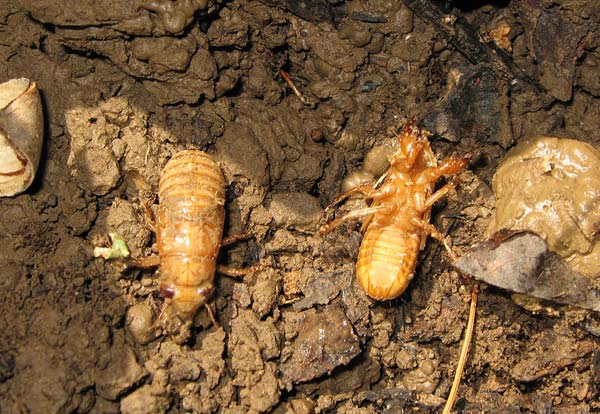
This is a pair of Magicicada nymphs, much like you might find when gardening or turning over logs or stones in your yard.
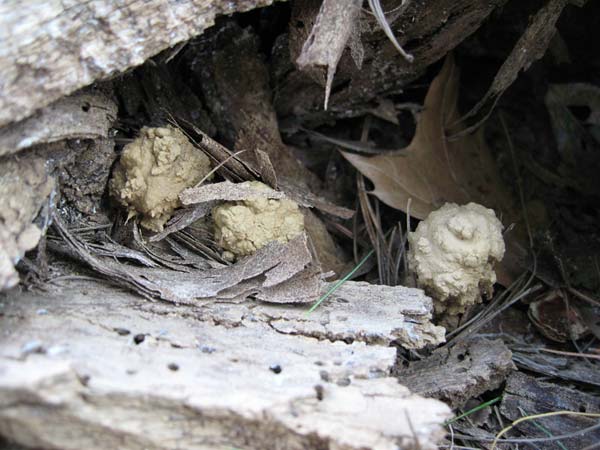
See those beige globs of soil amongst the leaves and debris? Those are called cicada chimneys. They are a sure sign that a cicada nymph is below the soil, and will emerge in a few days or weeks.
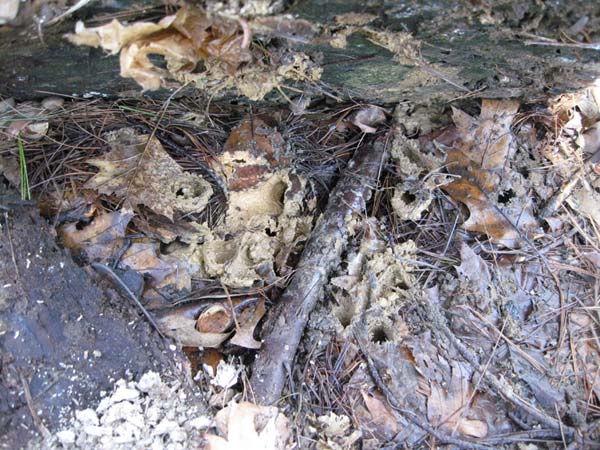
Look closely at this picture and you’ll see holes in the ground. Those are holes that cicada nymphs have dug, and they’re another sure sign of where a cicada will emerge.
On May 1st we’ll start making predictions as to when they’ll start to emerge.
Here is a video I shot in my basement tonight of one of my captive nymphs (septendecim female) excavating it’s tunnel. I have 3 makeshift nymph burrows sandwiched between 2 panes of Plexiglas. This video is sped up about 250%. There is about 20 minutes of footage but 30 seconds is enough to show what it was doing.
Names: People call these cicadas “locusts” but they are not true locusts — real locusts look like grasshoppers. The phrase “17 year cicada” indicates that they arrive every 17 years, and “periodical cicadas” indicate that they arrive periodically and not each and every year. The scientific name for the Genus of these cicadas is Magicicada, and there are 3 types of 17 year Magicicadas: Magicicada septendecim, Magicicada cassini and Magicicada septendecula.
There’s 13 year cicadas too: there are 13 year cicadas too! Magicicada tredecim, Magicicada neotredecim, Magicicada tredecassini, and Magicicada tredecula.
You’ll have to wait a long time to see another emergence after 2008: if you’re unwilling to move or travel, you’ll have to wait another 17 years to see another 17 year cicada. If you are willing to travel, the next 17 year cicada brood will emerge in 2012, Brood 1 in Virginia and West Virginia. The next 13 year cicadas will emerge in 2011 (AL, AR, GA, IN, IL, KY, LA, MD, MO, MS, NC, OK, SC, TN, VA).
Fungus: The Massosporan fungus infects Magicicadas, filling their abdomens and destroying their ability to reproduce. Often, their entire abdomen will fall off. The cicadas actually spread the fungus throughout their local colony via mating — the Massosporan fungus is a cicada STD!
People eat them: People eat them. You can barbecue it, boil it, broil it, bake it, saute it. There, uh, cicada kabobs, cicada creole, cicada gumbo, panfried, deep fried, stir fried. There’s pineapple cicada, lemon cicada, coconut cicada, pepper cicada, cicada soup, cicada stew, cicada salad, cicada and potatoes, cicada burger, cicada sandwich… that’s, that’s about it.
Animals eat them: all wild animals and domestic pets will eat them. Dogs will gorge themselves until they choke. Squirrels will eat them like corn on the cob. Wild turkeys will grow fat and juicy on the cicada feast. Fish go crazy for them too — you can use them as bait, or use lures that mimic them.
Cicadas “eat” tree fluids: Cicadas don’t eat solid foods — instead they use their slender, straw-like mouth parts to drink tree fluids.
Cicadas pee: Yes cicadas pee, so wear a hat when walking under trees if that sort of thing bothers you.
That cicada sound: Only male cicadas make the sound they’re famous for. Males have organs on their abdomen called tymbals. Muscles pop the tymbals in and out, which creates the sound we hear. Males make different calls for different reasons, and each species has a unique sound. Females can make sound too — they flick their wings to respond to males. Read this article for more information.
There’s billions of them: there are literally billions of 17 year cicadas. Why? One theory suggests that the large number overwhelms predators, so predators are never able to eat them all and cicadas, and many always survive to mate.
They damage wimpy trees: the biggest concern about 17 year cicadas is their potential to damage young trees. The truth is they will damage limbs on the wimpiest of trees, so if you if you have weak, pathetic, wimpy ornamental trees in your yard you should consider placing netting around the trees if the cicadas visit your yard. Or, plant strong, beefy American trees — that’s what I would do. Cicadas actually benefit the health of trees by aerating the soil around the roots, and trimming the weak or damaged limbs.