
Categories
James Edward Heath Magicicada Periodical

64 Degrees Fahrenheit Eight Inches Deep

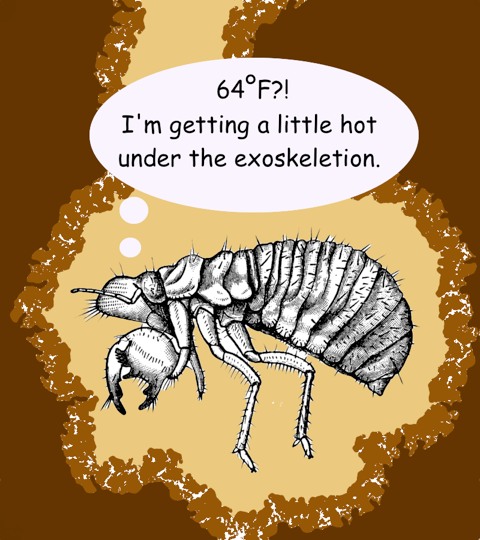
hot under the exoskeleton

Soil temperature triggers periodical cicada emergences:

James Edward Heath in his paper Thermal Synchronization of Emergence in Periodical “17-year” Cicadas (Homoptera, Cicadidae, Magicicada)1 discovered that periodical cicadas will emerge, on average, when the soil 8 inches below the ground reaches 64 degrees Fahrenheit:

Soil temperature at 20-cm [7.87 in] depth in seven locations averaged 17.89 C [64.202 F] at the time of emergence, regardless of date. Cicadas emerging from burrows had average body temperatures of 18.04 C [64.472 F]. Synchrony in emergence may be due to animals reaching a critical threshold temperature.

The soil warms their bodies and that triggers the cicadas to emerge.

A warm rain, which will seep into the earth and warm the bodies of cicadas, can trigger a “particularly intensive” emergence.

Alexander and Moore (1962) noted that emergences were particularly intensive following warm rains ( > 2 0 C ? ). I believe this suggests that the soil temperature probably was near emergence temperature and the heat transported by the water percolating into the ground warmed the soil sufficiently to raise soil temperature above the emergence threshold.

Some unanswered questions I have are: 1) how long does the temperature have to be 64°F+ – just a moment, or a certain number of hours, and 2) because we know not all cicadas emerge instantaneously, what is the maximum temperature that for certain will clear them from the soil?

This is an example of a temperature probe use to study the emergence temperature of cicadas. The probe in this picture is held by cicada researcher Gene Kritsky:
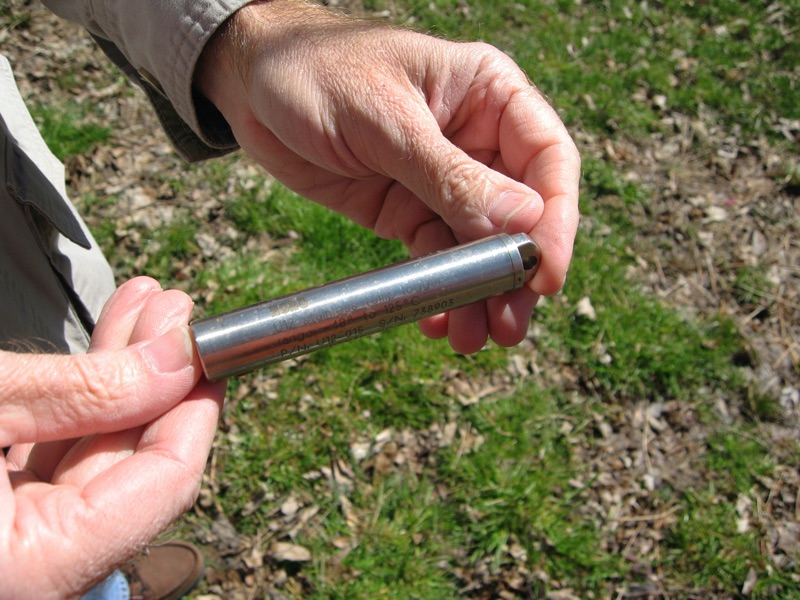
Gene Kristsky's Cicada Thermometer

Note that males typically emerge before females and that the larger ‘decim species emerge before the smaller cassini species.

For a more modern, crowd-sourced study of this see the radiolab Cicada Tracker project.

I think I know what you’re thinking: “I don’t own a temperature probe, how can I guess when the temperature is 64°F 8” below the soil? Direct sunlight, air temperature, and rain warms the soil. Southern facing land will warm sooner than northern facing land. Land in direct sunlight will warm faster than land in shade. Rainfall on an 80°+ day will quickly do the trick, but two weeks of temps in the 70°’s should work as well. So keep an eye on the 10-day weather forecast and watch for those days in the 70s, and especially the 80s.

Minimum Flight Temperature:
Their body temperature needs to be a little warmer than that to fly. Their minimum flight temperature (MFT) is 18-21°C / 65-70°F. The temperature varies depending on the Brood and species. They’ll need a few more degrees before they’re fully functional, and start singing and mating.

So, until their bodies are about 72°F (“room temperature”) they won’t be flying, singing and mating.

Maximum voluntary tolerance temperature:
Maximum voluntary tolerance temperature (MVT) for periodical cicadas is 31-34°C / 88-93°F, again depending on Brood and species. Maximum voluntary tolerance is the point at which cicadas seek shade and when thermoregulation takes precedence over other behaviors.

See Thermal responses of periodical cicadas: within and between brood parity (Hemiptera: Cicadidae: Magicicada spp.) and Thermoregulation by Endogenous Heat Production in Two South American Grass Dwelling Cicadas (Homoptera: Cicadidae: Proarna) for more information.

1 Thermal Synchronization of Emergence in Periodical “17-year” Cicadas (Homoptera, Cicadidae, Magicicada) by James Edward Heath, American Midland Naturalist, Vol. 80, No. 2. (Oct., 1968), pp. 440-448.

Categories
Cicadettana William T. Davis

Cicadettana calliope floridensis (Davis, 1920)

Cicadettana calliope floridensis (Davis, 1920)

Categories
Clidophleps Philip Reese Uhler

Clidophleps blaisdellii (Uhler, 1892)

Clidophleps blaisdellii (Uhler, 1892)

Categories
Allen F. Sanborn Beameria Maxine E. Heath

Beameria ansercollis Sanborn and M. Heath in Sanborn, M. Heath, Phillips and J. Heath, 2011

Beameria ansercollis Sanborn and M. Heath in Sanborn, M. Heath, Phillips and J. Heath, 2011.

Name, Location and Description

Categories
Platypedia Platypediini U.S.A. William T. Davis

Platypedia affinis Davis, 1939

Platypedia affinis Davis, 1939.

Name, Location and Description

Classification:

Family: Cicadidae
Subfamily: Cicadettinae
Tribe: Platypediini
Subtribe: ?
Genera: Platypedia
Species: Platypedia affinis Davis, 1939

List of sources

  1. Full Binomial Names: ITIS.gov
  2. Common names: BugGuide.net; The Songs of Insects by Lang Elliott and Wil Herschberger; personal memory.
  3. Locations: Biogeography of the Cicadas (Hemiptera: Cicadidae) of North America, North of Mexico by Allen F. Sanborn and Polly K. Phillips.
  4. Descriptions, Colors: personal observations from specimens or photos from many sources. Descriptions are not perfect, but may be helpful.
  5. Tribe information comes from: MARSHALL, DAVID C. et al.A molecular phylogeny of the cicadas (Hemiptera: Cicadidae) with a review of tribe and subfamily classification.Zootaxa, [S.l.], v. 4424, n. 1, p. 1—64, may 2018. ISSN 1175-5334. Available at: https://www.biotaxa.org/Zootaxa/article/view/zootaxa.4424.1.1

Notes:

  • Some descriptions are based on aged specimens which have lost some or a lot of their color.
Categories
Okanagana Tibicinini U.S.A. William T. Davis

Okanagana sugdeni Davis, 1938

Okanagana sugdeni Davis, 1938.

Name, Location and Description

Classification:

Family: Cicadidae
Subfamily: Cicadettinae
Tribe: Tibicinini
Subtribe: Tibicinina
Genera: Okanagana
Species: Okanagana sugdeni Davis, 1938

List of sources

  1. Full Binomial Names: ITIS.gov
  2. Common names: BugGuide.net; The Songs of Insects by Lang Elliott and Wil Herschberger; personal memory.
  3. Locations: Biogeography of the Cicadas (Hemiptera: Cicadidae) of North America, North of Mexico by Allen F. Sanborn and Polly K. Phillips.
  4. Descriptions, Colors: personal observations from specimens or photos from many sources. Descriptions are not perfect, but may be helpful.

Notes:

  • Some descriptions are based on aged specimens which have lost some or a lot of their color.
Categories
Tibicinini Tibicinoides U.S.A. William T. Davis

Tibicinoides minuta (Davis, 1915)

Tibicinoides minuta (Davis, 1915)

Name, Location and Description

From Davis’ key to Okanagana/Tibicinoides1:

A. Male uncus not hooked at the extremity, sometimes sinuate.

BB. Stouter bodied species, the fore and hind wings variegated with orange and black at the base.

CC. Marginal cells short; the third one in the fore wings about one-half as long as the second ulnar area adjoining and immediately behind it.

H. Both pairs of wings clear except near base.

Head including eyes about 4 mm. broad. Expands about 35 mm.

Similar cicada: Tibicinoides mercedita (Davis, 1915).

Classification:

Family: Cicadidae
Subfamily: Cicadettinae
Tribe: Tibicinini
Subtribe: Tibicinina
Genera: Tibicinoides
Species: Tibicinoides minuta (Davis, 1915)

List of sources

  1. Davis, William T. Cicadas of the genera Okanagana, Tibicinoides and Okanagodes, with descriptions of several new species. Journal of the New York Entomological Society. v27. 179-223. 1919. Link.
  2. Full Binomial Names: ITIS.gov
  3. Common names: BugGuide.net; The Songs of Insects by Lang Elliott and Wil Herschberger; personal memory.
  4. Locations: Biogeography of the Cicadas (Hemiptera: Cicadidae) of North America, North of Mexico by Allen F. Sanborn and Polly K. Phillips.
  5. Descriptions, Colors: personal observations from specimens or photos from many sources. Descriptions are not perfect, but may be helpful.

Notes:

  • Some descriptions are based on aged specimens which have lost some or a lot of their color.
Categories
Tibicinini Tibicinoides U.S.A. William T. Davis

Tibicinoides mercedita (Davis, 1915)

Tibicinoides mercedita (Davis, 1915)

Name, Location and Description

From Davis’ key to Okanagana/Tibicinoides1:

A. Male uncus not hooked at the extremity, sometimes sinuate.

BB. Stouter bodied species, the fore and hind wings variegated with orange and black at the base.

CC. Marginal cells short; the third one in the fore wings about one-half as long as the second ulnar area adjoining and immediately behind it.

H. Both pairs of wings clear except near base.

Head including eyes about 5 mm. broad. Expands about 40 mm.

Similar cicada: Tibicinoides minuta (Davis, 1915).

Classification:

Family: Cicadidae
Subfamily: Cicadettinae
Tribe: Tibicinini
Subtribe: Tibicinina
Genera: Tibicinoides
Species: Tibicinoides mercedita (Davis, 1915)

List of sources

  1. Davis, William T. Cicadas of the genera Okanagana, Tibicinoides and Okanagodes, with descriptions of several new species. Journal of the New York Entomological Society. v27. 179-223. 1919. Link.
  2. Full Binomial Names: ITIS.gov
  3. Common names: BugGuide.net; The Songs of Insects by Lang Elliott and Wil Herschberger; personal memory.
  4. Locations: Biogeography of the Cicadas (Hemiptera: Cicadidae) of North America, North of Mexico by Allen F. Sanborn and Polly K. Phillips.
  5. Descriptions, Colors: personal observations from specimens or photos from many sources. Descriptions are not perfect, but may be helpful.

Notes:

  • Some descriptions are based on aged specimens which have lost some or a lot of their color.
Categories
Philip Reese Uhler Tibicinini Tibicinoides U.S.A.

Tibicinoides cupreosparsa (Uhler, 1889)

Tibicinoides cupreosparsa (Uhler, 1889)

Name, Location and Description

From Davis’ key to Okanagana/Tibicinoides 1:

A. Male uncus not hooked at the extremity, sometimes sinuate.

BB. Stouter bodied species, the fore and hind wings variegated with orange and black at the base.

CC. Marginal cells short; the third one in the fore wings about one-half as long as the second ulnar area adjoining and immediately behind it.

HH. Both pairs of wings clouded, particularly the basal half of the front pair.

Head including eyes about 4.5 mm. broad, membranes at the base of both pairs of wings vermilion; tergum black. Expands about 34 mm.

Classification:

Family: Cicadidae
Subfamily: Cicadettinae
Tribe: Tibicinini
Subtribe: Tibicinina
Genera: Tibicinoides
Species: Tibicinoides cupreosparsa (Uhler, 1889)

List of sources

  1. Davis, William T. Cicadas of the genera Okanagana, Tibicinoides and Okanagodes, with descriptions of several new species. Journal of the New York Entomological Society. v27. 179-223. 1919. Link.
  2. Full Binomial Names: ITIS.gov
  3. Common names: BugGuide.net; The Songs of Insects by Lang Elliott and Wil Herschberger; personal memory.
  4. Locations: Biogeography of the Cicadas (Hemiptera: Cicadidae) of North America, North of Mexico by Allen F. Sanborn and Polly K. Phillips.
  5. Descriptions, Colors: personal observations from specimens or photos from many sources. Descriptions are not perfect, but may be helpful.

Notes:

  • Some descriptions are based on aged specimens which have lost some or a lot of their color.
Categories
Platypedia Platypediini U.S.A. William T. Davis

Platypedia vanduzeei Davis, 1920

Platypedia vanduzeei Davis, 1920

Name, Location and Description

From W.T. Davis’ key to Platypedia1

AA. Fore wings much broader, the breadth being equal to about one-half the distance from the basal cell to the apex of the wing.

Uncus when viewed from above broadly lanceolate and subacute at apex, its width almost half the length. Last ventral segment in female with notch more narrowly V-shaped than in aperta. Membranes at base of fore wings orange. Expands about 36 millimeters. Occurs in California and Nevada vanduzeei new species.

Classification:

Family: Cicadidae
Subfamily: Cicadettinae
Tribe: Platypediini
Subtribe: ?
Genera: Platypedia
Species: Platypedia vanduzeei Davis, 1920

List of sources

  1. Davis, W.T. North American Cicadas Belonging to the Genera Platypedia and Melampsalta. Journal of the New York Entomological Society. V28. Pp 95-135. 1920. Link.
  2. Full Binomial Names: ITIS.gov
  3. Common names: BugGuide.net; The Songs of Insects by Lang Elliott and Wil Herschberger; personal memory.
  4. Locations: Biogeography of the Cicadas (Hemiptera: Cicadidae) of North America, North of Mexico by Allen F. Sanborn and Polly K. Phillips.
  5. Descriptions, Colors: personal observations from specimens or photos from many sources. Descriptions are not perfect, but may be helpful.
  6. Tribe information comes from: MARSHALL, DAVID C. et al.A molecular phylogeny of the cicadas (Hemiptera: Cicadidae) with a review of tribe and subfamily classification.Zootaxa, [S.l.], v. 4424, n. 1, p. 1—64, may 2018. ISSN 1175-5334. Available at: https://www.biotaxa.org/Zootaxa/article/view/zootaxa.4424.1.1

Notes:

  • Some descriptions are based on aged specimens which have lost some or a lot of their color.