Categories
Arnold Jacobi Becquartina China Gaeanini Michel Chantraine Thailand Vietnam

Becquartina electa (Jacobi, 1902)

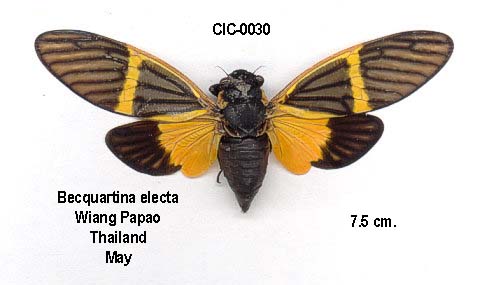
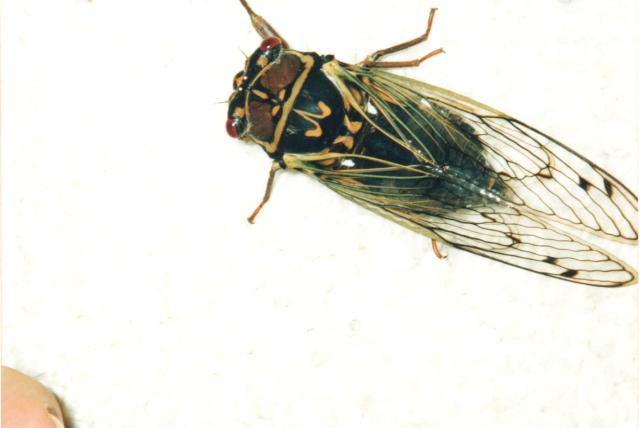
Becquartina electa is a cicada found in China, Thailand, and Vietnam. They are part of a group of cicadas known as “butterfly cicadas” because of their colorful wings.

Photo by Michel Chantraine:
Becquartina electa

Scientific classification:
Family: Cicadidae
Subfamily: Cicadinae
Tribe: Gaeanini
SubTribe: Becquartinina
Genus: Becquartina
Species: Becquartina electa (Jacobi, 1902)

Categories
Ayuthia Ayuthiini Malaysia Thailand Tosenini Vietnam W. L. Distant

Ayuthia spectabile Distant, 1919

Ayuthia spectabile is a cicada found in Malaysia, Thailand, and Vietnam.

Female Ayuthia spectabile:
Ayuthia spectabile Distant, 1919

Scientific classification:
Family: Cicadidae
Subfamily: Cicadinae
Tribe: Ayuthiini (formerly Tosenini)*
Subtribe: Ayuthiina
Genus: Ayuthia
Species: Ayuthia spectabile Distant, 1919

* The tribe changed in 2021. See: Hill Kathy B. R., Marshall David C., Marathe Kiran, Moulds Maxwell S., Lee Young June, Pham Thai-Hong, Mohagan Alma B., Sarkar Vivek, Price Benjamin W., Duffels J. P., Schouten Marieke A., de Boer Arnold J., Kunte Krushnamegh, Simon Chris (2021) The molecular systematics and diversification of a taxonomically unstable group of Asian cicada tribes related to Cicadini Latreille, 1802 (Hemiptera:Cicadidae). Invertebrate Systematics 35, 570-601. https://doi.org/10.1071/IS20079

Categories
Auritibicen Japan Masayo Kato Osamu Hikino Tacuini (Cryptotympanini)

Auritibicen kyushyuensis (Kato, 1926)

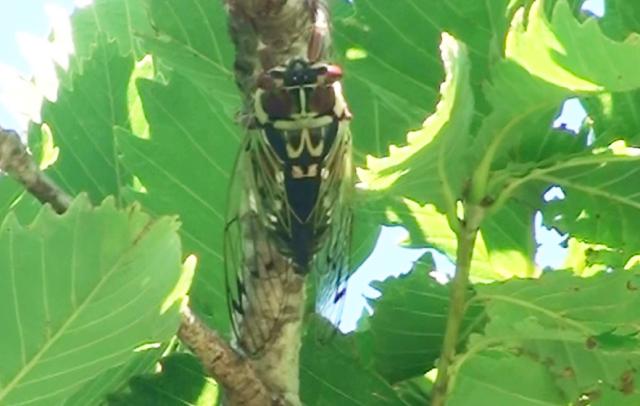
Auritibicen kyushyuensis is found in Japan and is known as Kyushu-ezo-zemi.

Auritibicen kyushyuensis photo by Osamu Hikino:
Photo by Osamu Hikino

Scientific classification:
Family: Cicadidae
Subfamily: Cicadinae
Tribe: Cryptotympanini
SubTribe: Cryptotympanina
Genus: Auritibicen (formerly Lyristes and Tibicen)
Species: Auritibicen kyushyuensis (Kato, 1926)

For more information about this cicada, visit Cicadae in Japan.

Categories
Auritibicen Japan Osamu Hikino Shōnen Matsumura Tacuini (Cryptotympanini)

Auritibicen japonicus

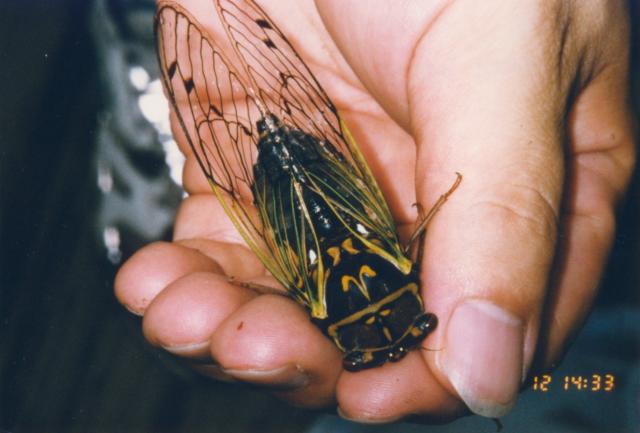
There are ten sub-species of Auritibicen japonicus. They are found in Japan and known as Ezo-zemi.

Photo of a male Auritibicen japonicus by Osamu Hikino.
photo by Osamu Hikino

Photo of an Auritibicen japonicus by Osamu Hikino:
Lyristes japonicus by Osamu Hikino_001

Scientific classification:
Family: Cicadidae
Subfamily: Cicadinae
Tribe: Cryptotympanini
SubTribe: Cryptotympanina
Genus: Auritibicen (formerly Lyristes and Tibicen)
Subspecies:

  1. Auritibicen japonicus echigo Kato, 1936
  2. Auritibicen japonicus hooshianus (Matsumura, 1936)
  3. Auritibicen japonicus immaculatus Kato, 1933
  4. Auritibicen japonicus interruptus Kato, 1943
  5. Auritibicen japonicus itoi Kato, 1939
  6. Auritibicen japonicus iwaoi Kato, 1939
  7. Auritibicen japonicus japonicus (Kato, 1925)
  8. Auritibicen japonicus kobayashii Kato, 1939
  9. Auritibicen japonicus niger Kato, 1933
  10. Auritibicen japonicus nigrofasciatus Kato, 1940

For more information about this cicada, visit Cicadae in Japan.

Categories
Borneo Burma China Cicadettini Huechys India Indonesia Malaysia Michel Chantraine Thailand

Huechys sanguinea

Huechys sanguinea is a cicada found in Burma, China, India, Indonesia, Malaysia, Pakistan, Thailand, and likely many other nations in Asia. There are at least 5 subspecies of this cicada. It is also known as the “medicinal cicada” because people use it as a medicine (see my translation below).

Photo by Michel Chantraine:
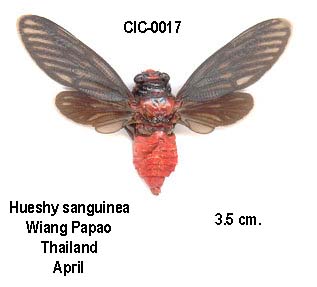
Huechys sanguinea

Description1:

Body and legs black; front and face to head, two large spots to mesonotum — sometimes fused and covering the whole disk — and the abdomen, sanguineous; base of abdomen narrowly black.

Tegmina black, opaque; wings shining fuscous, sometimes almost black, the interior of the anal area always paler.

Rostrum passing the intermediate coxae; face moderately compressed, and very coarsely striate.

Long. excl. tegm. Male and Female 17 to 25 millim. Exp. tegm. 43 to 65 millim.

Here’s my translation, from French, of a note about the medicinal properties of the cicada. The original text comes from A Monograph of Oriental Cicadas:

According to Dr. Fumouze, “Huechys sanguinea, the Cicada sangiunolenta d’OIivier, is a very strong [common] insect in certain provinces of China, where it is harvested for the needs [valuable medicinal properties] of the species. In China, this insect would pass into China to enjoy curative properties, and it would be used chiefly in the treatment of rabies, but its value as much as the medicine against rabies is doubtful, but its action on the genitourinary organs seems to be certain, and this is what is in the fore, if the Huechys sanguinea would not yield a particular or similar active ingredient to the cantharides, what I can say now, it is because, by the procedures used to extract Cantharidin from cantharides, I have obtained no results, perhaps I will be later after that, but my first researches have not been completely unsuccessful, because I arrived to extract from Huechys sanguinea the material which gives to the abdominous teguments of this insect their magnificent yellow-orange color. This matter, which I will call Huechys’ red, is of a color exactly like that of the abdomen of the animal, as you can see by means of a sample which I put before your eyes. Huechys sanguinea also contains, but in smaller quantities, another yellowish, hygrometric dying material. “- Btdl. Soc. Ent. Fr. 1888, pp. xxii., xxiii.

TL;DR = “People use it to treat rabies, but it’s doubtful it actually works as a rabies treatment. It does work for its ‘Viagra-like’ properties. And its red pigment can be extracted.”

Scientific classification:
Family: Cicadidae
Subfamily: Cicadettinae
Tribe: Cicadettini
SubTribe: Huechysina
Genus: Huechys
Species:

  • Huechys sanguinea hainanensis Kato, 1931
  • Huechys sanguinea philaemata (Fabricius, 1803)
  • Huechys sanguinea sanguinea (Degeer, 1773)
  • Huechys sanguinea suffusa Distant, 1888
  • Huechys sanguinea wuchangensis Liu, 1940

For more information about this cicada, visit Cicadas of India.

References:

  1. The description and location information comes from A Monograph of Oriental Cicadas by W. L. Distant. 1889-1892. Read it on the Biodiversity Heritage Library website.
  2. Species name information comes from Allen Sanborn’s Catalogue of the Cicadoidea (Hemiptera: Auchenorrhyncha).
  3. Tribe information comes from: MARSHALL, DAVID C. et al.A molecular phylogeny of the cicadas (Hemiptera: Cicadidae) with a review of tribe and subfamily classification.Zootaxa, [S.l.], v. 4424, n. 1, p. 1—64, may 2018. ISSN 1175-5334. Available at: https://www.biotaxa.org/Zootaxa/article/view/zootaxa.4424.1.1

Categories
Australia Cicada Killer Wasps

Exeirus lateritius: Australian Cicada Killer Wasp

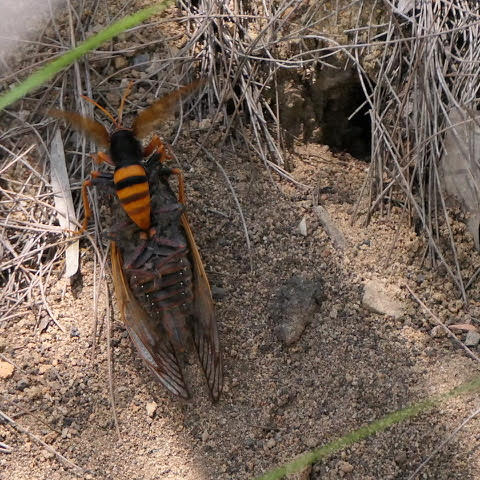
Australia has a Cicada Killer Wasp: Exeirus lateritius. It belongs to the same family, Crabronidae, as American Cicada Killer Wasps. Dr. Lindsay Popple says “They go for the big ones like Thopha [Drummer cicadas], Cyclochila [Green Grocers, Yellow Mondays]”.

This was provided by Gary Warner, and was taken by Jeff Doring.
Exeirus lateritius

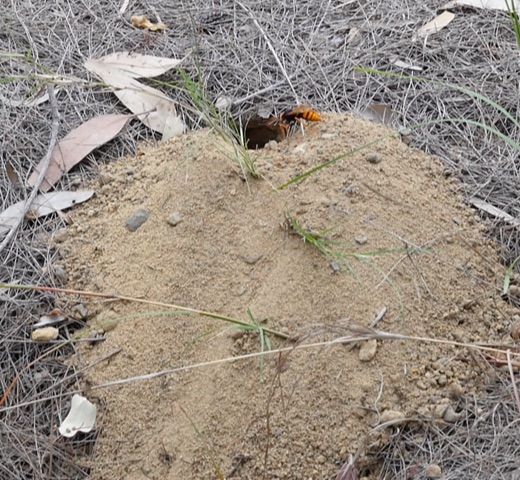
This photo of an empty-handed Cicada Killer heading back to its burrow is by Gary Warner.
empty handed wasp returns to burrow

Here is a video from YouTube. According to the video description, they are also known as Ground Digger Wasps.