
Found this on Flickr. Is this the same species as the latest mystery cicada? Thanks to David Emery for the tip.
Categories
 Cicada Mania
Locations where cicadas can be found, including countries and continents.
Found this on Flickr. Is this the same species as the latest mystery cicada? Thanks to David Emery for the tip.
Can you identify this Australian cicada??? The photo was take by Elizabeth Barnett.
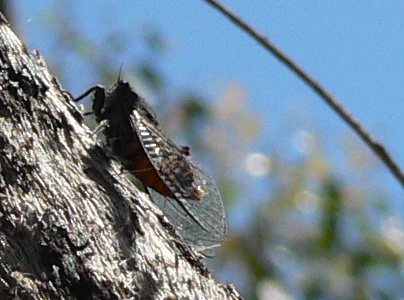
Hi, I wondered whether you can help me identify a cicada we saw at Hall’s Gap (Midwest Victoria, Australia) in January this year? It had a limited tolerance for being photographed and took off asap. From memory its call was a sort of short “eck! eck!” rather than the continuous shrill you get from a greengrocer. There were heaps of them calling but this was the only one we saw. I’d estimate it was about half the size of a greengrocer.
I asked David Emery, and he said:
Looks pretty close to Pauropsalta mneme (Alarm clock ticker) with the orange belly and wing infuscations and is in the right place! Heard the first C.celis around Sydney last week, but very dry at present.
After a Google search for Pauropsalta mneme I’d say David was correct.
The Pauropsalta mneme can be found in south-eastern NSW, Victoria, and a small pocket in South Australia, from late September to early January. (Moulds, M.S.. Australian Cicadas Kennsignton: New South Wales Press, 1990, p. 131.)
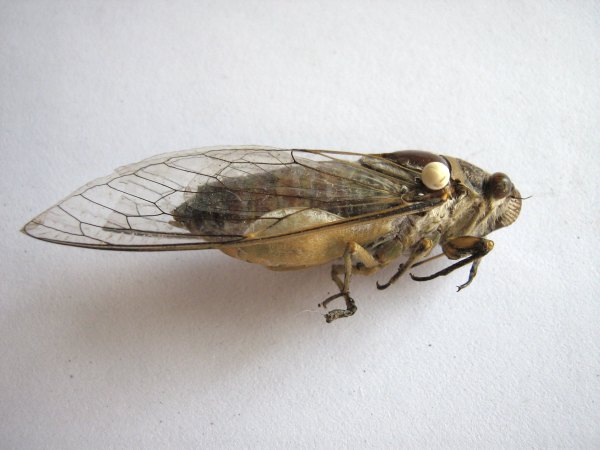
New cicada photos from Santisuk Vibul’s in Thailand.
This is a photo of the amazing Bagpipe cicada (Lembeja paradoxa) was taken by Timothy Emery (David Emery’s son).
Attached is a photo taken by my son, Timothy Emery from Thursday Island, Torres Strait off Cape York, Queensland. This a male “bagpipe cicada” (Lembeja paradoxa) singing for his female. These guys at rest look like dead leaves with wings folded under stems of grass, but when singing at dusk, rush up the stems and can expand their abdomens incredibly up to 5-10 x resting size (hence the bagpipe bit) and emit a very loud droning sound for their size. A great emergence of these on Thursday Island in the first 2 weeks of January.
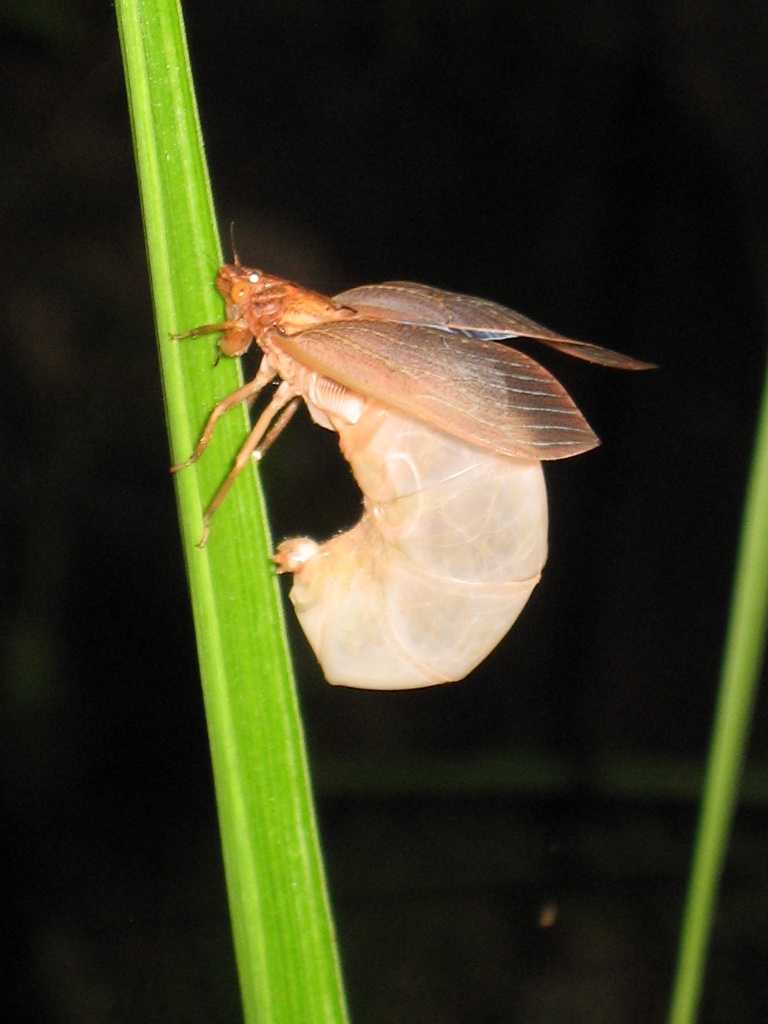
The Bagpipe cicada can be found in the Northern tip of Queensland, from October to February, but they’re most common during January. (Moulds, M.S.. Australian Cicadas Kennsignton: New South Wales Press, 1990, p. 178)
David Marshall and Kathy Hill have discovered that a particular species of katydid mimics the wing-flick of female cicadas to lure male cicadas to their certain doom.
We have found that predatory Chlorobalius leucoviridis katydids (Orthoptera: Tettigoniidae) can attract male cicadas (Hemiptera: Cicadidae) by imitating the species-specific wing-flick replies of sexually receptive female cicadas. This aggressive mimicry is accomplished both acoustically, with tegminal clicks, and visually, with synchronized body jerks. Remarkably, the katydids respond effectively to a variety of complex, species-specific Cicadettini songs, including songs of many cicada species that the predator has never encountered.
Read the entire research article: Versatile Aggressive Mimicry of Cicadas by an Australian Predatory Katydid.
Another Flickr find. The rich blue color is amazing.
Australia should be knee deep in cicadas by now. Here’s a list of Australian cicada posts on the site.
If you’re curious as to what cicadas in India look like, check out India Nature Watch, and visit their Cicadidae and Cicada pages. Try a search on their site too to reveal more.
This cicada is particularly pretty.
Update (2012), also visit The Cicadas of India Facebook group.
Someone asked me for photos of cicadas from the south of France; my curiosity peaked, I did a search. Cigales is the French word for cicadas, and sud is the French word for south. I took fives years of French in school; I’ve forgotten a lot of it due to lack of use, but I remember those words. Searching sites written in French using Google I came across: Cigale à Porquerolles, insecte de provence, sur la côte méditerranéenne.
Considering the large number of illustrations, photos and information Cigale à Porquerolles, insecte de provence, sur la côte méditerranéenne is essentially the French Cicada Mania — in fact, it’s better than that. It’s the French Massachusetts Cicadas.
Check the site out. Even if you can’t read French, the photos and illustrations speak for themselves, and you’ll get a chance to see what cicadas look like in France.
This is a Bottle Cicada from Australia.

