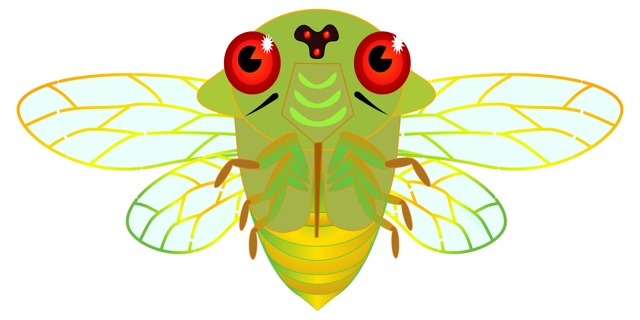
I felt bad about always using an illustration of North American cicadas, so I made a Green Grocer cicada for Australian fans.
Get this image on a shirt, mug or even a pillow case via CafePress (the mugs are the most affordable).
 Cicada Mania
Locations where cicadas can be found, including countries and continents.
I felt bad about always using an illustration of North American cicadas, so I made a Green Grocer cicada for Australian fans.
Get this image on a shirt, mug or even a pillow case via CafePress (the mugs are the most affordable).
This is a selection of links to websites dedicated to the cicadas of Australia.
Cicada season in New Zealand begins in November and lasts throughout their Summer months.
Here is a list of the best New Zealand cicada links:
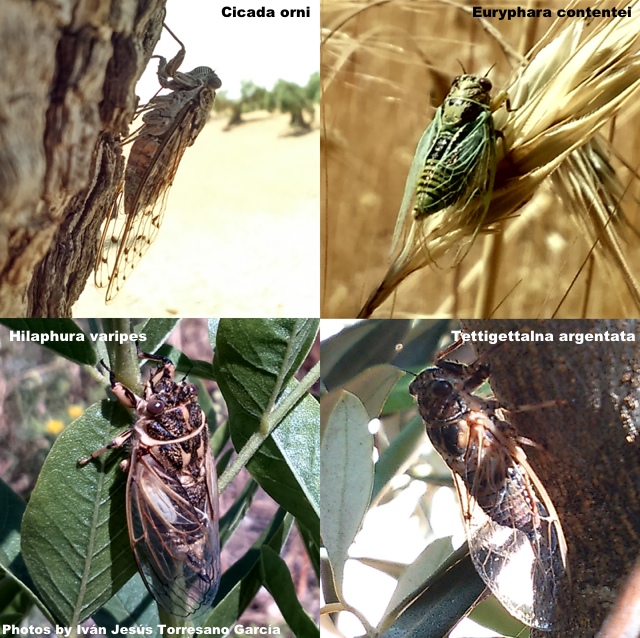
Iván Jesús Torresano García send us a dozens of cicada photos from Spain, where he resides. According to Iván June is a peak time for cicadas in Spain. Cicadas common to the area are: Cicada orni, Lyristes (old Tibicen) plebejus, Tettigetta argentata, Hilapura varipes, Euryphara contentei (miniature), Tibicina tomentosa, and finally the brownish “Barbara Lusitanica Cicada”.
Galleries:
Here are some of these cicadas captured by Iván.
Cicada orni:
Cicada orni is one of the most common cicadas in Spain and all of Europe. The are incredibly well camouflaged.
Tettigettalna argentata:
Hilaphura varipes:
Euryphara contentei:
For more information of the cicadas of Spain, visit Songs of European Singing Cicadas.
It’s Winter in Australia but I have two cool pieces of Australian Cicada news for you.
First, Australian cicada expert and researcher Lindsay Popple has created a new website about the cicadas of Australia.
Also, he’s been placing cicada songs on SoundCloud as well:
@cicadamania The sounds that will link into my almost completed cicada website have already been uploaded here: https://t.co/yd9bGupveR
— Lindsay Popple (@_DrPop_) July 24, 2014
Second, Samuel Orr has shared some video of cicadas from Australia and New Zealand on Vimeo. I believe this video will be part of the cicada documentary he is working on.
Update! L. W. Popple said on Twitter that cicada season will start in Australia in 1 or 2 weeks! Australia has 8 month long cicada season!
@wapogipo88 @cicadamania With Tibicen out in USA and Birrima out in Australia, it will be world #cicadas in stereo! pic.twitter.com/zdFLBAnLOU
— Lindsay Popple (@_DrPop_) July 28, 2014
There is a new cicada keychain toy from Japan. It comes in five colors, and produces its sound using a wind up mechanism. Buy it here.
Chremistica umbrosa can be found in South-East Asia, in particular Singapore. If you go to see them, bring an umbrella. I don’t know why these cicadas pee this often, but I imagine they are eliminating some toxin or waste or chemical (sugar, perhaps) that is not good for them.
Watch the videos:
Here’s a cicada I never thought I would see, but thanks to Raghu Ananth, here are two photos of a Tosena sibyla Gaeana atkinsoni.
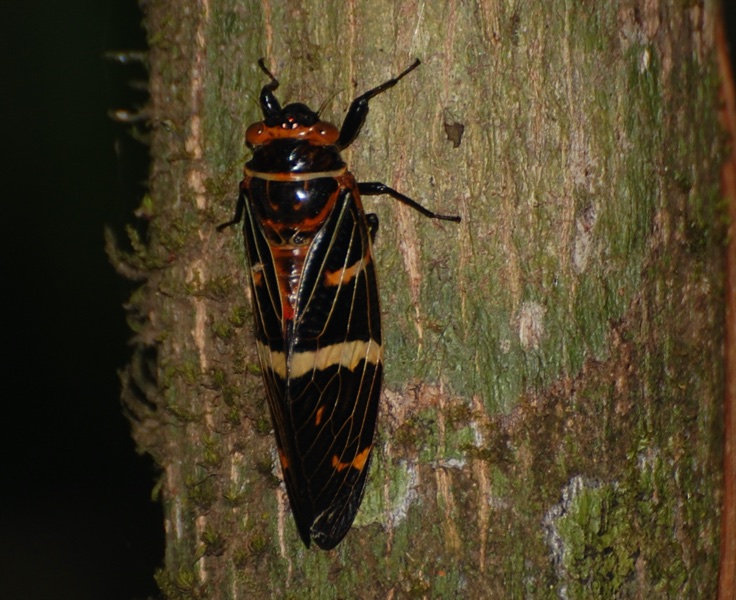
This photo was taken on May 2nd, 2009:
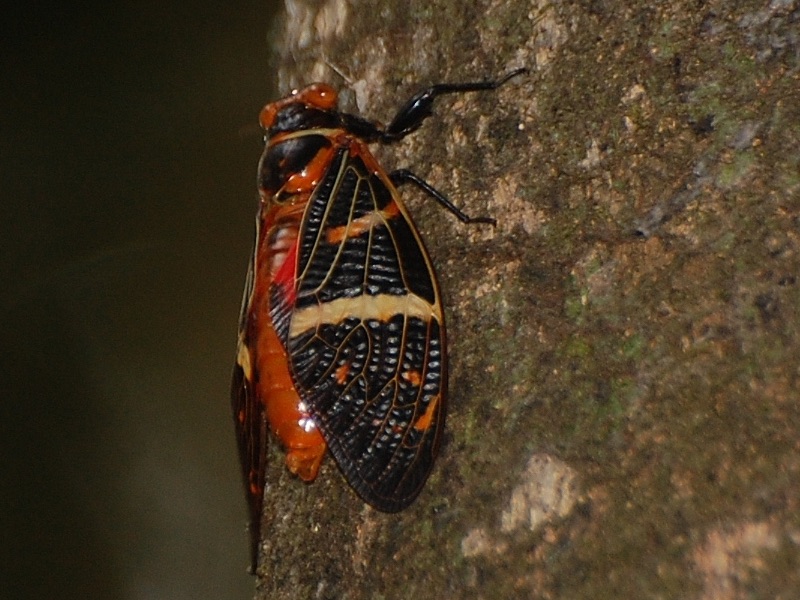
Note the characteristic double stripes on the forewings. Note how the smaller stripe doesn’t make it all the way to the claval fold.
Here are observations about this cicada provided by Raghu Ananth:
Brief description –
The cicada has red eyes, red thorax with black patch above, red abdomen, black wings with yellow veins and a large yellow patch lines on the wings.Numbers. found – several dozens.
Habitat – tree barks near forest path
length – 4-5 cmsThe orange-red coloured cicada is one of the beautiful cicadas in the forests. It has a red body, red eyes and black wings with yellow patches. During one of our trips to the evergreen forests in the Uttara Kannada district (Karnataka), we spotted two of them camouflaged on the bark of each tree, actively walking up and down and then appearing a colourful red when in flight from one bark of the tree to another. Their singing, however, seemed not in sync with each another. On our approach, they would try to hide behind the bark or fly to a distant tree.
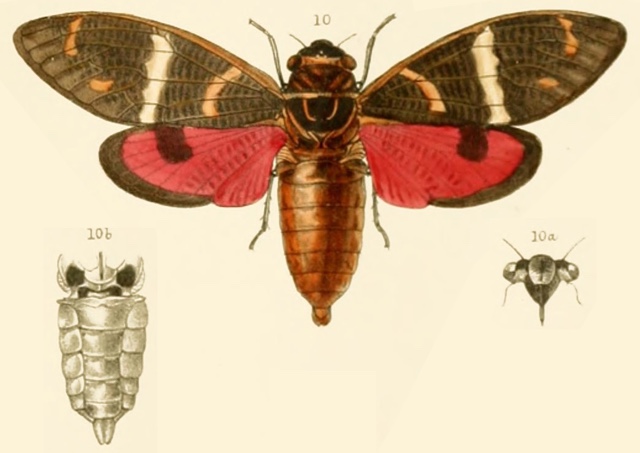
This illustration of a T. sibylla Gaeana atkinsoni comes from the document A monograph of oriental cicadidae (1892) by W. L. Distant.
Updated (5/8/2014) with a video by Harinath Ravichandran:
This photo points out the Tymbal (the organ that makes the cicada’s signature sound), the Tympanum (their hearing organ), the Operculum (which covers the Tympanum), and its wings.
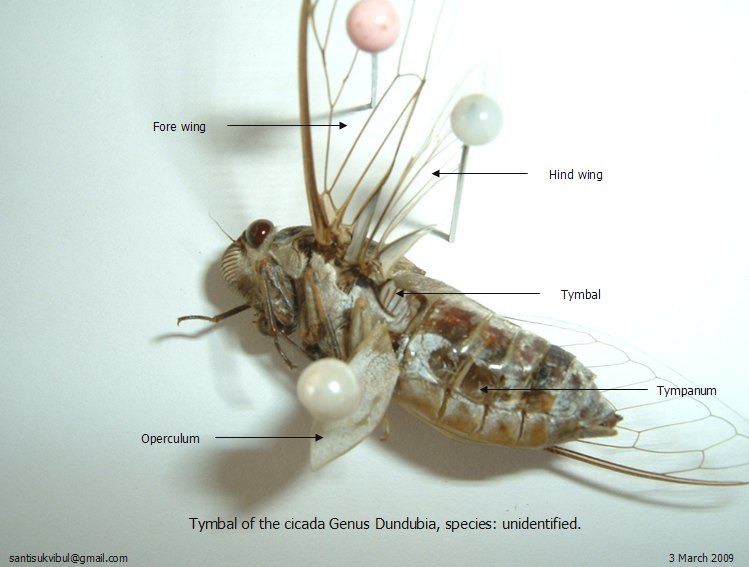
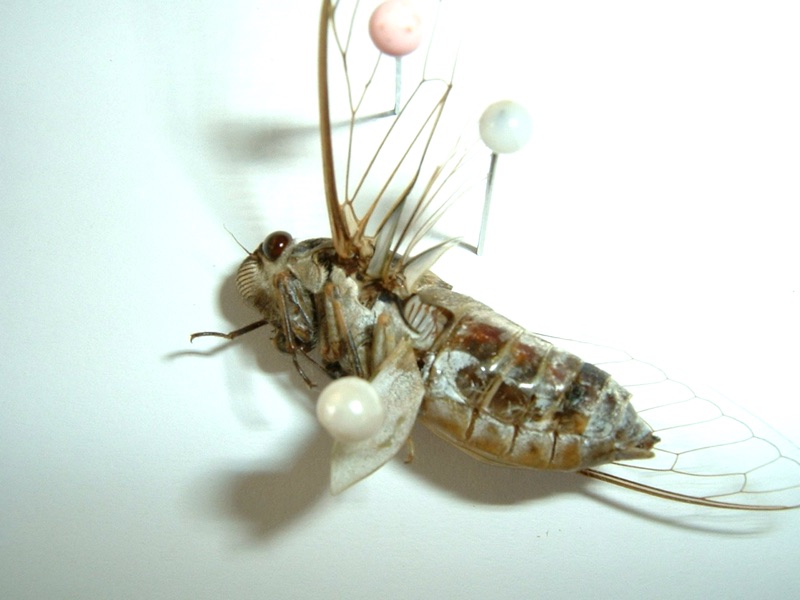
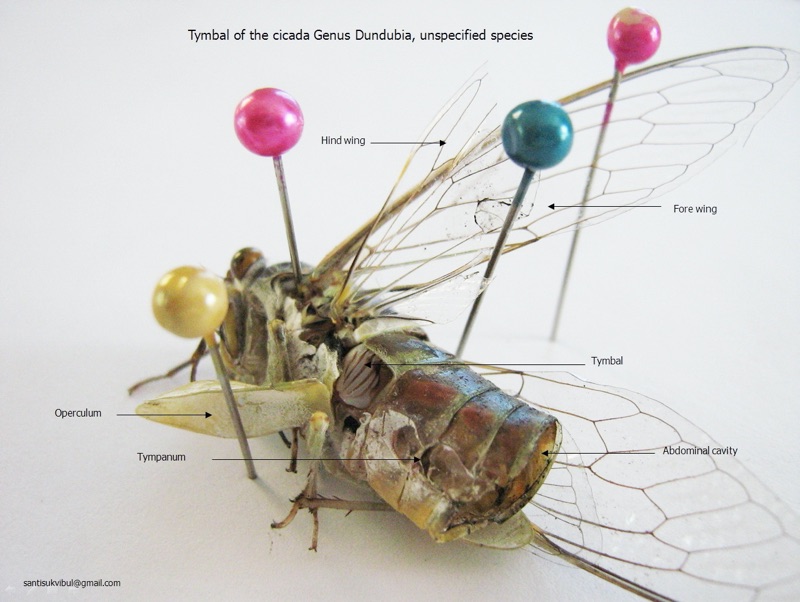
Here’s the song of a cicada belonging to the Dundubia genus recorded by Santisuk Vibul in Bangkok, Thailand.